
Vietnam - US: A future where "nothing is impossible"
The mere fact that the US President invited and received General Secretary Nguyen Phu Trong, the head of a nation's political party, at the highest level for the first time demonstrates how rapidly Vietnam-US relations have progressed after 20 years of normalization.
That event also showed that "strategic trust" in the Asia-Pacific region is not just a story of relations between major powers, but needs and can be driven by relations between major powers and smaller countries.
In recent decades, Vietnam has been one of the very few countries in the world to participate in numerous "super marathon" negotiations with the United States. These include the Paris Peace Accords (1968-1973), the normalization of relations (1992-1995), the Bilateral Trade Agreement (BTA) (1996-2000), the Permanent Normal Trade Relations (PNTR) (2003-2006), and most recently, the Trans-Pacific Partnership (TPP) agreement from 2011 to the present.
These events, on the one hand, reveal that many difficulties and complexities still exist in the relations between the two countries. On the other hand, thanks to these "super negotiations," the two "former enemies" have gained a more thorough understanding of their strengths, weaknesses, and obstacles to moving the relationship forward.
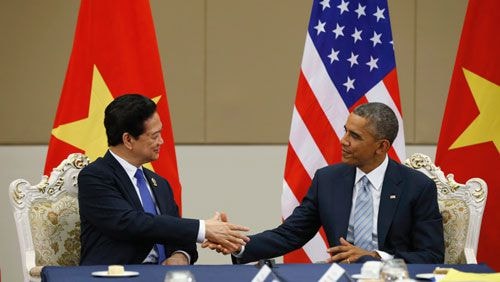 |
| Prime Minister Nguyen Tan Dung and US President Barack Obama met on the sidelines of the East Asia Summit (EAS). Photo: Getty Images. |
Normalizing the relationship after normalization.
When the United States and Vietnam normalized relations in 1995, beyond diplomatic ties, the two countries were not truly "normal" in the literal sense. The starting point for their relationship was very low: bilateral trade and US direct investment (FDI) in Vietnam were almost zero. Political and defense-security cooperation remained largely untouched, and in the field of education, only about 200 Vietnamese students were studying at American universities.
The only "bright spot" at this point is cooperation in searching for American soldiers missing in action (MIA), but this stems from a "unilateral" response from Vietnam. Furthermore, the past and the heavy burden of war mean that any "breakthrough" initiatives aimed at strengthening relations face considerable resistance from both sides.
However, in just 20 years, the landscape of relations between the two countries has fundamentally changed.
In terms of politics and diplomacy, high-level visits between the two countries take place regularly, such as the official visits to Vietnam by US Presidents Bill Clinton and Bush, the official visits to the US by Presidents Nguyen Minh Triet and Truong Tan Sang, the visits by Prime Ministers Phan Van Khai and Nguyen Tan Dung, and the upcoming visit by General Secretary Nguyen Phu Trong.
Thanks to the ripple effect of these high-level visits, a series of documents and cooperation agreements, ranging from economics to education, and from investment to education, have been signed, expanding the foundation of relations. Notably, the two countries have now established over 10 effective dialogue channels to both build trust and address emerging challenges, from the Defense Policy Dialogue, the Political, Security and Defense Dialogue, the Asia-Pacific Dialogue to the Human Rights Dialogue. In addition to bilateral cooperation, the two sides have relatively effective cooperation in regional and global multilateral forums such as ARF, ADMM+, the East Asia Summit (EAS), and the United Nations.
Economically, US-Vietnam trade relations have grown faster than those of the US and other partners, primarily driven by imports from Vietnam. For Vietnam, while it only began accessing the US market in 1995, by the time the two countries signed the Bilateral Trade Agreement (BTA) in 2000, exports to the US had increased to $800 million, with coffee and shrimp being the two main commodities.
By 2014, the US had become Vietnam's largest export market with over $30 billion, including garments, electronics, footwear, rice, fish, etc. In terms of investment, although it entered the Vietnamese market relatively late, by June 2015, the US had risen to 7th place among the countries and territories investing the most in Vietnam with a total FDI of $10.7 billion.
Regarding defense cooperation, the two countries made significant progress in 2011. Vietnam and the United States signed a Memorandum of Understanding (MOU) between the Ministries of Defense of the two countries to promote bilateral cooperation, focusing on five priority areas.
First, establish regular high-level dialogue mechanisms between the US Department of Defense and the Vietnamese Ministry of Defense. Second, maritime security. Third, search and rescue. Fourth, research and exchange of experience on United Nations peacekeeping operations. Fifth, humanitarian assistance and disaster relief.
As an example within the framework of this MOU, the two countries cooperated in the search for the missing Malaysian Airlines flight MH-370, and the US provided technical assistance to Vietnam's participation in UN peacekeeping operations.
In June 2015, the Ministers of Defense of Vietnam and the United States signed a Joint Vision Statement, replacing the MOU on defense cooperation, during US Secretary of Defense Ashton Carter's visit to Vietnam. It included five key areas: strengthening policy consultations; cooperation in addressing the consequences of war, such as demining and dioxin decontamination; cooperation in UN peacekeeping operations; disaster relief and search and rescue; and cooperation in maritime security based on international law and the laws of each country.
Education and training, as well as other sectors, have also seen remarkable development. With over 17,000 students currently studying in the US, Vietnam now has the fifth largest student population in Asia, and this is a crucial source of high-quality human resources for Vietnam's integration and development process.
A significant turning point in Vietnam-US relations during this period was the signing of the Comprehensive Partnership Agreement when President Truong Tan Sang visited the US in July 2013. This agreement covered all areas, from trade and science and technology to education and training, from politics and security to defense and security, politics and diplomacy, and even sensitive issues such as human rights. Although formally a comprehensive partnership, in reality, the scope and level of cooperation were even broader than some of Vietnam's agreements with other strategic partners.
Foundation for the future
Commenting on the development of Vietnam-US relations after 20 years of establishing ties, US Secretary of State John Kerry affirmed: "No two countries have worked harder, done more, and done better to try to come together, change history, and change the future" than Vietnam and the United States.
Despite differences in political systems and approaches to democracy and human rights, it is important that through dialogue, the two countries have gained a better understanding of these differences, sought to minimize negative aspects, and promoted areas where both sides share common interests. Many valuable lessons have been learned by both countries over the past period.
Firstly, it requires the independence and autonomy of both sides in planning and implementing bilateral relations, stemming from the interests of both countries and not from the influence or impact of a third party.
Secondly, it is crucial to thoroughly respect the principle of equality, respect each other's legitimate interests, and avoid negatively impacting each country's relations with other countries. Notably, in bilateral cooperation documents, the US side consistently emphasizes respect for Vietnam's political system, independence, sovereignty, territorial integrity, and non-interference in its internal affairs. These are important foundations for building a relationship of trust, and this cannot be achieved unless relations between the two countries are normalized and develop normally.
Third, while looking towards the future, both countries remain concerned with resolving issues left over from history. The history of both countries has been marked by painful and devastating times, and that is a fact. The best way to advance relations is to not turn our backs on the past, but at the same time, not allow the past to negatively impact the future of the relationship.
Based on that, the US has increased humanitarian assistance to Vietnam to help overcome the consequences of war and Agent Orange, and to support the search for those who died and went missing in the war. Conversely, Vietnam has continued to actively cooperate and assist the US in searching for soldiers missing in the war.
Despite significant progress, the potential for future Vietnam-US relations remains enormous. US Ambassador Ted Osius stated that "nothing is impossible." Certainly, with the foundations and frameworks already established, we have ample reason to believe that Vietnam-US relations will progress even further in the future.
Hoang Anh Tuan (Director of the Institute for Strategic Studies, Ministry of Foreign Affairs)
(According to VNN)
| RELATED NEWS |
|---|


