
Vietnam has its own concept of a war correspondent.
What distinguishes Vietnamese war correspondents from their international counterparts? The answer: Beyond the concept of a profession, they entered the field with the mindset of a soldier, with over 400 journalists having perished on the battlefield.
This was evident in the discussions at the seminar on "Journalism on the topic of war – The work of war correspondents" (jointly organized by the Vietnam News Agency and the Vietnam Journalists Association in Hanoi yesterday afternoon, April 24).
Special reunions
Alongside international scholars and journalists, nearly 20 former war correspondents from the Vietnam News Agency (VNA) and several other newspapers were present at the seminar. The event began with a brief but moving encounter between two journalists, Tran Mai Huong (former Director General of VNA, author of the photograph "Tanks occupying the Independence Palace") and Doan Cong Tinh (author of the photograph "Smiling at the Ancient Citadel"). Both prominent figures in Vietnam's war correspondent community, it was only decades after 1975 that they had the opportunity to sit together in this seminar.
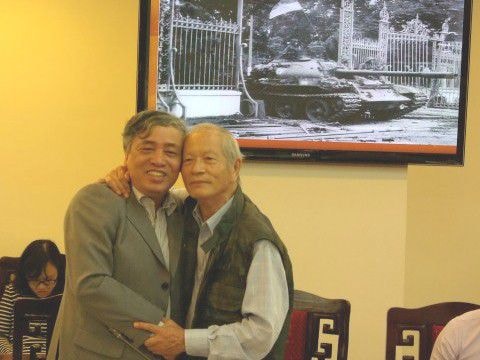 |
| Two journalists, former war correspondents Doan Cong Tinh (right) and Tran Mai Huong |
And, we can also mention another special meeting at the seminar, between journalist Tran Mai Huong and Australian filmmaker George Burchett. His father was Graham Burchett, a famous left-wing journalist who visited the Cu Chi Tunnels during the war and was always considered a great friend by Vietnam. As journalist Tran Mai Huong recounted, he had the opportunity to meet and work alongside Graham Burchett during his time reporting in Cambodia. During that time, thanks to Vietnamese volunteer troops, Graham Burchett was fortunate enough to avoid an ambush by remnants of the Khmer Rouge.
Journalists with guns
In the recollections of the participants at the seminar, many Vietnamese journalists were not so fortunate. As a former VNA journalist in the Central battlefield, Mr. Duong Duc Quang sadly recounted the story of journalist Van Gia – a martyr who died with a bullet piercing his camera lens (and two rolls of film were preserved by American veterans and returned to his family in 2005), and of colleagues who sacrificed their lives while filming "Vinh Linh Steel Fortress" – a documentary that won a gold medal at the Moscow Film Festival in 1971. In his speech, VNA Director General Nguyen Duc Loi mentioned journalists who had directly taken up arms, who had received the title of "Hero of the Anti-American Struggle" or who had destroyed enemy armored vehicles before their deaths.
"During the national resistance wars, Vietnamese journalists, including the large number of journalists from the Vietnam News Agency (VNA), were truly journalist-soldiers. These young journalists of a newly established state, with outdated and limited technical resources, boldly declared to the world the unwavering determination of the Vietnamese people to fight to the end for independence, freedom, and human dignity," shared General Director Nguyen Duc Loi. "Along with those victories, there were inevitably losses and sacrifices."
Few people know that, for writer Anh Duc to write the novel "Hon Dat," he not only had the real-life martyr Phan Thi Rang as a model, but also the written accounts of two VNA reporters who fell in the war against the US. More broadly, throughout the 30 years of the war of national defense, 260 reporters and staff of VNA sacrificed their lives on all battlefields while on duty... "And, I also don't know if any news agency in the history of world journalism has ever sacrificed so many people while on duty?" - journalist Tran Mai Huong asked in the silence of the international scholars.
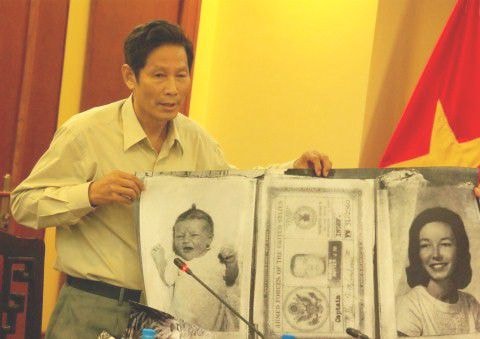 |
| Photographer and former war correspondent Chu Chi Thanh shares about the photos he didn't use. |
And the moral story
Another personal story was shared by former Vietnam News Agency correspondent Chu Chi Thanh (VNA) while working in Hanoi in late 1972, during the 12-day and 12-night victory against the B52s. At that time, international press conferences were constantly being held to announce information from Hanoi to the world. Mr. Thanh took a set of documentary photos but did not release them for use.
"This is a photo of the body of a downed American pilot. Then there are photos of his military ID card and pictures of his wife, children, and family that he carried with him," this former member of the Vietnam People's Army showed the photos to international scholars. "To some extent, our way of reporting also reflects our own perspectives compared to our international friends. Despite the suffering, Vietnamese people, according to their moral principles, would never want to retaliate by reopening the wounds of the enemy."
In response to Mr. Thanh's remarks, former soldier James Rhodes, now a reporter at Webster University (USA), shared some heartfelt thoughts. James fought in Vietnam and, unintentionally, became a victim of the chemical weapons that the Americans dropped there. "I want to thank the Vietnamese journalists for helping me understand this war better. For many years now, I have always considered helping and supporting the victims of chemical weapons in Vietnam as a way to atone for past mistakes," James said.
According to TT&VH
| RELATED NEWS |
|---|


