
Vietnam faces immense historical responsibility.
Vietnam is truly facing a tremendous responsibility entrusted to it by history: to use international law to maintain peace in a crucial region of the world.
What factors influence the dispute?
In recent times, countries in the region such as the Philippines, Malaysia, Indonesia, and Vietnam have seen significant developments surrounding disputes in the South China Sea.
In the case of the Philippines, after a period of peaceful dialogue to resolve the dispute, faced with China's unchanging stance, at the end of January 2013, the Philippines decided to file a lawsuit against China in the Arbitration Tribunal under Annex VII of UNCLOS.
In late February 2014, Francis Jardeleza, the lawyer advising the Philippine government on the case, called on Vietnam and Malaysia to join the lawsuit. One month after the call, the Philippines officially submitted its nearly 4,000-page legal dossier to the Arbitration Tribunal in accordance with the procedure.[1]
In Malaysia, in March 2013, Chinese warships first appeared at James Shoal, deep within Malaysia's EEZ, just 43 nautical miles off the coast of Sarawak. This is the southernmost point of China's "nine-dash line". About six months later, Malaysia deployed a plan to establish a new naval base in Sarawak's largest town to counter the Chinese threat.[2]
From the early 1990s until recently, Indonesia had no maritime territorial disputes with China. Indonesia maintained a neutral stance and played a mediating role in resolving disputes between the parties. After signing the "Declaration on the Conduct of Parties in the South China Sea" (DOC) with its limitations in 2002, for almost a decade, Indonesia, along with other ASEAN countries, drafted the "Code of Conduct in the South China Sea" (COC), which is more binding than the DOC. This effort did not receive a positive response from China.
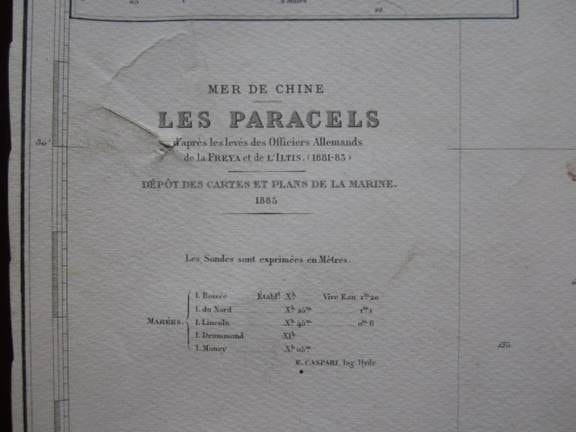 |
| Ancient source material provided by the author. |
In mid-April 2014, Indonesia changed its neutral stance when it announced its decision to strengthen its military presence in the Natuna Islands in response to China's "nine-dash line" claim which includes Indonesian territorial waters.[3]
On the Vietnamese side, from the early 2000s until now, China has annually and brazenly declared a fishing ban in Vietnam's waters. Furthermore, China has continuously caused damage to property and loss of life for Vietnamese fishermen.[4]
In early October 2011, in the presence of leaders of the two parties, Vietnam and China signed an agreement to resolve the issue in the sea “through friendly negotiations and consultations”.[5]
At the end of November 2011, Vietnamese government leaders first mentioned the event of China using force to seize the entire Paracel Islands in 1974.[6]
Faced with China's escalating aggression, provocation, and serious violations of international law, in late April 2013, Vietnamese leaders also for the first time mentioned international law as a tool to resolve disputes with China.[7]
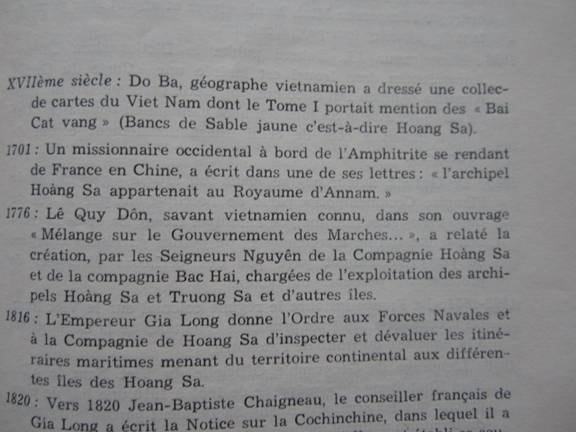 |
| Ancient source material provided by the author. |
In early May 2014, when China brazenly placed the Haiyang 981 drilling rig deep within Vietnam's EEZ, seriously violating Vietnam's sovereignty, China officially let Vietnam and the international community know that China's commitments to Vietnam, including the agreement signed in 2011, on resolving maritime disputes in the East Sea through "peaceful dialogue" were completely worthless.[8]
For nearly 40 years, Vietnam has consistently called on China to engage in peaceful dialogue to resolve the dispute over the Paracel and Spratly Islands.
According to Chinese scholar Wang Hanling, China's position is: "There is nothing to negotiate... China's sovereignty over the Paracel Islands has never been a subject of dispute, and Vietnam has acknowledged this in the past. Discussing cooperative efforts to protect resources, search and rescue, and other matters is one thing; China's sovereignty is another."
China's position on the Paracel Islands could not be more decisive or clear: the Paracel Islands belong to China. They even brazenly proposed that Vietnam "set aside disputes and jointly exploit" the Spratly Islands, in the sea area belonging to Vietnam.[9]
A breakthrough in the South China Sea dispute.
With an area of over 3.5 million square kilometers, the South China Sea is part of the Pacific Ocean, bordering the territorial waters of Vietnam, China, Taiwan, the Philippines, Malaysia, Brunei, Indonesia, and Singapore.
In the era of economic globalization, the South China Sea is not only important to neighboring countries but also extremely important to many other developed and developing countries around the world.
Every year, more than $5.3 trillion in international trade passes through the South China Sea, of which $1.2 trillion is from the United States. This amount of trade contributes to the US trade deficit with China, which was nearly $320 billion in 2013, accounting for 3.5% of China's GDP or double Vietnam's GDP in the same year.[12]
Due to the strategic importance of these two archipelagos, Vietnam actively and proactively demonstrates to the world that the Paracel and Spratly Islands play a crucial role in China's "nine-dash line" claim in the South China Sea.
By using international law to resolve the South China Sea dispute with China, Vietnam is not only addressing the issue of maritime sovereignty between the two countries but also contributing to security and stability for all countries that depend on maritime traffic through a region that is one-third the size of the United States.
Such behavior strongly demonstrates to the world that Vietnam is a country that respects the rule of law and is responsible to the international community.
 |
To achieve a breakthrough in the deadlock and to capitalize on existing opportunities, from the perspective of international law, historical evidence, and the regional situation as mentioned in the article, Vietnam should publicly call on China to agree to allow international courts to resolve the South China Sea dispute.
China has representatives in the International Court of Justice and the Tribunal for the Law of the Sea; China consistently asserts to the world that it possesses ample historical and legal evidence to support its claim of sovereignty over the "nine-dash line" in general and the Paracel and Spratly Islands in particular.
If China wants to demonstrate that it is also a country that respects international law and is responsible to the international community, if China's assertion of sovereignty is based on facts, there is hardly any other legitimate reason for China to invoke to refuse the role of resolving disputes between countries that the International Court of Justice has effectively played for more than 60 years.[13]
Vietnam is truly facing a tremendous responsibility entrusted to it by history: to use international law to maintain peace in a crucial region of the world.
According to Vietnamnet


