
"Martial arts are recorded in national history, literary virtues permeate people's hearts."
Colonel Hoang Minh Phuong, former Deputy Commander-in-Chief of the 4th Army Corps, former Assistant to General Vo Nguyen Giap, Commander-in-Chief, has written very truthful and moving memoirs about General Vo Nguyen Giap - the elder brother of the Vietnam People's Army, a military genius, and an outstanding leader of the Ho Chi Minh era. With the permission of the Colonel's family, Tin Tuc newspaper would like to excerpt and publish his memoirs about General Vo Nguyen Giap, Commander-in-Chief.
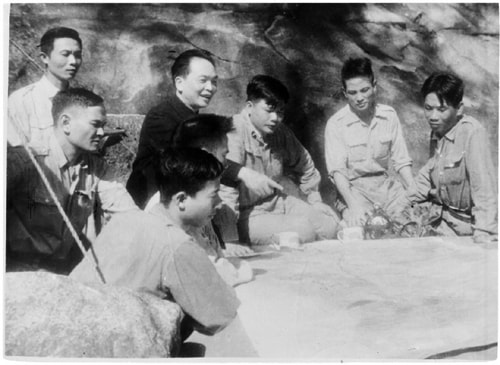 |
| The Dien Bien Phu Campaign Command, under the direct leadership of General Vo Nguyen Giap, is discussing battle plans for each battle. Photo: VNA archives. |
Through the stories of General Vo Nguyen Giap, we learn many things: the patriotism instilled in us by our parents from childhood, the spirit of overcoming difficulties, the passion for learning of a poor child combined with exceptional intelligence to constantly strive for higher education, and serve the revolution more effectively.
A question arises: What is the difference between our Commander-in-Chief and the Commander-in-Chief of other countries' armed forces? In my opinion, perhaps there are the following points:
Firstly, unlike many other Commanders-in-Chief around the world, who are often tasked with leading an entire army that has long been organized, Comrade Vo Nguyen Giap had the great responsibility of building and commanding our army from its very inception, from nothing to something, from small to large, from weak to strong.
In times of hardship and difficulty, he led a guerrilla army of 34 soldiers with a few dozen rudimentary rifles and flintlock guns, gradually developing them into well-trained regiments and divisions to create the glorious Dien Bien Phu victory that shook the world. Subsequently, it developed into a modern, regular revolutionary army comprising various branches of the armed forces, with powerful divisions and corps, sometimes numbering over 1.5 million men, leading to a victorious Spring. This army was affectionately called "Uncle Ho's Soldiers" by the people, with a noble revolutionary nature clearly demonstrated in the Ten Oaths of Honor drafted by Comrade Giap during the preparation for the establishment of the Vietnam Propaganda and Liberation Army. It can be said that the image of the "Uncle Ho's Soldier" is a beautiful symbol of Vietnamese revolutionary heroism in the new era. Deeply imbued with Ho Chi Minh's thought on building revolutionary armed forces, Vo Nguyen Giap played a leading role in creating that image.
Secondly: Before assuming the important responsibilities entrusted to him by the Party and the people, Vo Nguyen Giap was a political activist, journalist, and teacher, who had not attended any military academy or school like the commanders-in-chief of many other countries. With a high sense of responsibility towards the destiny of the Fatherland, he diligently sought out knowledge through self-study, cherishing the precious military heritage of the nation, researching ancient and modern military works from East and West, and the experiences of the armies of fraternal countries. He particularly learned from practical experience, valuing the summation and improvement of the experiences of officers, soldiers, and the people to enrich his own knowledge. He tirelessly strived to reach the highest level of his mission, excellently fulfilling the responsibilities of a Commander-in-Chief in both guerrilla warfare and modern warfare, successively defeating 11 generals and commanders-in-chief of two imperial powers.
General, Professor Hoang Minh Thao, former Director of the High-Level Military Academy, former Commander of the Central Highlands Front, told an international reporter (1981): “Vo Nguyen Giap was a master of tactics. He always found unique and creative ways to fight, ensuring the highest possible victory in battles while minimizing casualties among his officers and soldiers. He was a commander with outstanding strategic talent…”
Thirdly: As Secretary of the Central Military Commission and Commander-in-Chief of the Army, and at one time also serving as General Political Commissar, General Vo Nguyen Giap was a comprehensive leader and commander.
He attached great importance to Party work, political work, military work, as well as logistics and technical work; he deeply directed strategic planning as well as the art of campaign and tactics, constantly focusing on summarizing war experiences, inheriting and developing the precious military traditions and heritage of the nation to a new level under the light of the Party's military line and Ho Chi Minh's military thought, building the Vietnamese military doctrine in the new era.
Major publishers both within and outside the military have printed and distributed more than 100 works by Vo Nguyen Giap. With these important works, Vo Nguyen Giap was not only an all-powerful Commander-in-Chief, but also a leading politician, military strategist, economist, cultural figure, scientist, and military theorist of Vietnam in the Ho Chi Minh era...
Fourth: General Vo Nguyen Giap was not only a Commander-in-Chief who was "well-rounded in both military and intellectual pursuits," but also a commander with "complete virtue and talent," worthy of being a close and outstanding disciple of President Ho Chi Minh.
Comrade always remembered and put into practice President Ho Chi Minh's teaching, "Putting the public good above all else," never elevating himself personally but always upholding the role of President Ho Chi Minh, the Politburo, the Central Military Commission, and the Central Executive Committee. He maintained the Party's principles, possessed a sense of organizational discipline, and strictly obeyed the assignments of the leadership, even when those assignments did not suit his position and strengths. He also exercised self-restraint and patience to maintain unity and consensus.
In the army, he consistently cared for and nurtured cadres, cherishing and respecting those with virtue and talent, expanding democracy, listening to opinions and utilizing the intelligence of subordinates, and discussing together to find ways to overcome difficulties. During the fierce battles at Dien Bien Phu, he repeatedly wrote letters to the soldiers, clearly outlining the advantages and disadvantages of both sides, our direction of struggle, and the prospects for victory in the campaign, so that everyone understood and was determined to charge forward and annihilate the enemy. Present at Dien Bien Phu during those arduous months, writer Nguyen Dinh Thi once remarked: "A Commander-in-Chief who was also the commander of the campaign writing letters to soldiers with such intimate words as brothers is truly rare in the wars of other countries!"
The late General Tran Van Tra, former Commander of the Southern Liberation Armed Forces, said: "Vo Nguyen Giap was the Commander of Commanders, the Political Commissar of Political Commissars," "a Commander-in-Chief who felt the pain of every soldier's wound, who regretted every drop of blood shed by every warrior." Moved by the feelings of the highest commander of the army towards the martyrs who died on Phu Le Nhich Pass, Lieutenant General Dong Si Nguyen, former Commander of the Truong Son Army Corps, wrote in his memoirs: "The tears shed by the Commander-in-Chief for the soldiers who forever rest on this strategic point in the Truong Son Mountains truly reflected human compassion, deeply etched in our hearts, and unforgettable!"
Fifth: With the achievements, talents, and virtues mentioned above, Comrade Vo Nguyen Giap had the great fortune of enjoying the almost absolute trust and admiration of the entire army and people, the respect of heads of state of many countries and international friends. He also had the great fortune of being the longest-living of the key leaders of our Party and army from the pre-revolutionary period to the present day.
In our country, apart from President Ho Chi Minh, few leaders, decades after leaving their positions of power, receive annual congratulations on their birthdays, the anniversary of the Dien Bien Phu Victory, the April 30th Victory, and the founding of the People's Army from veteran revolutionaries, numerous former soldiers, former students, and representatives of all walks of life across the country. Hundreds of delegations, thousands of people, follow one another, and it takes many days to finish!
This is truly an invaluable reward for one of the founding fathers of the nation, worthy of the ten golden words: "His military achievements are recorded in national history, his literary virtues permeate the hearts of the people."
Hoang Minh Phuong/News


