
2016-2017 Sugarcane Harvest Season: Nghe An Province Achieves 1.2 Million Tons
(Baonghean.vn) - On the morning of November 17th, the Department of Agriculture and Rural Development held a conference to summarize sugarcane production for the 2015-2016 crop year, plan for 2016-2017, and evaluate the results of implementing the sugarcane raw material plan up to 2015.
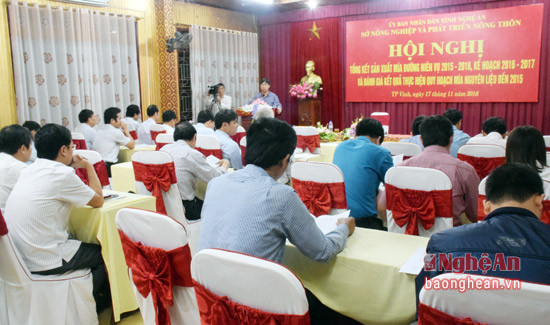 |
| The conference was attended by representatives from the agricultural departments of the districts in the province that have planned land for sugarcane cultivation, and three sugarcane processing companies. |
The 2015-2016 crop year showed that the sugarcane growing areas of the province mainly planted the following sugarcane varieties: QD93-159, VD00236, ROC10, ROC16, ROX22, KK3, Viet Duong 00236, Que Duong 94-119….
An assessment of sugarcane production results shows that sugarcane yield and quality in the past crop year were affected by prolonged drought and diseases such as sugarcane grassy shoots, whiteflies, black smut, stem borers, and beetles that occurred in some areas.
Data from sugarcane processing companies in the province shows that: The total sugarcane area reached over 21,700 hectares (71.22% of the plan), the average yield reached over 51.34 tons/ha (80.86% of the plan), and the sugarcane production reached over 1.1 million tons, achieving 58.04% of the plan outlined in Decision No. 151/QD-UBND of the Provincial People's Committee.
According to data from sugarcane processing companies in the province, the 2016-2017 crushing season covered 22,647 hectares, with a yield of 53.4 tons/ha, resulting in a total production of over 1.2 million tons of sugarcane. The crushing period is expected to run from November 25, 2016 to the end of April 2017.
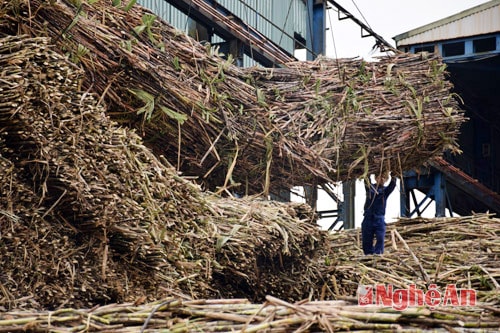 |
| Transporting sugarcane into production at Song Con Sugarcane Joint Stock Company. |
The plan for sugarcane cultivation area in 2017 was over 17,000 hectares, including 7,592 hectares of newly planted or replanted sugarcane and 19,548 hectares of ratooned sugarcane. Sugarcane processing companies in the province continued to implement policies to develop sugarcane raw material areas: investing in soil and fertilizer analysis systems; training human resources; developing large-scale and model fields; and mechanization projects…
Decision No. 151/QD-UBND of the Provincial People's Committee on the planning of sugarcane raw material areas in the province for the period 2013-2020 set a target of 28,400 hectares. In reality, by 2015, the total sugarcane area in the province only reached 71.22% of the plan. The reason is that the implementation of the sugarcane raw material production plan has only reached the stage of announcing the plan, without focused and decisive implementation at the local level. The efficiency of sugarcane raw material production has been low in recent years, while some other crops grown on land designated for sugarcane have higher yields: animal feed, oranges, lemons, etc. In addition, the sugarcane purchasing mechanism of the factories is not satisfactory, leading some farmers to switch to growing other crops.
Farmers' investment in intensive sugarcane cultivation remains low; seed selection has not received adequate attention; and scientific and technological advancements in intensive sugarcane cultivation have not been widely adopted.
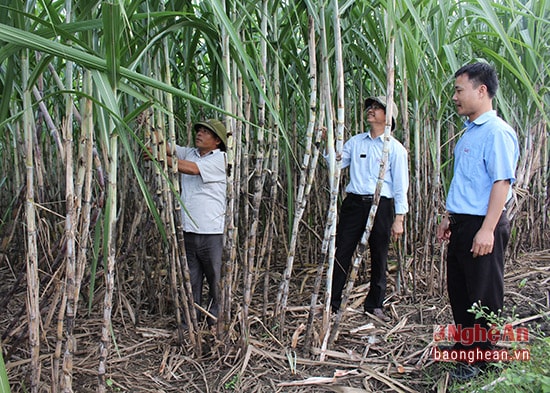 |
| Sugarcane grown in Tan Xuan - Tan Ky, Thailand, yields 100 tons/hectare. Photo: Chau Lan. |
Regarding solutions to increase sugarcane acreage and productivity, sugarcane processing companies in the province believe that the key issue for people to "stick" with sugarcane cultivation is to increase sugarcane productivity. Therefore, the companies continue to support farmers by providing loans for production, fertilizers, land preparation, etc.; supporting research and testing, and transferring some new high-yield, high-quality varieties into production; supporting land reclamation and road construction in concentrated raw material areas; and supporting the conversion of inefficient rice land to sugarcane cultivation.
The province needs to focus on directing the continued implementation of land consolidation; the conversion of crop structure on alluvial land, specifically sugarcane cultivation, should be applied to organize large-scale, commercial production. Authorities at all levels should concentrate on directing and organizing the implementation, and have sufficiently strong sanctions to enforce the plan.
Xuan Hoang


