
North Korea's most dangerous weapon is not nuclear weapons.
South Korea acknowledges that it is not North Korea's nuclear weapons, but rather its mini-submarines and outdated aircraft, that pose the greatest threat to the U.S. and South Korea.
Aerial threat
Although South Korea has almost absolute confidence in its control of the airspace, North Korean special forces still possess a means by which they can "roam freely," infiltrating South Korean airspace as if it were uninhabited.
South Korean media noted the detail that North Korean Central Television recently reported on a parachute infiltration training exercise using An-2 transport aircraft. Although this type of aircraft is old, its capabilities are very special, making it difficult for ground-based radars to detect it.
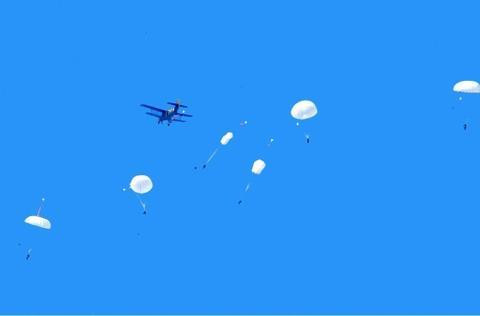 |
| North Korean soldiers parachute from an An-2 aircraft. |
The An-2 is constructed from alloy and wood materials, making it very lightweight and capable of scattering electromagnetic waves, allowing it to evade radar systems. Even if radar detects it, it can be mistaken for a flock of birds.
The An-2 has a top speed of 215 km/h and a maximum range of 1100 km. However, the most important point is its ceiling, which is only 170-215 meters. This extremely low ceiling makes it an "alien" to the air defenses of the US-South Korean coalition.
Terrifying from the depths of the sea
Along with its outdated aircraft fleet, North Korea's easternmost mini-submarine fleet is causing real unease in South Korea and the United States. These small submarines can carry out various operations such as: disrupting enemy sea lanes; transporting special forces for landing on beaches and islands; reconnaissance, neutralizing minefields and laying blockade mines; sabotaging port facilities and other critical targets.
North Korea's large, albeit outdated, submarine fleet poses a significant threat to South Korea. According to US military experts, North Korea currently possesses over 60 obsolete submarines, the majority of which are Sang-O and Una-class mini-submarines.
Based on the Una design, the North Korean navy has researched and developed a new class of mini-submarines called the Sang-O. Currently, the North Korean naval task force has approximately 40 of these vessels.
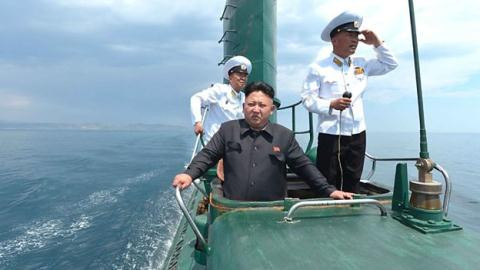 |
| North Korea's small submarines are causing concern not only in South Korea. |
North Korean mini-submarines are particularly dangerous in land-based infiltration operations. They can stealthily infiltrate, drop off commandos ashore, then return, coming back to pick them up at a predetermined time. Their small size and ability to operate effectively in shallow waters allow them to easily approach remote coastal areas, making them very difficult for the enemy to defend against.
A prime example of this type of warfare is the event on September 15, 1996, when a North Korean Sang-O-class mini-submarine secretly infiltrated the South Korean coast, dropping three groups of special forces soldiers ashore to conduct reconnaissance of South Korean bases. The North Korean Sang-O-class mini-submarine is 34 meters long and has a displacement of 370 tons when submerged.
Two days later, the submarine returned to its original location to retrieve the special forces team. The mission was on the verge of success, but unfortunately, the submarine ran aground, forcing the North Korean commandos to switch to land transport, where they were discovered and pursued by South Korea.
According to South Korean media, these outdated and not-so-modern weapons are actually the nemesis of the modern weapons that the US and South Korea often claim are the most advanced in the world. If the US and South Korea do not take countermeasures, their border defense system could easily be breached.
According to Baodatviet
| RELATED NEWS |
|---|


