
The ups and downs of Vietnamese journalism in 2016
2016 was a year of transformation for the press, striving to become a truly essential means of information for social life. However, the press still suffers from some issues that need to be addressed promptly in order to become healthier.
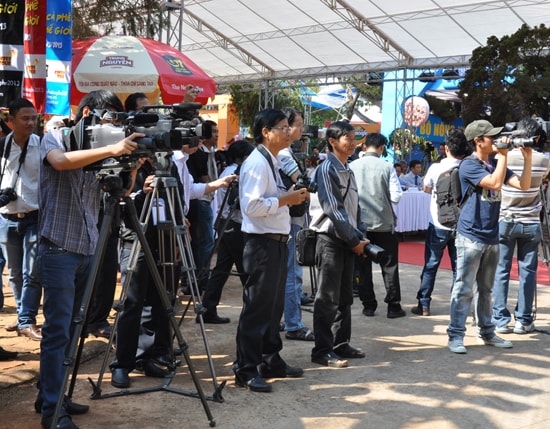 |
| Journalists and reporters at work. |
True joy
2016 was a year of transformation for the press, striving to truly become "an essential means of information for social life; the mouthpiece of Party organizations, state agencies, political and social organizations, political and professional social organizations, social organizations, and professional social organizations; and a forum for the people."
While some negative aspects of the press over the past year were serious, they could not distort the revolutionary press. Our country's press system, encompassing television, radio, print, and online media, boasts a formidable workforce of over 18,000 licensed journalists, along with tens of thousands of technical and professional staff working in 857 print media outlets, 125 online media organizations, 66 radio and television stations with 182 broadcast channels, and 82 pay channels…
There, the majority of journalists are honest authors, and most media outlets strictly adhere to the Party's guidelines and the State's laws; their activities are always conducted transparently and in accordance with their principles and objectives.
The two most important political events of the country last year were the 12th National Congress of the Party (the Congress), and the election of deputies to the 14th National Assembly and the election of deputies to People's Councils at all levels for the 2016-2021 term (the Elections). These were the two biggest events of the year, attracting the attention of the entire nation and becoming important topics in the activities of the press system.
Prior to the Congress and the elections, the press system successfully accomplished two crucial tasks: Firstly, it publicized and highlighted the significance of the events, affirmed the spirit of democracy and fairness in society, highlighted the achievements, and conveyed the positive contributions of the entire population; secondly, it contributed to countering the distorted propaganda of hostile forces and some political opportunists who exploited these two events to distort the leadership role of the Party and the State, deny the achievements of the revolutionary cause, and create doubt and confusion in public opinion, thereby carrying out their plot to destabilize life.
During the Congress and the elections, the press provided the entire population with full access to the picture and issues of the country that were discussed and decided at the highest leadership body of the Party, and at the sessions of the National Assembly - the highest state power body, the highest representative body of the people. After the Congress and the elections, the press contributed to quickly bringing the resolutions of the Party and the decisions of the National Assembly into practice.
Although the rapid development of social media and internet communication tools has led many to worry about the role of mainstream journalism, the reality shows that mainstream journalism has always maintained its leading role as the most reliable source of information for the public. Information in the press is always truthful, professionally processed, with clear and verifiable sources, and any misinformation is subject to legal sanctions.
When the truth is conveyed through the press, it is powerful enough to counter fabricated and distorted information about the country's situation, contributing to strengthening trust and creating consensus among the people regarding the leadership of the Party and the State, consolidating political stability to promote the country's development in all fields. And that is the greatest joy for journalists. Among them is an event that may seem small but carries great significance.
The incident involving the Xin Chào coffee shop in Binh Chanh district (Ho Chi Minh City), which was reported in the press, attracted widespread public attention. This small business would have suffered injustice indefinitely if not for the media's intervention. Following media coverage, the Prime Minister directly instructed law enforcement agencies to intervene and bring justice to the people.
This is precisely what VI Lenin once said: Soviet authorities should not only undertake major tasks of reform and modernization, but also care about the specific fate of each individual. Our press has stood alongside the Party and the State in defending many vulnerable individuals who have been driven to the brink by bureaucracy.
Restoring justice to figures like Nguyen Van Chan and Huynh Van Nen, and in cases such as the Xin Chao coffee shop, has contributed to pushing back against bureaucracy, bringing peace to the people, and strengthening the people's trust in the Party and the regime. This is a great joy for journalists.
The Trinh Xuan Thanh case also began with a news report. Based on this report, the General Secretary directly instructed Party and State law enforcement agencies to investigate. Although Trinh Xuan Thanh has fled and the case is not yet closed, this incident continues to send the message that there are no "forbidden zones" for the press, and that no one who commits a crime or abets or condones it can escape the law.
Sadness needs to be cast aside.
It can be said that the fact that 50 media outlets were penalized by the Ministry of Information and Communications, and many journalists were disciplined and had their press cards revoked in the "arsenic-contaminated fish sauce" incident is the biggest journalistic incident of the year. It is truly a sad and shameful event for the mainstream press in our country.
 |
| 50 media outlets were fined in the fish sauce media scandal. |
This is a prime example of collusion between corrupt and degenerate journalists and a "special interest group," seriously impacting the country's healthy business environment and causing widespread public outrage. This incident is a "negative mark" on the reputation of the press.
It is also worth mentioning that the appointment of former US Senator B. Kerrey as Chairman of the Board of Trustees of Fulbright University Vietnam by the university, and the debate in the press, was a regrettable journalistic incident, as some newspapers took the issue too far, blurring the lines between right and wrong in history.
Mr. B. Kerrey is a veteran who commanded and directly participated in the brutal massacre of innocent civilians in Ben Tre during the American war of aggression in our country. These crimes were exposed by the American press, and Mr. B. Kerrey himself admitted to them. Some evidence of this event is even displayed in the War Remnants Museum in Ho Chi Minh City. However, due to the policy of "closing the past and looking towards the future," the Vietnamese government and people not only did not pursue legal action but also acknowledged and welcomed some of his positive activities that contributed to the normalization of relations between the two countries.
We simply disagree with his appointment to head a university whose mission is to educate the younger generation of Vietnam. This disagreement stems from Vietnamese moral principles, principles that the American people and the world will undoubtedly uphold.
Finally, there's the sad, long-standing problem of sensationalist reporting and writing, driven by the desire for clickbait and views, catering to unhealthy curiosity or distorted tastes of a segment of the public.
News articles and images of this type are published frequently on many online newspapers and some print newspapers, depicting behaviors and images contrary to the nation's customs and traditions, in the name of fighting violence to incite violence. Many cases are described with gruesome details not to condemn the crimes but to stimulate public curiosity.
Some businesspeople, artists, and figures in the entertainment industry have had their private lives excessively exploited by the press, sometimes even fabricated and embellished to attract readers and views. Most recently, for this same purpose, a number of newspapers even "praised" an artist who had just returned to Vietnam after serving a prison sentence in the US for pedophilia, creating a very dangerous trend that causes anxiety among parents about the risk of sexual assault on millions of children by this kind of depraved figure promoted by the media.
This is a manifestation of moral decay that transcends the boundaries of civilization among a segment of journalists, a situation that must be ended not only through journalists' self-awareness of their responsibility to their readers, but also through decisive measures by the authorities.
Addressing the negative behavior of some journalists and newsrooms is synonymous with protecting honest journalists who are dedicated to the country, the people, and justice. This is the responsibility of press management agencies and law enforcement agencies. Pointing out the sad events in the journalistic world is not about "nitpicking" to become pessimistic, but about resolutely discarding them. Discarding these sad events and eliminating negative behavior in the journalistic world will also make the joy of journalistic activities in the coming year more complete and multiplied, so that readers will continue to trust and place their faith in us.
According to Infonet
| RELATED NEWS |
|---|


