
The sacred "fence" stands firm...
(Baonghean) - The ethnic minority communities of Nghe An are an inseparable part of the province's population. Through centuries and historical ups and downs, they have become the true masters of the western districts, playing the role of a "defense line" for the sacred territory along the border region. In this, the role of village elders, community leaders, and other respected individuals is particularly noteworthy...
One day in early September, we had the opportunity to visit Nam Can commune (Ky Son district). The road to Nam Can is now much closer thanks to the wide, smooth asphalt road leading to the border gate. Heavy trucks loaded with goods and Vinh-Xieng Khouang passenger buses constantly pass by. The transformed appearance of this border commune is partly due to the efforts of the village elders and respected individuals. In particular, four village elders – Lau Xai Ho (Huoi Poc village), Lau Chu So (Truong Son village), Cut Man Loi (Noong De village), and Mr. Nhang Pho Xom (Pha Ca village) – truly serve as a trustworthy bridge between the government and the people. Like many other communes in Ky Son, Nam Can's roads to the villages are always treacherous, with many steep rocky slopes; even walking for an hour only allows for less than 2km. However, despite their advanced age and frail health, these elderly people regularly visited individual households to conduct ideological work and disseminate information to the Hmong people, urging them to listen to the Party and the State, and to avoid the influence of evil elements. As a result, in the past two years, migration in Nam Can has significantly decreased, security and order have been maintained, and the spread of heretical doctrines has also declined considerably.
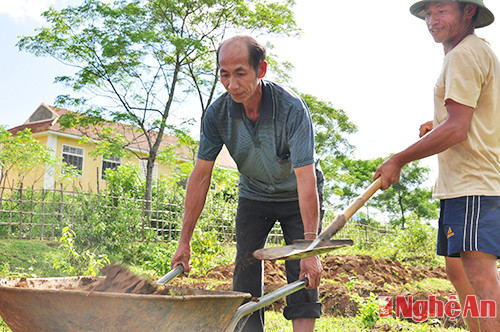 |
| Village head Ly Tong Sua (Huoi Moi 1 - Tri Le commune) instructs villagers on how to cultivate rice paddies. |
The story of Nam Can is also a story about the role of village elders and community leaders among ethnic minorities throughout the province. Currently, the province has 1,250 influential figures in ethnic minority areas. These elders have effectively played their role in the process of building and implementing the Party and State's ethnic policies in their areas, becoming a source of trust and affection for their villages. This is the story of Vu Chong Pao, the "great figure" of the Mong ethnic people in Ky Son, who met President Ho Chi Minh twice and received his profound advice.
Uncle Ho taught Vu Chong Pao: "All 54 ethnic groups are our compatriots. But our compatriots currently have limited understanding, so they are easily misled by evil people. If you all consider your compatriots as enemies, you will never be able to defeat the enemy, and the country will never have peace. To defeat Chau Pha, you must win over your compatriots, make them understand good and bad, and show them their mistakes..." Following Uncle Ho's advice, Mr. Vu Chong Pao won over his compatriots with wise words and sound reasoning. Thanks to this, the Vang Pao bandit gang, which had been causing trouble for a time, was finally quelled.
Traveling down to Tuong Duong district, we heard many good and inspiring stories about the district's respected individuals. Many have truly fulfilled their roles well, setting examples for the community. Elder Kha Van Hanh (Huoi To 2 village - Mai Son commune) has tirelessly worked day and night with others to teach, preserve, and pass on the precious cultural heritage of the Thai people to his descendants through traditional dances like the "khap" and "nhuon" dances. Elder Va Chu Xenh (Huoi Co village - Nhon Mai commune), using his prestige, has educated the younger generation in his family to preserve the traditions of the Mong people and to live according to the teachings of the Party and President Ho Chi Minh; or Mr. Vy Cong Tinh (Vang Cuom village - Yen Tinh commune), who is loved and respected by the people in his community for his exemplary and harmonious life, worthy of being a respected Party branch secretary...
Further north along National Highway 48, there are many heartwarming stories. For example, the story of Mr. Ly Tong Sua, head of Huoi Moi 1 village, Tri Le commune (Que Phong district), who not only abandoned opium cultivation but also successfully encouraged his fellow villagers to follow suit. He recounted: "At first, when I spoke to them, very few listened! They said, 'If we quit opium cultivation, we'll starve!' So I had to persuade them gradually. Initially, I focused on rice farming, raising buffalo and cattle, and building a comfortable life for my family first. Over time, they saw that my family could still make a living after quitting opium cultivation, so they followed suit." Mr. Tho Chu Xa is one of the last three people in Huoi Moi 1 village to quit opium. After quitting, his family's business improved significantly, not lagging behind anyone else in the village. He confided, "My family was the poorest in the village at that time. Village head Sua persuaded me for six years before I finally gave it up." "Village head Sua is very persistent. In some cases of severe addiction, he had to work tirelessly for 10 years before the addicts finally quit. Now, the whole village is much better off than before," added Mr. Lo Xuan Thu, Chairman of Tri Le commune.
Nghia Mai (Nghia Dan district) is a mountainous commune located in the Northwest, nearly 30km from the district center. It is a particularly disadvantaged commune benefiting from the Government's Program 135. Ethnic minorities account for over 70% of the population, with three ethnic groups – Tho, Thai, and Kinh – living together. For many years, they have upheld the revolutionary traditions of their homeland and effectively promoted national unity. Notably, the Cao Van clan of the Tho ethnic group in Hamlet 4A has actively propagated and mobilized their descendants and the community to combat illegal proselytization in the area. The clan leader, Cao Van Son, is a respected village elder and a prominent figure among the ethnic minority community. He received a commendation from the Provincial People's Committee for his contributions to national security protection in 2011 and another from the Provincial Fatherland Front Committee in 2013.
It can be said that the great and encouraging achievements that the Party Committee and people of all ethnic groups in Nghe An province have achieved in recent years have been significantly contributed to by influential figures among the province's ethnic minority communities. These influential figures have always been an important support for Party committees and authorities at all levels in disseminating information and mobilizing ethnic minority communities to effectively implement the Party's policies and the State's laws.
Speaking about the contributions of ethnic minority communities in maintaining border security, Lieutenant Colonel Vy Hoè, Commander of the Ky Son Military Command, said: "Ethnic minority communities are the true owners of the border region, assisting functional forces in managing, patrolling, and protecting the integrity of the border markers and border line. In addition, ethnic minority communities serve as a bridge connecting the friendly relations between Vietnam and Laos; through long-standing kinship ties, the ethnic minority communities of Nghe An always maintain close relationships and provide assistance to the people of the Lao ethnic groups. In particular, with their prestige, understanding, and heartfelt desire to help their people develop in many aspects, the village elders and community leaders are truly one of the strong bulwarks of the western region of Nghe An."
Text and photos:Tran Hai


