
Heading out to sea for big business.
(Baonghean) - This is the sentiment of Mr. Nguyen Van Binh (Block 1, Nghi Thuy Ward, Cua Lo Town). Since building a new pair of larger, more powerful fishing vessels, he has the means to venture further out to sea and undertake longer voyages, resulting in noticeably improved fishing performance. After each trip, he sometimes brings back tons of fish.
(Baonghean) - This is the sentiment of Mr. Nguyen Van Binh (Block 1, Nghi Thuy Ward, Cua Lo Town). Since building a new pair of larger, more powerful fishing vessels, he has the means to venture further out to sea and undertake longer voyages, resulting in noticeably improved fishing performance. After each trip, he sometimes brings back tons of fish.
Cua Lo and Cua Hoi are areas where the people have a long tradition of seafaring and fishing for generations. However, in the time of Mr. Binh and Ms. Oanh's grandparents and parents (Block 1, Nghi Thuy - Cua Lo Town), fishing was limited to short trips in inshore waters using small boats, returning within a day, and mostly catching small fish. Married in 1990, in the early days, lacking capital, Mr. Binh and Ms. Oanh applied to work for a local fishing cooperative. Later, the cooperative disbanded, and Mr. Binh moved on to work for another boat owner. However, even with their best efforts, their work as hired hands barely provided enough to live on. In 2005, they decided to pool their resources, borrowing an additional 30 million VND from a credit bank and raising capital from relatives and friends to build a fishing boat. However, due to the small size of the boat, the three of them mostly fished for squid in inshore waters and couldn't venture far out to sea. After working for a few years, someone hired him to work as a crew member on a larger ship, so Binh returned to the job. "After years of hard work, the dream of owning my own pair of boats kept nagging at me. I decided to team up with seven other people from the neighborhood, borrow money from the bank, and each contribute 170 million dong to buy a pair of used boats. At that time, my family still owed the bank nearly 100 million dong for my children's overseas labor export, but I still decided to take the risk because only by venturing out to sea could I make a big profit," Binh confided.
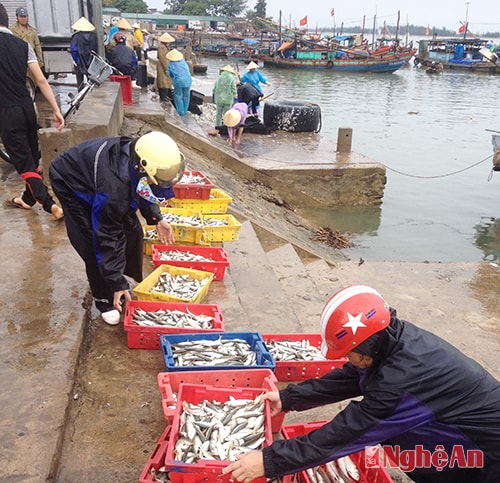 |
| Fish arrive at Cua Lo port. Photo: PH |
After nearly three years of diligently working at sea, Binh and his wife repaid over 1 billion VND of their initial investment. However, after a few more years, their boats became old and damaged, no longer meeting the demands of long voyages. He discussed it with his wife, decided to sell the boats, borrowed nearly 1 billion VND from the bank, and added another 1 billion VND from friends and relatives. He then commissioned the construction of a new, larger pair of boats, worth 3 billion VND, in Nghi Thiet Shipbuilding Village.
Since building his new twin boats, Mr. Binh's trips last 3-5 days each, venturing more than 30 nautical miles offshore. Throughout the year, except for days with rough seas and winds of force 6 or 7 or higher, he only lets his boats rest. While many other boats usually return after only 3 days, his boats regularly go out for 5-6 days. On trips where he doesn't catch fish, he stays longer. Thanks to the newly built boats, more modern equipment, and better ice chests, he can preserve the fish for longer while maintaining quality. Each trip brings in an average of 150 million VND. After deducting all expenses and sharing half with his crew, he still has a profit of 25-30 million VND. This doesn't include lucky trips where he encounters schools of scad or other fish, sometimes catching 500-700 kg, or even 1 ton, earning 150-200 million VND. However, there are also unfortunate times when they encounter areas with few fish, spending 5-6 days at sea, and the money earned from the fish is only enough to cover the expenses. He said: "Each day at sea costs about 14 million VND in fuel, not including food and other expenses for 12 people on the boat."
Currently, to build these two new fishing vessels, Mr. and Mrs. Binh owe the bank nearly 1 billion VND, with an interest rate of 11.5% per year. Each month, Mr. Binh has to pay over 11 million VND in interest alone. Despite the difficulties and hardships, building two offshore fishing vessels offers many advantages compared to fishing in inshore waters. Going out to sea means not having to pay for fuel for daily round trips, saving over 10 million VND per trip. The amount of fish caught is also greater and more concentrated, allowing them to deliver large quantities to freezing agents and animal feed processing facilities at once after each trip.
“Currently, in addition to the interest payments made every three months, I have to pay the bank 150 million VND in principal in the first year. I only hope that the government will have policies to support fishermen venturing further out to sea so that we can afford to build larger, more robust vessels that can stay at sea for longer periods,” Mr. Binh shared.
Phu Huong


