
Striving to become a key growth hub for the province.
(Baonghean) - Comrade Doan Hong Vu, Member of the Provincial Party Committee, Secretary of the Town Party Committee, and Chairman of the People's Council of Hoang Mai Town, gave an interview to Baonghean Newspaper.
Reporter:Could you please tell us about the outstanding achievements that the Party Committee and people of Hoang Mai Town have strived to attain during the 2013-2015 term?
Comrade Doan Hong Vu:During the 2013-2015 term, Hoang Mai Town achieved quite positive results. The average economic growth rate over the three years (2013-2015) reached 10.8%. The economic structure shifted towards industrialization, with industry accounting for 52.51%, services 22.71%, and agriculture, forestry, and fisheries 24.78%. The average added value per capita reached 41.31 million VND, an increase of 8.5 million VND compared to the beginning of the term, and the people's living standards improved.
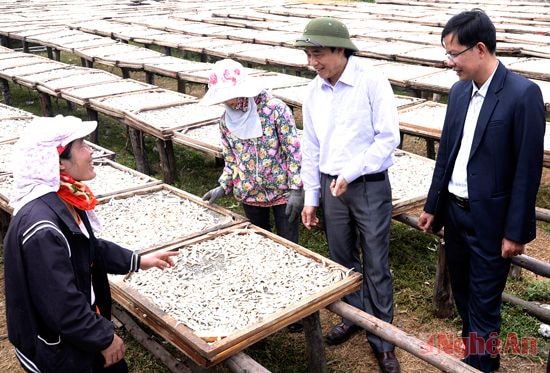 |
| Leaders of the Hoang Mai Town Party Committee held discussions with residents of the seafood processing village in Quynh Phuong ward. Photo: Sy Minh |
It is noteworthy that the technical infrastructure of Hoang Mai Industrial Park I has been completed; the entire 1,200 hectares of Hoang Mai Industrial Park I, Hoang Mai II, and Dong Hoi have been adjusted by the Government to belong to the Southeast Economic Zone and enjoy the preferential policies of the economic zone. Several large projects have invested in the town, such as: Hoa Sen Steel Sheet Factory, Vinatex Garment Factory, Dong Hoi Port, and the Medical Adhesive Sheet Factory; essential infrastructure projects have received investment attention, especially important transportation routes from Hoang Mai to Dong Hoi, National Highway 1A, Xuan-Lien road, inner-city roads, Mai Hung bridge, and the 50,000 m3/day water treatment plant... Urban planning, construction, and beautification have been effectively directed. Three important plans have been completed: the overall socio-economic plan to 2025 with a vision to 2030; the general construction plan at a scale of 1/10,000; Land use planning up to 2020; planning for the central administrative area, tourism planning, historical and cultural relics planning, and several other detailed plans. The criteria for building a Type III urban area have received significant investment and achieved many results, especially in urban infrastructure. The town's central administrative area has been invested in, as have the inner-city roads, and the buildings housing the Town Party Committee, mass organizations, People's Council, People's Committee, police, military, and tax offices. The urban landscape is more attractive, with some streets now having sidewalks, trees, and street lighting.
Trade, services, and tourism are growing rapidly with diverse forms, meeting the ever-increasing demands of a rapidly developing urban area. Commercial infrastructure is developing, with investments in local markets, shops, and supermarkets, effectively serving the production and living needs of the people. The strengths of beach tourism, ecotourism, and cultural and spiritual tourism have been initially exploited. The number of tourists visiting Hoang Mai has increased rapidly over the years, reaching over 20,000 in 2014.
Agricultural, forestry, and fisheries production has grown steadily. Several production models have been implemented in agriculture, such as large-scale model rice farming, encouraging the development of cooperatives and farm economies, resulting in high production efficiency and an estimated average rice yield of 67-68 quintals/hectare. Seafood exploitation has been boosted through investment in offshore fishing fleets with modern and synchronized equipment, and the development of a comprehensive fisheries service system, with annual catches exceeding 30,000 tons. The New Rural Development program has received attention and leadership, achieving positive results. The people have donated 4,683 square meters of land, 3,167 square meters of brick walls, and assets worth over 20 billion VND. To date, the average number of criteria met per commune in the New Rural Development program is 12, and Quynh Lien commune achieved its New Rural Development goals in 2015.
Socio-cultural aspects have seen positive changes. The overall quality of education has improved; the number of outstanding students at all levels has increased, and the graduation rates at all levels, as well as the rates for college and university admissions, have been higher each year than the previous year. Progress has been made in public health care, population management, family planning, and the protection and care of mothers and children. Social policies and benefits for war veterans, families of policy beneficiaries, and social welfare recipients have been effectively implemented. Poverty reduction efforts have received consistent attention from all levels and sectors. The poverty rate has decreased rapidly from 12% at the beginning of 2013 to 3.37% in 2015.
National defense has been maintained, and social security and order have been ensured. Efforts to combat crime and social vices have been strengthened, achieving positive results and showing many improvements compared to the past.
Party building and the political system have received special attention and achieved many good results. The town has promptly established agencies and organizations within the political system: Party agencies, the Fatherland Front and mass organizations; the People's Council and the People's Committee; town-level public service units; and newly established 14 grassroots Party organizations. The quality of grassroots Party organizations has improved, the political system in the religious area has been strengthened; the work of recruiting, assigning, and promoting cadres has been carried out effectively; and attention has been paid to training, nurturing, planning, and standardizing the cadre team. During the term, 360 new Party members were admitted, including 2 private business owners.
 |
| Leaders of Hoang Mai town inspect the application of information technology in management at the town's Education Department. Photo: Sy Minh |
Reporter:Comrade, besides the tremendous achievements, what limitations and weaknesses still need to be overcome?
Comrade Doan Hong Vu:The following shortcomings and limitations need to be addressed:
The economy has experienced relatively good growth, but it is not yet commensurate with the town's potential and advantages; the economic restructuring is still slow; and the average per capita added value is uneven across regions. Three out of 28 targets were not met: the targets for building national standard schools, achieving national standards for healthcare in communes, and the high rate of third births.
Some issues in the socio-cultural, resource, and environmental fields have not been completely resolved, and illegal land encroachment persists. Environmental pollution in some areas has not been addressed promptly.
Technical and social infrastructure remains weak. The mobilization of investment resources is limited and has not met the development requirements of the town.
Public awareness of building a civilized urban lifestyle remains limited; potential complications exist in some specific areas.
The fighting spirit of some grassroots Party organizations; the capacity, responsibility, and cooperation of some grassroots officials are still limited. The work of grasping, handling, and guiding public opinion is sometimes not timely in certain places.
In some localities, mass mobilization work, the activities of the Fatherland Front and people's organizations are at times and in some places heavily bureaucratic, with content and methods of operation that are not practical and do not meet the requirements of urban construction and development.
Reporter:Comrade, in order for Hoang Mai to fully utilize its potential and achieve the goal of accelerating urbanization, striving to meet the criteria of a type 3 urban area by 2020, what are the directions for the next phase?
Comrade Doan Hong Vu:During the 2015-2020 term, Hoang Mai continued to receive timely attention and guidance from the province and the central government; in particular, Resolution No. 11-NQ/TU dated September 18, 2014, of the Provincial Party Committee on the construction and development of Hoang Mai town until 2020 and beyond will create important conditions to maximize the potential and advantages of this key economic region; along with the unity and cooperation of the staff, the efforts of the political system and the entire population. These will be extremely important conditions for Hoang Mai to reach a strong level of development, commensurate with its position as one of the province's growth poles. The development direction is defined as mobilizing all resources for investment and development, achieving rapid, comprehensive, and sustainable economic growth. It aims to accelerate the shift in economic structure and improve the quality of growth by prioritizing the development of industry, trade, services, and tourism, with industry accounting for the maximum proportion. Step-by-step construction of socio-economic infrastructure, prioritizing attracting businesses to invest in key economic zones, industrial parks, and the town's administrative center; ensuring social welfare; maintaining political stability, ensuring national defense and security. Promoting democracy and discipline, strengthening unity, and emphasizing the responsibility of the cadre. Building a strong Party committee, government, and organizations within the political system, striving to ensure Hoang Mai town basically meets the criteria of a type 3 urban area by 2020.
Reporter:Thank you, comrade!
Huu Nghia(Perform)
Some key targets that the Hoang Mai Town Party Committee strives to achieve and surpass by 2020: 1. Total production value in 2020 (at constant 2010 prices) reached VND 14,000 billion. Average annual economic growth rate was 15-17%. 2. Economic structure by 2020: Industry and Construction: 59.1%, Services: 29.8%, Agriculture, Forestry and Fisheries: 11.1%. 3. Average value added per capita/year: 81 million VND (Of which, the town manages 62.3 million VND). 4. State budget revenue assigned to the locality increased by an average of 17-18% annually, reaching a total of 534 billion VND by 2020. 5. Total investment capital for development in the area over 5 years: 66,000 billion VND. 6. The percentage of schools meeting national standards will reach 80% or higher by 2020. The percentage of culturally exemplary families will be 85-87%; the percentage of culturally exemplary villages will be over 60%. 7. The rate of trained workers reaches over 65%; 1,500 jobs are created annually. 8. Reduce the poverty rate by an average of 1.5-2% annually, aiming for a poverty rate below 2% by 2020. 9. Maintain political security and social order, create a safe and healthy environment for socio-economic development, and attract investment; 100% of facilities ensure security and combat readiness, with 70% of facilities being strong; the Police and Military maintain their "Unit of Victory" status. 10. The town's Party Committee has consistently achieved the title of "Strong and Stable". |


