
Rising fuel prices are causing hardship for fishermen.
(Baonghean.vn) -The unexpected record high in fuel prices has caused anxiety among fishermen. Many are considering staying home and waiting for prices to drop before going out to sea, while others are losing interest in fishing and considering switching professions.
On a late April afternoon, the sun shone faintly, a gentle sea breeze blew, and along the Lam River near Cua Hoi, many fishing boats lay ashore, with only a few fishermen occasionally seen on board. With a pensive expression, Mr. Vo Van Tuong (60 years old) from Nghi Hai ward, Cua Lo town, was trying to fix the lamp on his boat's deck while gazing out at the sea. Down below, in the engine room, his youngest son was busily repairing the engine. When the topic of fuel came up, both father and son sighed wearily.

Many fishing boats belonging to fishermen in Quynh Luu are anchored ashore, unwilling to go out to sea because the more they go out, the more losses they incur.
Considered one of the well-off families in Nghi Hai fishing village, Mr. Tuong owns three fishing boats, each with a capacity of 10-15 tons. Each trip to sea, lasting a few days, costs him approximately 15-20 million VND in fuel. Since gasoline and diesel prices reached record highs, fuel costs have increased significantly. Mr. Tuong stated that since the price hike, he has only made two trips to sea, but his income has dwindled considerably because "fish are scarce, fuel prices are high, and labor costs cannot be reduced." Facing these difficulties, coupled with a breakdown on one of his fishing boats, Mr. Tuong and his youngest son decided to moor the vessel for repairs without hesitation.
“We fishermen are always worried about fuel prices. After Tet, we heard rumors that the government wouldn't raise fuel prices yet, and everyone was happy. But then suddenly, fuel prices increased and reached record levels, leaving everyone stunned. The prices of fish and squid haven't increased, so why are fuel prices soaring? It's hard for fishermen to feel secure staying at sea,” Mr. Tuong shook his head.
Sharing the same predicament as Mr. Tuong, Nguyen Van Tu, the owner of an offshore fishing boat, also anchored his vessel at the Nghe An fishing port without considering going out to sea. Mr. Tu explained that this is the breeding season, and fish often hide in coral reefs and rocks to lay their eggs, resulting in very low fishing yields. Meanwhile, fuel costs have skyrocketed, causing losses for fishing boats. This is also the time of year when fish prices are at their lowest due to the poor quality of the fish.
Mr. Tu said that his fishing boat fishes in the fishing grounds of Nghe An and Thanh Hoa provinces, and the products are usually supplied to food processing companies for export and animal feed. This season, it's rare to catch large fish, so fishermen are often criticized and pressured by traders, making boat owners like Mr. Tuong and Mr. Tu less enthusiastic about going out to sea. In addition, many seafood processing and export companies are also facing difficulties due to lack of capital and operating at a reduced capacity, so the market for fish and shrimp is also challenging, unlike other times of the year.
Many seasoned fishermen in Nghi Thiet fishing village say that this is the transitional period between the southern fishing season and the lean season for fishing, when catch yields are at their lowest of the year. The fish caught are mainly low-value, small fish with no export value. The sharp drop in fuel prices at this time has caused significant difficulties for the fishermen.
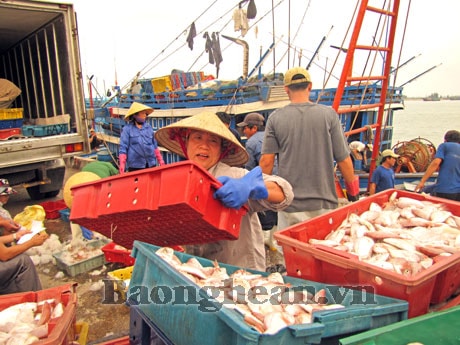
The near-shore fishing practices of fishermen in Nghe An often involve catching low-value, miscellaneous fish.
“Each fishing trip for a 90 HP fishing boat costs about 3-4 million VND in fuel per night. At the beginning of 2011, the price of diesel was nearly 15,000 VND/liter, but now it has increased to over 22,000 VND/liter. Labor costs, ice, and lubricants are also constantly rising, while the prices of fish and other seafood have remained virtually unchanged. Hundreds of price increases are piling up on fishermen, so the more they go out to sea, the more losses they incur,” confided Mr. Nam, a fishing boat owner docked at Nghi Thiet estuary. He added that for high-capacity, offshore fishing vessels, fuel costs are even higher.
In coastal communes such as Dien Ngoc and Dien Bich in Dien Chau district, and Quynh Phuong, Quynh Nghia, and Tien Thuy in Quynh Luu district, fishermen are also struggling due to the excessively high price of fuel.
The increase in fuel prices not only directly affects fishermen but also reduces the income of hired laborers on fishing boats. Mr. Vo Van Tuong's three fishing boats employ 40 workers, whose wages are calculated based on the results of each trip. On average, his workers are paid between 3.5 and 4.5 million VND per month after deducting other expenses. The first trip after the recent price increase did not yield the desired catch, forcing Mr. Tuong to reduce his workers' wages. “Currently, most fishermen are between 40 and 60 years old, and their income is unstable, so many are considering quitting the profession. Few young people are going to sea; they often choose overseas employment, which is easier and offers higher income. With prices continuing to rise like this, will future generations still be interested in the sea?” Mr. Tuong worried.
With 82km of coastline, Nghe An currently has over 4,200 fishing vessels and tens of thousands of fishermen, with thousands of families depending on their livelihoods from fishing trips. The increase in fuel prices will bring many difficulties to those who rely on the sea for their livelihood. Many fishermen are feeling anxious and worried, wondering if they still have the strength and patience to continue fishing. Mr. Nguyen Huy Nam, Chairman of the Farmers' Association of Nghi Hai Ward, Cua Lo Town, said that Nghi Hai used to be one of the localities with the strongest fishing traditions in the province and renowned nationwide, but now the ward's fleet has only 50 vessels left. All five former fishing cooperatives have been dissolved because the members are no longer interested in fishing.
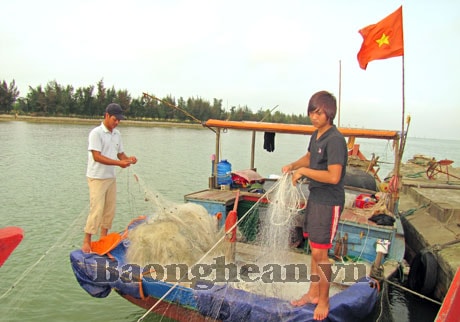
Mr. Dau Xuan Tu and his son, Dau Xuan Hung, are repairing their fishing nets in preparation for going out to sea. After this trip, Hung will return to shore and wait to go abroad for work, not pursuing a career in fishing.
“Life at sea is very unpredictable; each trip out to sea is like a gamble. For generations, our ancestors have braved natural disasters and storms to cling to the sea, but with the constant price fluctuations like this, very few people can survive in this profession. The greatest wish of fishermen like us is for the government to soon implement policies to subsidize fuel prices and lower interest rates on loans for building new boats, so that people have more hope to stay in this profession,” old fisherman Vo Van Tuong slowly confided, gazing into the distance towards the sea.
Nguyen Khoa


