
Green hills of red rocks in Chau Binh
I had known about Chau Binh (Quy Chau) before, but only through stories about a sad "red stone era." Twenty-two years later, I visited Chau Binh. Now, the entire commune is covered in the green of vast planted forests. The traces of the trenches are still there, but things are different now...
(Baonghean)I had known about Chau Binh (Quy Chau) before, but only through stories about a sad "red stone era." Twenty-two years later, I visited Chau Binh. Now, the entire commune is covered in the green of vast planted forests. The traces of the trenches are still there, but things are different now...
It was 1992, when I was just starting 10th grade, still naive and unaware of where Quy Chau was or the value of the red gemstones. I only knew from my uncles that digging for red gemstones would make me rich. Two weeks later, three uncles returned from Quy Chau, their clothes stained, their bodies emaciated, and one of them suffering from severe malaria and requiring treatment at the provincial hospital. Later, I also learned that tens of thousands of mothers and relatives had tearfully awaited the return of their husbands and sons from that gemstone-rich area… Occasionally, when recounting the story, my uncles consider themselves lucky not to have lost their lives in that red gemstone area.
When he learned that I wanted to learn about the current lives of the people in Chau Binh commune on this red stone land, Mr. Lang Thanh Nhat, the commune's land cadastral officer, happily took me on his motorbike. Winding through several mountains and vast mangrove forests, Mr. Nhat enthusiastically began his story: “Now, Chau Binh is all lush green forest like this. This is the third harvest, and my family also owns a few hectares. Before, this area was barren, and people from all over came to dig for red stones. The locals saw this and jumped in, forgetting about their fields, hills, and mountains, leaving them fallow. But then the red stones ran out, and the people here remained poor…” I asked if Mr. Nhat had participated in the red stone search back then. He frankly replied: “Yes, of course, people from all over flocked here, not just the locals. But it wasn't worth it, because rumors spread that it was easy to find red stones, so people from everywhere rushed in. They dug along all the streams and even encroached on the commune's meager rice paddies.” Many households sold their rice fields to contractors for red stone quarrying and received in return a deep pit filled with jagged rocks and pebbles. People fought over the red stone all day long, and bloodshed occurred almost daily. Chau Binh became a desolate, barren, rocky area. With the help of the State and timely support policies, the people gradually stabilized, began planting forests, improving rice paddies, reclaiming land, and cultivating vegetables, leading to a better life. Now, the hills of Hoa Co May, Ty Hill, and Tu Hill in Chau Binh are covered with green melaleuca forests. Over 10,000 hectares of hilly land in Chau Binh have been leased to the people for reforestation. To date, the forests in Chau Binh are entering their third harvest cycle. After 6 to 7 years of planting and protection, each hectare of melaleuca forest in Quy Chau yields between 70 and 90 million VND. This income may not be high for forest planters, but it is sustainable and contributes to protecting the ecological environment in areas that were previously abandoned.
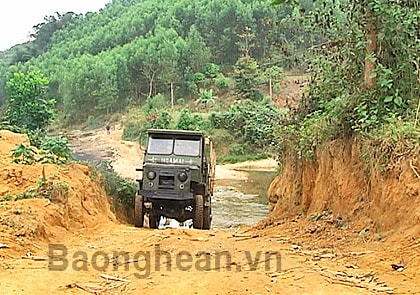
Opening roads to facilitate reforestation.
While chatting, Mr. Nhat turned his car and took me to a sturdy, single-story house nestled amidst a lush green melaleuca forest. Mr. Vi Duc Thuan, the owner of the house, greeted us with a radiant smile. Through our conversation, I truly admired Mr. Thuan's determination and that of the local people. After the red stone quarrying incident, with government support for forest development, production, and livestock farming, Mr. Thuan discussed and collaborated with 36 Thai ethnic minority households in Ke Khoang and Binh Mai villages to form a forest plantation covering over 120 hectares. Mr. Thuan, as the group leader, acts as the cooperative's chairman, organizing the purchase of seedlings, assigning tasks to the 36 households for land preparation, planting, protection, and harvesting. Using a rotational system—harvesting several dozen hectares and then immediately replanting the forest on the same area—combined with livestock development, the households in Mr. Thuan's group have a stable income. The sustainability of the planted forest economy is highly demonstrated. To facilitate the planting, protection, and harvesting of forests, over the years, Thuan's group has spent 300 million VND of their own money to rent bulldozers and build about 7 km of roads leading up the hills to the planted forests. After the melaleuca harvest at the end of 2012 and the beginning of 2013, his group is planning to convert about 50 hectares to rubber plantations in accordance with the province's policy. Chau Binh currently has hundreds of family-based integrated economic development models through concentrated forest planting combined with commercial livestock and poultry farming. Among these, large-scale forest planting models ranging from 10 to over 100 hectares have become exemplary models in Quy Chau district.
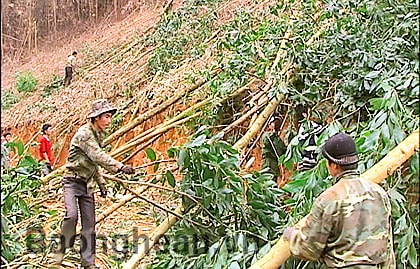
People in Chau Binh harvest acacia trees.
On the road from the lush green melaleuca forest back to National Highway 48, we met Mr. Lang Van My from Ke Mong village and 12 other young men harvesting 5 hectares of melaleuca forest planted 6 years ago. Sweating profusely, Mr. My was using a chainsaw to fell melaleuca trees with trunk circumferences of 50cm to 70cm, cutting them into short sections of 4-5m, and transporting them to the main road. Others were cutting branches and stripping bark according to orders. Stopping his chainsaw and wiping away sweat, Mr. My confided: “It’s very hard work, sir. The price of melaleuca has dropped lately, and the profit is minimal. We’re considering switching to other, more profitable forest crops…”
In Chau Binh, there are still many large and small ponds and lakes left over from the past red stone mining. Above, dense forests are planted, providing a solid foundation for the local people. Reforestation and the conversion of planted trees are still challenging processes, but the people of Chau Binh are determined to stick with it and consider it a sustainable livelihood.
Future generations may not know about the sad stories of the "red stone era," but I, my uncle, and many others will surely tell them, so that our children and grandchildren can see the admirable progress of our homeland...
Text and photos: Nguyen Son


