
Building a prosperous and happy family.
(Baonghean) - They are farmers with calloused hands who have overcome outdated customs, ideologies, and prejudices, choosing to stop at two children to raise healthy, well-behaved children and build warm, happy families... These are the "cells" that contribute to building a prosperous society...
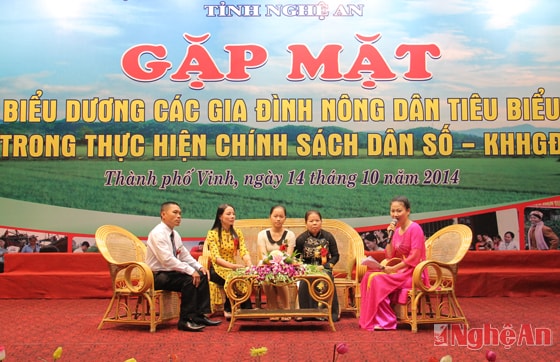 |
| Families socialized at the ceremony. |
At the Nghe An Guest House hall on the morning of October 14th, everyone present, regardless of whether they came from the highlands or lowlands, Kinh, Thai, Mong, or Khmu ethnic groups, shared a feeling of pride and excitement as they represented over 500,000 members of the Farmers' Association throughout the province at the ceremony honoring exemplary farming families in implementing the Population and Family Planning policy. The images of families with all members present conveyed the message: True happiness is when the whole family loves each other and looks in the same direction. And we could see in the eyes of the fathers and mothers the boundless pride of introducing their well-behaved, academically successful children, even though they all had only daughters…
The story of having only daughters was also a recurring theme throughout the awards ceremony. In rural areas, the patriarchal mindset of valuing sons over daughters still prevails, with the belief that "one son is worth more than ten daughters," and the mentality of "having many children is better than having much wealth." Therefore, as Ms. Hoang Thi Anh Hoe from Hamlet 9, Lam Son Commune, Do Luong District shared: “When we had two daughters, my husband and I faced a lot of pressure from our family and public opinion. Especially since my husband's father was the head of the clan. But, having been farmers our whole lives, we knew very well that having many children would be difficult and we wouldn't have the means to provide for them properly, and they wouldn't receive a complete education. With that in mind, my husband and I decided that even if we had daughters, we would stop at two… After more than 20 years of sharing hardships, our two daughters are now grown up. Our eldest daughter is a fourth-year student at the Hanoi Academy of Finance, and our second daughter has been an all-around excellent student for nine consecutive years, a top student in Mathematics and English at the provincial level, and the valedictorian of Do Luong 2 High School… We are satisfied with our choice, because at least we have tried our best to raise our children to adulthood.”
The family of Mr. Nguyen Huu Toan and Ms. Du Thi Nhuong in Hamlet 8, Tho Thanh Commune, Yen Thanh District is also a prime example. Both are Catholic, and Ms. Nhuong was entrusted with the responsibility of being a population collaborator and a member of the Women's Association in the hamlet. Despite having two daughters, she discussed with her husband the idea of stopping having more children to set an example for others. Their encouragement came from their two well-behaved and academically successful children. During their secondary education, both children achieved the status of advanced and excellent students. Their eldest son, born in 1986, is now an engineer working at Viet Phat Construction Company. Their second daughter, born in 1991, graduated from Nghe An College of Education and is now a teacher at Hoa Thanh Primary School. Meanwhile, Ms. Dau Thi Lich, a Kinh woman who married into a family in Hop Thanh village, a village with over 90% Mong ethnic minority population in Xa Luong Commune, Tuong Duong District, is admired for her perseverance and hard work.
She recounted: Her parents are Kinh people, so 10 years ago, when they learned she was in love with Ly Nhia Thanh, everyone objected because they feared she wouldn't be familiar with the customs, wouldn't know the ethnic language, and that his family was poor and had many children. But believing in his genuine feelings, she was determined to be with him. Having two children together, she endured considerable criticism and gossip from her relatives for "not being able to give birth to a son to carry on the family line." However, as a Party member and the Party branch secretary, and wanting to dedicate more time to developing the economy and raising her children, she and her husband discussed and implemented family planning, focusing their efforts on caring for their children. She always believed that as a daughter-in-law of the Mong people, as a daughter of the village, she had to do her best to help the village, to encourage the villagers to implement population policies, and to educate the youth to avoid social vices... helping the villagers gradually escape poverty.
The meeting also included stories and experiences shared by those working in special and disadvantaged areas. It's hard to believe that, more than 10 years ago, Son Thanh commune, the province's first new rural commune, was one of the poorest in the district, with one of the main reasons being large family sizes. Faced with this reality, the commune's Farmers' Association proactively coordinated with population specialists to outline nine key tasks with specific actions. These included clearly outlining the negative consequences of having many children, such as low education levels, poverty, and unemployment, to help people understand their future prospects; launching a movement to encourage smaller families; and registering for contraceptive methods. Families with fewer children were given priority in accessing loans and in the transfer of scientific and technical knowledge. Tam Thai commune (Tuong Duong district) is the only unit that has had no third births for three consecutive years, proudly sharing its effective methods in encouraging people to practice family planning.
Highly appreciating the efforts of the families and the endeavors of the Population Department and the Provincial Farmers' Association over the years, Mr. Nguyen Van Tan, Deputy Director General of the General Department of Population/Family Planning, emphasized: The 25 families honored this time are exemplary role models. They are pioneers, people who have resolutely changed their behavior and thinking in making choices, overcoming outdated prejudices to effectively implement the State's policies and guidelines. This has contributed to positive changes in the province's population work, such as: the increasing prevalence of families with one or two children; the rapid population growth rate has been basically controlled; the quality of the population has improved, and average life expectancy has increased.
My Ha


