
Model building must be realistic.
(Baonghean) - For many years, the State has allocated significant capital through programs and projects such as Program 135/CP and Resolution 30a, integrating investment into the implementation of livestock farming and production models in localities, with priority given to particularly disadvantaged mountainous districts.
This is a correct policy, in line with the people's wishes, aimed at exploiting potential, gradually changing production practices, and increasing income for ethnic minority communities. However, in many localities, the development and implementation of the model are not practical, resulting in low effectiveness. Chau Thon commune, Que Phong district, is an example.
In recent years, Chau Thon commune, Que Phong district, has received significant investment from Resolution 30a and other programs to implement models for developing crops and livestock. However, when asked about the effectiveness of these models, Mr. Vi Van Chin, Chairman of the Commune People's Committee, stated: "Over the past four years, Resolution 30a's funds have supported the local area in investing in livestock such as cattle, pigs, black chickens, Muscovy ducks, honeybees, and fish fry; and crops such as corn, peanuts, sesame, and various vegetables and beans. Objectively speaking, only the cattle and black pigs are suitable for the local conditions, developing quite well, and many households have escaped poverty thanks to this livestock support. The rest, after the model ended, were abandoned, and the people did not replicate them. For example, the honeybee farming model in Co Nghiu village, from mid-2013 to the present, has been considered a failure!"
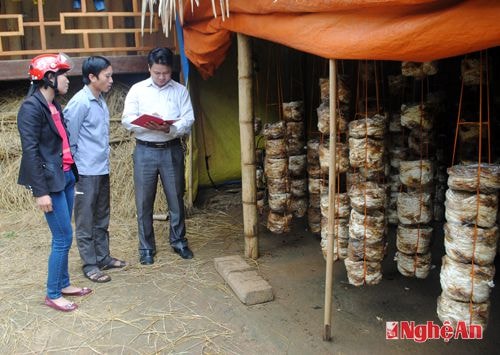 |
| Growing straw mushrooms at the home of Mr. Loc Van Son. |
Mr. Loc Van Son, head of Co Nghiu village, said that in 2013, 10 households in the village received bees from the government for beekeeping. To date, only Mr. Loc Van Ty's household has maintained its bee colonies; the rest have all fled. He took us to Mr. Ty's family home to see the bees. His stilt house is located in the center of the village. Right under the house are three beehives placed close to the house's pillars. Mr. Ty excitedly showed us: "We received two beehives from the government in mid-2013. During the beekeeping process, we managed to separate two more hives, one has fled, and we currently have three left…" Then, Mr. Ty gently lifted the cover of one beehive, revealing six frames inside, each covered with a thick layer of honey. When asked if he had received any training on beekeeping techniques before starting, Mr. Ty replied that he had, but didn't understand much. He asked where the instructors had instructed him to place the beehives during the training. Mr. Tý replied that he placed it under a tree. Why didn't he put the beehive under a tree? Because his house doesn't have a garden, so there are no trees. He knew that placing it under the house wouldn't be practical. Mr. Tý also said that the households in the village that received support for beekeeping all placed their beehives under the floorboards, but now they've all been swept away. Placing the beehive directly under the floorboards is unsuitable. According to what I've learned, successful beekeepers usually place their beehives under trees in the garden or on hillsides, where the environment is clean, fresh, and cool, because honeybees are very sensitive to their environment and are very "fussy" insects.
According to village head Loc Van Son, this village is only suitable for raising local pigs and cattle, as these are traditional livestock that have been passed down through generations of the Thai ethnic group. He believes it's not advisable to support the villagers with crops or livestock that are too far-fetched and require advanced scientific and technological applications. The best approach is to support the local black pigs and yellow cattle, or to cultivate crops suitable for sloping land, such as acacia trees or upland melons. He also mentioned the straw mushroom cultivation model, implemented by the district government at his family's farm since early 2014, which has proven effective. According to Mr. Son, mushroom cultivation isn't difficult; it utilizes agricultural by-products as materials, and the resulting products are easily sold in the local market. He plans to invest in building a larger-scale model in the future.
Mr. Vi Van Chin further explained that in the future, funding from Resolution 30a, as well as other sources, needs to be based on the practical realities of each locality to ensure effective investment. In Chau Thon, where the majority are Thai ethnic people, who have long been accustomed to raising pigs and cattle, the focus should be on those two livestock. Ducks and black chickens are unsuitable because they require advanced techniques, and each household only receives support for a few animals, leading to neglect or failure to breed them. For example, passion fruit, although widely grown in Tri Le commune (10 km from Chau Thon) with high quality, was recently tested in Chau Thon. While it produced a good number of fruits, the quality was poor, with a sour taste, not as sweet as passion fruit grown in Tri Le. The reason could be that the weather in Chau Thon is unsuitable. According to Mr. Chin, in the future, the government needs to provide more focused support. Regarding pig farming, previously, support was provided for 2 pigs per household, but now it should be focused on supporting 4 pigs per household, creating conditions for them to invest in care and rise out of poverty more quickly. For crop farming models, long-term investment is needed, by gradually reducing the support level: 100% support in the first year, 70% in the second year, and 50% in the third year, in a gradual reduction to encourage farmers to follow suit.
Therefore, before implementing any crop or livestock model in a particular locality, relevant authorities and sectors need to carefully study the strengths of each region to determine the best investment. A successful model is first assessed for its economic effectiveness after implementation, and then for farmers to adopt and expand it on a larger scale. If farmers do not continue to adopt and expand it, then the model is considered a failure!
Xuan Hoang


