
Building new rural areas: The concerns of poor districts.
(Baonghean) - For Ky Son border district, in addition to promoting sustainable poverty eradication, the construction of new rural areas is also being implemented by Party committees, authorities, and ethnic minority communities. However, the "difficulties" of this poor district are hindering the solutions. Therefore, implementing the criteria for building new rural areas is a major challenge.
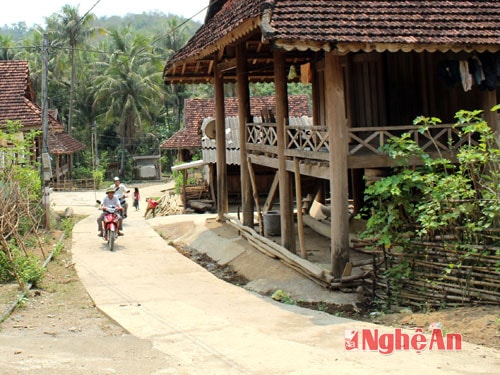 |
| The roads in Chieu Luu commune have been paved with concrete. |
Both commune and district leaders are complaining about difficulties.
Like other localities, when embarking on the National Target Program for New Rural Development, the District Party Committee, the District People's Committee, and various departments, along with all 20 communes of Ky Son district, implemented many comprehensive solutions such as: intensifying widespread propaganda among the people, developing commune planning, mobilizing resources, and integrating various programs and projects… However, to date, after 3 years of implementation, the commune with the highest number of criteria achieved is Huu Kiem - the unit selected as the pilot unit, while most communes have only reached 2-3 criteria.
Located adjacent to National Highway 7A and bordering Muong Xen town, Huu Kiem commune is expected to rapidly develop its socio-economic conditions and successfully implement the criteria for building a New Rural Area. This locality has a large area of rice paddies, offering many advantages in trade and the development of livestock farming and crop cultivation towards commercial production. Therefore, in the three years of implementing the New Rural Area program, the commune proudly leads the district with 9 targets achieved. During the implementation process, the commune integrated projects such as: the poverty alleviation program, the school and health station reinforcement program, and infrastructure projects according to Resolution 30a… These initial results are a great source of encouragement for officials, Party members, and ethnic minority people in the area.
However, during the discussion, Mr. Kha Van Quyen, Chairman of the People's Committee of the commune, expressed his concerns, stating: "We are truly at a loss as the remaining 10 criteria are all challenging issues. For example, regarding the completion of the rural road construction criterion, currently 4 out of 9 villages are only 8-10km from the commune center and Highway 7, but road construction is very difficult. Just widening the road to meet the criteria requires a huge amount of funding to level mountains and fill ravines. Widening the road through these villages is very difficult because households have traditionally built their houses very close together due to limited flat land, so widening the road would require significant compensation and relocation costs. Furthermore, criteria related to income, rural markets, cemeteries, and clean water are all difficult to achieve… The district has set a target of completing all rural development criteria by 2015, but we find it hard to reach that goal…"
As for Nam Can commune, one of the two pilot communes for building new rural areas in Ky Son district (previously, the district chose Huoi Tu commune as the pilot but later switched to Nam Can), it is considered to have great potential with National Highway 7 running through it and an international border gate with Laos. It is also planned to develop a duty-free zone to promote socio-economic development in the border region. However, to date, Nam Can has only achieved 5 out of 19 criteria for building new rural areas. Entering 2014, the commune set a goal to strive for an additional 3-4 criteria, but according to Mr. Ho Chong Nhia - Chairman of the People's Committee of the commune, it is "very difficult". Among the criteria to strive for, similar to Huu Kiem, the construction of rural roads is facing many difficulties for several reasons: As of April 2014, all concrete pouring stages in the remaining four villages were only at the planning stage, waiting for cement and additional funding from higher levels. In this area, mobilizing local people to mine sand and gravel is impossible due to a lack of resources; and mobilizing people to contribute funds is largely impossible, as 65% of households are poor, and another 20% are near-poor. Meanwhile, buying and transporting sand and gravel to this border region is 3-4 times more expensive than in other areas.
The reality in the two pilot communes highlights the difficulties of building new rural areas in the impoverished Ky Son district. In a conversation with us, Mr. Bui Tram, Chairman of the District People's Committee, said: "Except for the two pilot communes, the other communes have only met 2-4 criteria for New Rural Development. We're not trying to dwell on poverty and hardship, but in this mountainous area, which is fragmented by many streams, establishing villages, settling people, and practicing agriculture has long been a difficult task requiring significant resources. Most of the ethnic minority people here are poor, making it difficult to mobilize financial contributions like in other regions. The terrain is complex, with no flat land, mainly steep hills and mountains, making it very costly to create land for the construction of technical infrastructure and transportation. The people's production is mainly based on slash-and-burn agriculture, self-sufficient, with over 98% of agricultural laborers lacking formal training. Meanwhile, the capacity of local officials is limited, and some local Party committees and authorities have not shown sufficient interest in directing and supervising the implementation. Furthermore..." "The mentality of waiting and relying on others is still prevalent among the people and some officials and Party members. These factors make it difficult for the district's new rural development progress to achieve the set goals."
Try to take steady steps.
Over the years, with the support of the central government, the province, and various departments and agencies, Ky Son district has combined and integrated programs and projects such as 135, 167, and 30a to build infrastructure, transportation, schools, and health stations, as well as providing assistance with seedlings, livestock, and scientific and technical development for production and animal husbandry. This has contributed positively to reducing the poverty rate from 80.2% in 2010 to 58.86% at the end of 2013. Looking at these statistics, it shows that within three years, the entire district reduced the number of poor households by over 21%. Clearly, this is due to the collective efforts of the community and the great efforts of the Party Committee and the people in this mountainous border region.
To eradicate hunger and reduce poverty, Ky Son district prioritizes the restructuring of its economy by building household and farm-based economic models oriented towards commodity production and livestock farming, and replicating these models throughout the district to increase income for the people. This will leverage internal resources to attract investment and effectively integrate programs and projects for socio-economic development. The immediate and fundamental task is to prioritize infrastructure development, especially transportation, and focus on supporting production development, while also organizing effective cooperative production models based on household groups. The district leadership is also strengthening its leadership and guidance, assigning capable officials to directly monitor, guide, inspect, and supervise the implementation of the plan in the communes. Based on the approved New Rural Development plan, implementation will be carried out in a sustainable manner. Regarding resources, in addition to support and assistance from the central government, the province and district have a policy of allocating 30% of the district's surplus revenue to communes for new rural development; the two pilot communes will receive 50% support.
Entering 2014, Ky Son district, taking advantage of the favorable weather during the dry season, urged communes to focus on surveying, designing, and allocating detailed amounts of cement provided by the province for various transportation projects, and promptly commenced construction to maximize practical effectiveness. This task not only fulfilled the set goals in rural transportation construction but also created leverage for socio-economic development, fostering confidence and motivation for the people to strive for progress. Mr. Bui Tram affirmed: “In 2015, the district registered with the province that two communes, Huu Kiem and Nam Can, had completed the targets for building new rural areas. Looking at the reality, it is a challenge, and the district's Steering Committee also finds it difficult to achieve the goal, but we are not discouraged. We are actively urging the pilot communes to accelerate progress, but we are focusing on sustainability. We may not reach the target on time, but the district's policy is to ensure that the communes achieve the targets they set, only then will we create real momentum for socio-economic development in the area…”
Nguyen Son


