
Establishing a vaccination fund: How it's being done in Nghi Loc.
(Baonghean) - In recent years, the vaccination rate for livestock in Nghi Loc district has consistently been among the highest in the province. To achieve this result, the district has implemented many specific and effective methods.
Currently, Mr. Nguyen Van Hoa's broiler chicken farm, with a capacity of 7,000 chickens per year, located on Kho Vom hill, Van Tai hamlet, Nghi Hoa commune, is raising a new flock, preparing for the year-end sales of broiler chickens. He said: "To ensure the health and quality of the chickens, the most important factor is vaccination twice a year. Vaccination begins when the chickens are one week old. I proactively invest in hiring veterinary officers to administer the vaccinations. The autumn season is a transitional period, a time for large-scale restocking, making vaccination even more crucial in preventing the risk of disease outbreaks and the spread of diseases from the external environment."
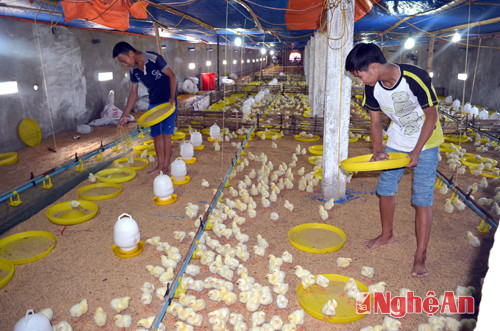 |
| Nguyen Van Hoa's chicken farm - Van Tai hamlet, Nghi Hoa commune. |
Nghi Hoa commune currently has 380 buffaloes and cows, nearly 700 pigs, and 15,000 poultry. There are 3 joint-venture chicken farms with foreign partners, each with a capacity of 8,000-15,000 chickens, and 6 small-scale duck farms with 1,000 ducks each. Previously, the commune experienced several outbreaks of African swine fever and foot-and-mouth disease among livestock. The average annual vaccination rate for livestock was only 53%. In the last 3 years, thanks to effective public awareness campaigns, the commune's annual vaccination rate has reached 73%-80%, and there have been no outbreaks in the area. Mr. Dang Tho Thieu, Vice Chairman of the Nghi Hoa Commune People's Committee, said: To proactively manage vaccination efforts, the commune has implemented a livestock development plan through a fundraising scheme for vaccination by collecting an average of 2 kg of rice per household per year, equivalent to 11,000 VND per household per year. Over 95% of livestock-raising households contribute, raising 20-24 million VND per year, plus an additional 4 million VND per year from the commune budget. This funding has enabled the commune to proactively pay for veterinary staff's vaccination services, purchase vaccines and equipment to support disadvantaged hamlets, and cover transportation costs. For the 2014 harvest season, based on the state-supported vaccine supply, the commune aims to achieve an 85% vaccination rate for cattle and buffalo cholera vaccines, swine cholera vaccines, and 100% vaccination rate for avian influenza vaccines at large-scale farms and livestock facilities.
Nghi Loc District currently has over 600,000 poultry, 17,000 pigs, and 23-24,000 buffaloes and cattle. The district has 256 livestock farms and small-scale farms, including 50 large-scale farms. Located near Vinh City, close to the national highway and railway, and particularly near major trading centers for buffaloes, cattle, and poultry meat in Vinh City, Do Luong, and Dien Chau, the district has focused on vaccination efforts in recent years, achieving an overall vaccination rate of 70-80%. Several small outbreaks of livestock and poultry diseases in Nghi Hung, Nghi Van, and Nghi Hoa have been detected and handled promptly, preventing further spread. Compared to other lowland districts, the disease situation among livestock in the district is relatively stable.
One of the factors contributing to the effectiveness of vaccination efforts in Nghi Loc is the establishment of a vaccination fund. The District People's Committee has directed communes to issue council resolutions and develop mechanisms for raising vaccination funds at the grassroots level. Depending on specific conditions, some communes collect vaccination fees based on the number of livestock households, such as Nghi Trung, Nghi Hoa, Nghi Truong, and Nghi Thinh; others collect fees based on the number of animals, such as Nghi Dong and Nghi Hung. To date, most communes in Nghi Loc district have established vaccination funds, contributing to the effectiveness of vaccination and disease control for livestock and poultry in the localities.
Mr. Tran Quoc Cuong, Head of the Veterinary Station of Nghi Loc District, said: Currently, the network of veterinary officers in 30 communes and towns basically meets the quantitative requirements… The district has coordinated with the District Economic and Technical Vocational College to open 6 basic training courses in livestock farming and veterinary medicine for 248 students under 50 years old in 6 communes: Nghi Dong, Nghi Thiet, Phuc Tho, Nghi Thach, Nghi Cong Bac, and Nghi Yen. Of these, 89 farmers from Nghi Dong are qualified to practice veterinary medicine after graduation. With this advantage, the work of advising and implementing vaccination and disease control at the grassroots level is much easier than in many other localities. In addition, according to Mr. Tran Quoc Cuong's assessment, simultaneous and concentrated vaccination is very important. According to the province's general plan, the spring vaccination campaign is scheduled to run from March 15th to April 15th, and the autumn vaccination campaign from August 15th to September 15th. However, the district's approach is to shorten the vaccination period to half the timeframe.
With vaccines provided by the State, the district is currently implementing vaccination programs for livestock, with completion expected by August 30th. For the 2014 harvest season, Nghi Loc district aims to achieve a vaccination rate of over 85% for all types of vaccines.
Luong Mai


