
Developing rice raw material areas - Necessary but difficult.
In an effort to share risks between businesses and farmers, the Ministry of Industry and Trade has just issued a roadmap for building raw material areas or implementing production and consumption linkages for rice. Accordingly, starting from March 2015, exporting businesses must have their own raw material areas to serve their business operations.
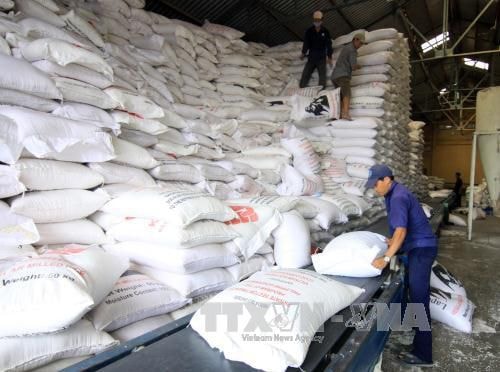 |
| Many businesses are concerned about a lack of investment capital for developing raw material areas to serve rice exports. |
Aligning interests
The Ministry of Industry and Trade has proposed three methods for businesses to choose from when establishing raw material areas. Specifically, businesses can develop large-scale farming projects or sign contracts for the production and consumption of rice with individual farmers or representatives of rice farmers. Another method is to establish raw material areas under the management and use of the business on land allocated, leased, or contributed by the State in the form of land use rights, or leased from households, organizations, or individuals for rice production.
“For rice exporting businesses with a volume of less than 50,000 tons per year, in the first year they must establish a raw material area of 500 hectares, and from the second year onwards, this will increase by an additional 300 hectares each year. The area of the raw material zone will increase proportionally with the amount of rice exported by the business. When conducting surveys, we found that many businesses chose option 2,” said Dr. Le Van Banh, Director of the Mekong Delta Rice Institute.
The Ministry of Industry and Trade determined the initial minimum scale and the minimum roadmap for gradually increasing the raw material area of enterprises during the 2015-2020 period based on the amount of rice exported by each enterprise during the 2011-2013 period. At that time, rice exporting enterprises would have to have their own raw material area or cooperate, place orders, and link with rice producers to be eligible to act as the main rice exporter. If this is achieved, enterprises will have more control over their supply sources, farmers will have a more stable market, and enterprises will be encouraged to invest in more storage facilities.
At the recent conference summarizing rice export activities in 2014 held in Ho Chi Minh City, Deputy Minister of Industry and Trade Tran Tuan Anh stated that it is necessary to quickly accelerate the process of encouraging businesses to invest in building stable raw material areas for all major production seasons of the year and to invest in building raw material areas larger than the minimum required size. Based on the actual situation and implementation results, the Ministry will consider and adjust the scale and roadmap for building raw material areas accordingly. Participants in the linkage program who violate the signed contract will not only be held liable according to the law but will also have their received support revoked and will not receive support in the following year.
“In reality, the main reason for the difficulties in selling rice has always been the lack of a role for export businesses. Through linkages, the roles and responsibilities of farmers and businesses will be enhanced. Farmers will be proactive in securing markets, confidently focusing on producing quality goods according to orders. Businesses, on the other hand, will be assured of meeting the quality requirements of importing countries regarding standards, traceability, and origin…”, Mr. Tran Tuan Anh emphasized.
Still difficult to implement.
According to industry experts, the current reality is that rice prices often fall during each harvest season. This is due to rice export businesses' reluctance to invest in storage facilities and their lack of established raw material areas; they mostly collect rice for export only after securing contracts. Meanwhile, farmers' production skills remain limited, leading to excessive use of seeds, fertilizers, and pesticides, resulting in high production costs and low profits. Currently, a very small percentage of farmers sell their rice directly to businesses, and most businesses buy rice rather than paddy, which negatively impacts the quality of exported rice and reduces farmers' profits.
“Due to a lack of connection with farmers and investment in developing raw material production areas, many businesses have failed to fulfill export contracts. Many businesses go abroad to pitch their products, and only return to collect goods after finding partners and signing contracts. However, this approach creates many obstacles such as: the rice varieties ordered by partners are no longer produced by farmers, the quantity of goods is insufficient to meet orders, and the quality of goods is not guaranteed... leading to the failure to fulfill contracts,” added Dr. Le Van Banh.
According to feedback from many businesses, a major limitation in the operations of most rice exporting enterprises today is the weakness in drying facilities and rice storage, the lack of proactive regulation of rice supply and demand, and the lack of linkages. The Ministry of Industry and Trade's requirement for businesses to invest in storage facilities and rice milling plants is necessary and reasonable to enhance rice export capacity. However, forcing businesses to also bear the burden of having their own raw material areas is very difficult because currently, businesses lack the expertise in rice production and sufficient capital to handle the entire rice production.
Mr. Le Minh Truong, Director of Song Hau Food Company, shared: “Our company is currently completing the necessary procedures to develop large-scale farming, but perhaps the most difficult challenge, not only for our company, is finding a substantial initial capital source for implementation. In the current context of numerous export difficulties, it is extremely challenging for us to allocate funds for additional raw material areas.”
According to VOV.VN


