
"Build high walls," "open wide doors."
(Baonghean) - Nowadays, every time the press successively reveals the truth about Vietnam's economic dependence on China, many people can't help but feel "shocked." Information such as: Chinese companies automatically win bids for hydroelectric, transportation, and cement factory construction projects; raw materials for textile products are now entirely dependent on China; and the output of agricultural, forestry, aquatic, and mineral products mainly passes through Chinese border crossings... The "levels of dependence" cited are around 70%, 80%, or even over 90%. This doesn't even include all the trade conducted through unofficial, informal channels.
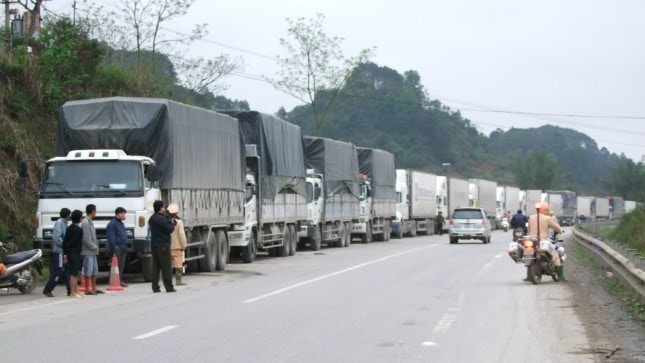 |
| Agricultural, forestry, aquatic, and mineral products are primarily exported through Chinese border crossings. In the photo: Thousands of trucks carrying agricultural products line up for tens of kilometers at Tan Thanh Border Gate (Van Lang District, Lang Son Province), waiting to be exported on March 25th. (Illustrative photo: PLO) |
There's no longer any need to hide it; we are now forced to acknowledge the truth: for a long time, our economy has been steadily declining, sinking deeper and deeper into a trajectory of dependence on the Chinese economy. Therefore, the challenge now is, after bravely confronting this truth, to demonstrate our resolve and be truly resourceful in finding a way out of this dependence – a concept that, to some extent, is synonymous with "economic de-China expansion." This is no simple matter, not something that can be accomplished overnight, and naturally, it requires accepting considerable difficulties and losses. Consequently, restructuring the economy towards genuine self-reliance is essential for sustainable development.
Moreover, we must be extremely vigilant to avoid a situation where misfortunes never come alone, and to avoid falling into new, unfavorable scenarios that may have been pre-programmed by malicious actors to destroy productivity, pollute the business environment, and weaken the economy, with the ultimate goal of forcing us to operate within their sphere of influence and dependence. The fact that we had to spend a considerable amount of money to compensate for the damage caused to businesses by some "protesters" in industrial zones in Binh Duong, Dong Nai, Ha Tinh, etc., is a major lesson. But from another perspective, that is actually only a small part of the story. It is quite possible that the more frightening phenomenon is the self-transformation and self- wavering, temporarily leading to a loss of direction for many industries and sectors that are currently strengths and priorities in many regions. Without timely guidance and solutions to address the precarious situation of some industries and professions, the abysses of losses and pitfalls of failure may be very close at hand.
Therefore, the urgent need now is to promptly assess and objectively understand what has happened and is happening, with the right orientation. This includes immediately answering pressing questions such as: Does "breaking away from China" mean that if China stops buying rice, we should destroy rice crops? If China stops buying rubber latex, should we simultaneously cut down rubber trees? If China stops buying minerals, should we abandon mines? If China closes its borders to raw materials for the textile industry, should we stop our textile production?... Is this "breaking away from China," or are we sinking deeper into a trajectory influenced by China, albeit in a different direction?
Isn't it true that if last time they came into our house, took our rice and firewood to cook, and then scooped up our pot of rice and took it home, this time they could simply "remove the firewood from the bottom of the pot" without much effort? Meanwhile, we, who have long been dependent, are now caught off guard, letting our rice go to waste or become mushy; and we are essentially throwing away our own rice pot when we desperately need it? This not only confuses workers and businesses, but also shows a clear lack of preparedness among leaders and managers.
While it's true that everything has its roots, the self-destructive acts of cutting down trees and ruining the business and production environment are nothing short of blindly following the roles and scenes written by those plotting to sabotage the Vietnamese economy. In the current difficult circumstances, we are now more clearly recognizing the gaps in responsibility and the void in the roles of many levels and sectors within the system of management and functional agencies that operate using taxpayers' money. The effectiveness of many agencies and organizations in supporting production and business over a long period of time will surely become clear if we look at their results.
A forest manager sadly confided: "Acacia trees will surely face difficulties, and rubber trees are unexpectedly struggling. Acacia only sells for wood chips or raw wood powder, and rubber only sells for granulated latex – these types of crudely processed export products can only be exported to China. When China closes its doors, naturally we have to look to markets in Europe, America, Japan, India... Sadly, while these markets still desperately need raw materials like iron and steel, wood, rubber, and rice, we can't export to them because they don't need to import semi-processed, raw materials of low quality. So we find ourselves in a situation where we have the potential to participate in other markets, but are forced to stay out because that potential hasn't yet become a resource or advantage."
Even more disheartening, we are left out of the game being played right on our home turf. When you go into a supermarket or store, you see an abundance of goods – steel, aluminum, plastic, rubber… – that we have to import at high prices. Yet, we still only exploit raw materials like iron, bauxite ore, rubber latex, wood chips… to sell at incredibly low prices. Tragically, the consumption of imported products – steel, aluminum, plastic, rubber, wood… – continues to boom. And yet, even selling the raw materials – steel, aluminum, plastic, rubber, and wood – that we produce ourselves still faces difficulties?!
From the familiar, yet still surprising and shocking, stories mentioned above, we are compelled to consider a shift in thinking towards "building high walls and opening wide doors." "Building high walls," first and foremost, means increasing investment in industrial development and processing technology, not only to refine raw materials for the European and American markets, but also to create a closed-loop production and processing system, from raw materials to finished products, capable of supplying the domestic market.
Along with that is the "opening up," which means expanding trade markets, cooperation, and promoting genuine trade development with all regions and economies. Breaking free from dependence and "building high walls" doesn't mean "isolating the country," but rather diversifying market types, which also means creating more business opportunities. And the more opportunities for cooperation and development, the less dependence there will be – that's the natural order of things. That's the true path to escaping dependence, the path to "breaking free from China" that aligns with current trends. And to open this path, as one National Assembly representative said, relevant agencies must be knowledgeable, the personnel assigned to the task must be competent, and most importantly, they must actually do their job.
Ngo Kien


