
Vietnamese motorbikes: If you want to survive... go abroad.
With declining domestic purchasing power and excess capacity, Vietnam's motorcycle industry is facing a difficult choice.
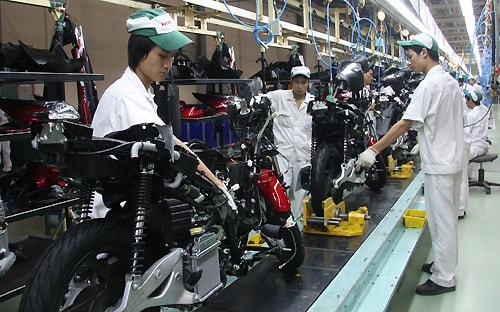 |
| Besides being the world's fourth-largest market, Vietnam is also a leading country in motorcycle manufacturing - Photo: Duc Tho. |
The "shirt" is too tight.
In 2011, total motorcycle sales across the market reached a remarkable 3.3 million units. Even at that time, many models were in high demand, becoming lucrative opportunities for distributors.
Even though the economy was deeply in trouble at the time, with its strong purchasing power, the Vietnamese motorcycle market was still considered fertile ground for manufacturers, especially foreign companies that had quickly entered the market through joint ventures with Vietnamese state-owned enterprises.
Since this period, many new motorcycle brands have entered the market, vying to capture untapped market segments. These include well-known brands such as Ducati, Benelli, Lambretta, and KTM... Among them, several businesses have been building and perfecting factories to conduct domestic production and assembly.
However, for the next two consecutive years, market demand began to decline significantly. In 2012, the total number of motorcycles sold across the market fell to 3.11 million units. According to statistics, the figure for 2013 dropped even more sharply, to approximately 2.8 million units. Of these, Honda remained the dominant brand with 1.87 million units, followed by Yamaha with 721,000 units, SYM with 500,000 units, Piaggio with over 56,000 units, and Suzuki with 50,000 units. The remainder belonged to other brands.
Over the past decade, the Vietnamese motorcycle market has never been considered unattractive. In fact, with an annual volume of around 3 million units, Vietnam has been and continues to be the 4th largest motorcycle market in the world after China, India, and Indonesia.
Clearly, the appeal is undeniable, and therefore, there's no reason why foreign motorcycle manufacturers shouldn't strive to grab every inch of market share.
However, despite its size, the "coat" seems to have become too tight. In June 2012, the total number of motorcycles in circulation nationwide reached 35.2 million. According to calculations by the Ministry of Industry and Trade and Japanese experts, with a population of 90 million, 35 million motorcycles would bring the Vietnamese market to a saturation point. Furthermore, the latest statistics from the Ministry of Transport show that by the end of 2013, the total number of motorcycles in circulation had climbed to 37 million, far exceeding the saturation point as calculated.
It should also be noted that, according to the transportation sector plan approved by the Prime Minister, the number of motorcycles in circulation in Vietnam will be limited to 36 million by 2020.
The world's "factory".
Having exceeded saturation and also surpassed the planned limits, it seems that the growth target for domestic consumption will no longer be achieved. Meanwhile, according to calculations, major players like Honda, Yamaha, Piaggio, and SYM are currently operating at over 50% excess capacity, with very large inventories at times.
Therefore, exporting is the inevitable choice and the ultimate goal for Vietnam's motorcycle industry now and in the future.
In fact, major car manufacturers in Vietnam have been considering exporting for about a decade now. Initially, their export activities have yielded encouraging results.
According to our research, in 2013, Honda Vietnam exported 40,000 complete vehicles to major markets such as the EU, Thailand, and back to Japan, primarily scooter models like the SH, PCX, SH Mode, and Lead. Piaggio also performed well, exporting over 30,000 vehicles. SYM has maintained exports of around 3,000-4,000 vehicles in recent years.
Besides being the world's fourth-largest market, Vietnam is also a leading producer of motorcycles. Therefore, it can be said that exports are not merely a temporary solution when the market is saturated, but rather the right direction. The Ministry of Industry and Trade recently set a target of approximately $1 billion in total motorcycle exports (including components, spare parts, and complete vehicles) by 2020. However, that target is likely still modest.
In recent years, major car manufacturers themselves have expressed hope and clearly stated their direction to focus production and development in Vietnam.
It is no coincidence that, in addition to expanding the production capacity of its two existing factories in Vinh Phuc, Honda has recently invested in building a third factory in the Dong Van Industrial Park (Ha Nam province) with a capacity of 500,000 vehicles per year.
Similarly, Piaggio, right from the start of its presence and factory construction in Vinh Phuc, clearly stated its ambition to make Vietnam a research and production center for exporting to the entire Asian market (excluding China), and moved its regional headquarters from Singapore to Vietnam.
Furthermore, according to an unofficial source, even another Italian car manufacturer, despite being relatively new to Vietnam, is planning to concentrate its production solely in Vietnam for export to the global market.
Regarding the discussion about enhancing the export capacity of the motorcycle industry, some experts have expressed concerns about the potential gains and losses, citing the reason that Vietnam does not yet have any 100% domestically produced motorcycle brands capable of doing so; all are foreign-owned companies operating through joint ventures and partnerships. "Therefore, if we only look at export figures without considering the localization rate, it's not certain that motorcycle exports will bring benefits to Vietnam," said one economic expert.
However, a thorough analysis reveals many benefits. Becoming a global manufacturing hub would create jobs for tens of thousands of highly skilled workers, expand research and training centers, and generate significant foreign exchange. Looking at currently exported models like Honda's SH and PCX, and some Piaggio models, with localization rates already reaching 60-90%, it's clear that an even greater benefit lies in the development of supporting industries, initially for motorcycles, then for the automotive industry, and even electronics and telecommunications.
Recently, the "big five" motorcycle manufacturers in Vietnam – Honda, Yamaha, Piaggio, Suzuki, and SYM – proactively established the Vietnam Motorcycle Manufacturers Association (VAMM). The organization's objectives clearly reflect the ambitions of the entire industry: connecting motorcycle manufacturers in Vietnam, applying advanced technology according to international standards, producing high-quality products, protecting the legitimate rights and interests of its members, and connecting businesses with state management agencies to contribute important opinions to promote the development of the Vietnamese motorcycle industry…
Perhaps this is a significant new step for Vietnam's motorcycle industry, aiming for a leading position in the world, and of course, exports are a major strength.
According to thoibaokinhte


