
Motorbike taxis into the village
(Baonghean) - Motorbike taxi drivers at street corners, intersections, and crossroads in the central districts of the highlands are no longer a strange sight to many people. However, the motorbike taxi profession in the highlands is not only popular in the district center and transportation hubs, but also in villages deep in the forests or in the middle of the Ban Ve hydroelectric reservoir, motorbike taxi driving is becoming a profession...
(Baonghean) - Motorbike taxi drivers at street corners, intersections, and crossroads in the central districts of the highlands are no longer a strange sight to many people. However, the motorbike taxi profession in the highlands is not only popular in the district center and transportation hubs, but also in villages deep in the forests or in the middle of the Ban Ve hydroelectric reservoir, motorbike taxi driving is becoming a profession...
During my first writing trips to the mountainous regions as an intern, I was amazed by the skills of the motorbike taxi drivers there. One time, I visited Khe Nong village in Chau Khe commune (Con Cuong district). It was called a village, but in reality, it was a production team from Chau Son village. This team, consisting of over 30 Dan Lai households, was located nearly 30 km from Chau Son village. Back then, before the border patrol road was built, the stretch of road from Khe Bu village to Khe Nong was a narrow, dangerous path that the highlanders called a "buffalo trail." The left side was a mountain slope, the right a deep ravine – extremely perilous. Yet, motorbike taxi driver Nguyen Van Dai from Chau Son village considered this his livelihood.
His customers are mainly teachers from remote villages like Khe Nong, border guards, and local villagers. On slow days, he sells kerosene, salt, dried fish, and pork to the villagers. He's been doing this for 10 years as a motorbike taxi driver, and he's managed to provide a decent education for his two children, one in middle school and the other in high school.
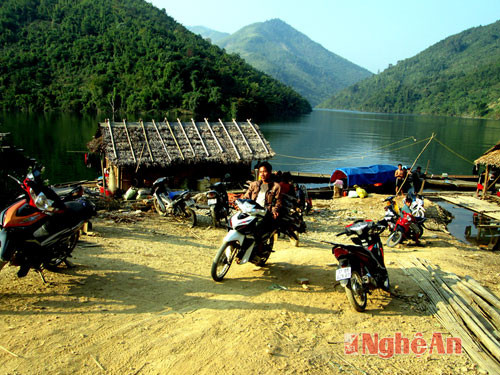 |
| Motorbike taxis wait for customers at the boat dock in Pủng Cà Moong village. |
He shared his "secret" to 10 years in the profession without any mishaps: "To drive confidently on some of the worst roads in the world, you first need to know how to choose a vehicle. It must be sturdy, have high ground clearance, and a powerful engine. You must not drink alcohol while driving. If you're drunk, you'll only fall off the motorbike on these roads. Another important thing is to understand the characteristics of each section of the road." To prove his skill and years of experience, the motorbike driver revved his engine, carrying me and all my belongings, and sped across a section of road barely wide enough for the motorbike wheels. Then, we continued climbing the hill for nearly half an hour before we finally covered the almost 10 km distance to reach Khe Nong village.
Before the Lunar New Year of the Year of the Horse, we visited Pủng Cà Moong village (Lượng Minh - Tương Dương). This Khơ mú village consists of 140 households who moved here in 2010 as part of the Bản Vẽ Hydropower resettlement project. Getting to the village from the Tương Dương district center requires two stages. First, you travel by car or motorbike to the upstream dock, then take a motorboat to the village's boat landing. From there, it takes another 20-minute motorbike ride to reach the village itself.
In the lowlands, mostly middle-aged people work as motorbike taxi drivers, but the motorbike taxi drivers at the dock in the middle of this lake are all young people, under 30 years old. The reason is that the roads are rough and winding along the edge of a ravine, so only those with steady hands, sharp eyes, and quick reflexes like these young people can handle the difficulties and dangers of the job. The visitors to Pủng Cà Moong village are quite diverse: officials from the district and commune, teachers from the local school, project staff building the national defense road, transient visitors, and villagers returning from long trips to the fields. The dock is always bustling with customers...
After quoting the price from the boat dock to the village, Mr. Lo Van Thanh added to me and my journalist friend: "You two can share one motorbike to save money. Here, the price is the same whether you carry one or two people." After some hesitation, we each got on separate motorbikes for safety. As Mr. Lo Van Thanh drove me, he shared stories about his profession. Since moving to the resettlement area far from the forest and fields, the land around the village has been under the management of the district's protective forest management board. Young people in the village have flocked to find work outside.
Having started a family, Mr. Thanh wanted to stay home and focus on his work. He asked his parents for some of the compensation money from the hydroelectric project to buy a motorbike to use for transportation from the boat dock to the village. After three years, he had to replace the motorbike three times. According to Mr. Thanh, the roads are too difficult and there are no mechanics, so the lifespan of the motorbikes he buys is usually very short. The market is far away, and each liter of gasoline costs over 30,000 dong, but the villagers are economically disadvantaged and cannot charge as much as in the town. "The worst part is when the motorbike breaks down. We have to take the motorbike on the boat to the hydroelectric dam to find a mechanic." However, for Mr. Thanh, motorbike taxi driving is a fairly stable job, earning 200,000 to 300,000 dong per day, which helps him cover his expenses.
Another noteworthy point about motorbike taxi drivers and passengers in remote villages is that hardly anyone pays attention to wearing helmets. When asked why no one wears a helmet, some drivers quickly replied, "The traffic police don't come here to work, so don't worry." It turns out that for them, wearing a helmet is just a way to avoid being fined by the authorities. However, motorbike accidents are a common occurrence.
On my first visit to Pủng Cà Moong village, I had an unforgettable experience. While engrossed in conversation, the motorbike suddenly lost control; the driver had forgotten to ease off the throttle while downshifting. The motorbike lunged forward like a wild horse, nearly throwing both the passenger and the driver into the abyss. According to Mr. Thành, this is an "everyday occurrence" here. Only occasionally do a few people ask about helmets. Even the motorbike taxi drivers at the boat dock don't have helmets because they rarely ride their motorbikes to the district center...
Huu Vi