
Shovels used to sift sand on Cua Lo beach.
(Baonghean)On the beach, I encountered a sanitation worker from the urban environmental sanitation company swiftly pressing a shovel into the sand. When she lifted it up, it wasn't sand, but a pile of seashells, peanut shells, and crab shells. Curious, I inquired and learned that this was a tool invented by the people of Cua Lo to replace the broom used for sweeping trash on the beach.
Along with the "5 No's" policy, over the years, Cua Lo has been trying every way to maintain the cleanliness of the marine environment, especially the beaches. In 1996, the town spent billions of dong importing sand screening machines from France. The advantage of the machine is that it screens quickly and removes all trash, but because it is large, it cannot reach the areas around the stalls. This is especially true around the area where tourists rest under umbrellas after swimming. This is the most polluted area due to waste discarded by tourists during meals. To address the sanitation problem in this area, in 2007, the enterprise came up with the idea of using rakes to collect the trash. However, only about one-third of the trash was collected. Smaller pieces of trash that slipped through accumulated in the sand over time, leading to increasingly serious pollution risks.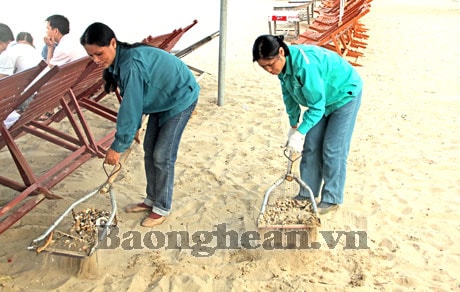
Workers from the Cua Lo Town Environmental Sanitation Enterprise use shovels to sift sand.
Struggling to find a definitive solution, one morning in early May 2012, Ms. Hoang Thi To, Director of the Cua Lo Environmental Sanitation Enterprise, along with her staff, were collecting garbage on the beach when they saw a man experimenting with a handheld sand sieve. Curious, everyone gathered around to watch. After a moment of hesitation, Ms. To asked to borrow one and tried it herself. Seeing its effectiveness, she requested five more from the company, and they proved successful. To date, the entire enterprise has been fully equipped with these tools. Since acquiring the sand sieves, the sanitation workers' jobs have become easier, and productivity has tripled.
Ms. Thu, a worker at the factory, said that Mr. Nguyen Trong Linh invented this tool. He was involved in the tourism business here and noticed the increasing amount of trash mixed in the sand at the beach, especially in areas where tourists sit and eat. He was always concerned about how to thoroughly collect the trash in these areas. He immediately thought of a handheld tool like a broom that could "sweep" deep into the sand to remove all the trash. From that idea, he used wire mesh, water pipes, and saw blades to create the "shovel." The sheet metal blade of the "shovel" was replaced with wire mesh so that when scooped up, the trash in the sand would settle on the surface of the mesh. For sandy soil, this "shovel" is extremely effective.
Mr. Phung Ba Thao, residing in Block 1 and owning a business stall in the beach area, received a shovel as a gift from Mr. Linh. He said: "Every morning, just 10 minutes of 'sieving' is enough to clean the area around my stall perfectly, not a single peanut shell or seashell left... I suggest the town plan to expand the use of this tool, so that each stall has a shovel for cleaning its area. In our opinion, this is not difficult because a shovel costs between 120,000 and 180,000 VND (depending on the material). This is not a large sum of money compared to the effectiveness it brings."
Mr. Tuan


