
Heartbreaking "sweet salt"...
Hundreds of salt farmers in Dien Ngoc commune (Dien Chau district) have suddenly had to abandon their lifelong salt-making profession because their salt fields have become saline. Without salt production, the farmers have to find other ways to make a living, and their greatest wish now is for the salt fields to be converted to other uses so they can quickly stabilize their lives.
(Baonghean)Hundreds of salt farmers in Dien Ngoc commune (Dien Chau district) have suddenly had to abandon their lifelong salt-making profession because their salt fields have become saline. Without salt production, the farmers have to find other ways to make a living, and their greatest wish now is for the salt fields to be converted to other uses so they can quickly stabilize their lives.
In early June, under the intense summer sun, salt farmers in many localities enter their peak production season. But for the salt farmers of the Hai Thuong Salt Cooperative in Dien Ngoc commune, Dien Chau district, this is the third season they have had to leave their traditional salt-making profession. Having abandoned their main occupation, 335 salt-farming households living in the three hamlets of Trung Yen, Hong Yen, and Truong Tien are struggling to find a solution to their daily livelihood problems as more than 30 hectares of salt fields (an average of 1,000 square meters per household) belonging to the cooperative have been left fallow for the past three years. Leading me on a tour of the salt fields, Mr. Nguyen Xuan Ty, the chairman of the cooperative, couldn't help but feel sorrow and regret as he recalled the time when the salt-making profession wasn't as harsh as it is today. The cooperative was established in 1967; during the war and the period of state subsidies, all the salt produced by the cooperative members was supplied to the State for distribution. At that time, the salt farmers felt secure and enthusiastic about continuing their profession. By 1989, with the transition to a market economy, salt farmers in the cooperative produced salt on a self-sufficient basis until 2010-2011, when they completely stopped production due to the salt becoming too sweet and the yield being too low.
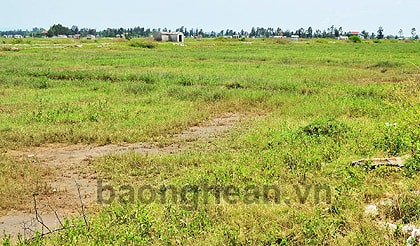
The salt fields in Dien Ngoc (Dien Chau) have been abandoned.
Before me lay 31 hectares of abandoned salt fields belonging to salt farmers. Salt storage facilities stood desolate beside the fields, now overgrown with lush green grass. Instead of the image of hardworking salt farmers toiling during the production season stretching from March to May (lunar calendar), the salt fields had become an ideal place for carefree children tending cattle and flying kites. When asked about the reason for the abandoned salt fields, Mr. Ty sighed: "In recent years, the water supplied to the fields has become freshwater and polluted due to the influence of the Bung River. As a result, salt yields are much lower than before, and coupled with extremely volatile market prices, it's impossible to make a living."
At the end of 2011, all the villagers had to stop salt production, and the already difficult lives of the salt farmers became even more challenging. Following Mr. Ty's directions, I went to the house of Mr. Vu Le Tho, the head of Hong Yen hamlet, a veteran salt farmer who had been making salt since 1986 until he was forced to stop completely in 2011. Mr. Tho said: "Previously, nearly 70 households in Hong Yen hamlet were involved in salt production. Although it was hard work, the people were all secure because they had a source of support to take care of their lives. When salt production stopped, most households had to find other jobs, from making rice paper and rice noodles to working as bricklayers, to make a living."
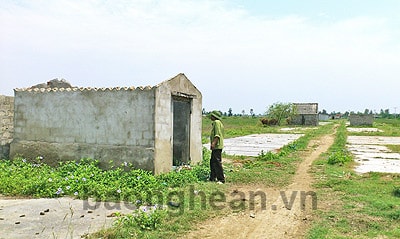
The salt storage facility stands isolated beside the abandoned salt fields.
For Mr. Tho's family, since they stopped salt production, their livelihood has depended entirely on making rice paper. The income from making rice paper is more stable than salt production, but having spent almost their entire lives working in the salt industry, the "blood of the trade" is deeply ingrained in their minds and thoughts. During our conversation, I could clearly sense the regret emanating from his words and gestures. "Salt production used to be the main occupation for all of us. Before, our lives depended entirely on it; making rice paper was just a side job. But now, the whole family relies on this side job for our livelihood," Mr. Tho sighed, then helped his wife dry a batch of rice paper in the sunny courtyard in front of their house. His hands, stained with the salt, were still strong and nimble!
The concerns of salt farmers in Dien Ngoc are also a worry for local authorities and management at all levels. Faced with this situation, Mr. Nguyen Xuan Ty suggested: "We hope that relevant levels and sectors will soon have a plan to convert the entire salt field area for other purposes. This will prevent land waste and provide the people with additional compensation to transition to new occupations." Mr. Nguyen Van Hoa, Secretary of the Party Committee and Chairman of the People's Council of Dien Ngoc commune, stated: "We have submitted a proposal to the district requesting the conversion of this area to other purposes and are awaiting guidance on how to resolve the issue. Several factories and companies have also come to inquire and offer compensation to the salt farmers for land use to support production and business. The local authorities are eager to have a plan to convert the land use soon so that the people can wholeheartedly transition to more stable occupations."
Hopefully, the authorities at all levels will find a solution to address the aspirations of the Hai Thuong Salt Cooperative soon and satisfactorily, so that the salt farmers can quickly stabilize their lives after leaving the salt industry.
Text and photos: Thanh Duy


