
Dealing with pesticide residue hotspots: A difficult task!
(Baonghean) - In order to limit the impact of pesticide residue on people's health, nearly 20 heavily polluted sites in the province have been treated recently. However, due to a lack of funding and inadequate technology, the results have not been very effective.
(Baonghean) - In order to limit the impact of pesticide residue on people's health, nearly 20 heavily polluted sites in the province have been treated recently. However, due to a lack of funding and inadequate technology, the results have not been very effective.
We returned to Dien Yen (Dien Chau district) nearly a year after the pesticide storage facility in the Hon Tro area was decontaminated. Although the old pesticide storage facility no longer had the pungent smell it had when it was first decontaminated, the scene remained desolate. Mr. Le Quang Hao, head of Hamlet 15, said: "The pesticide storage facility has been here for nearly 40 years. From the early 1990s until now, it has been abandoned and no longer in use. However, the impact of pesticides in the area is still very significant. Especially the pesticides from the time the new facility was built, which had no proper storage place, were haphazardly left outdoors, and rainwater seeped into the ground. In 2013, the national target program allocated funds to treat the residue. However, besides removing about 3,000 cubic meters of soil in the affected area, no other solution has been implemented."
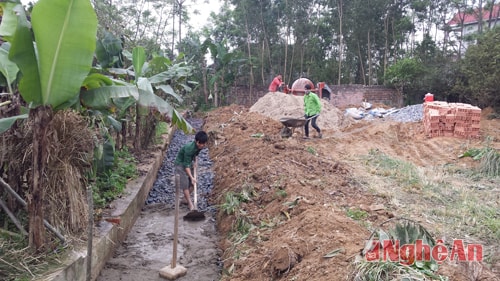 |
| Addressing pesticide residue in Mau 2 hamlet, Kim Lien commune, Nam Dan district. |
According to the initial plan, the handling of the pesticide storage facility in Hon Tro was divided into two phases: the first phase involved collecting, packaging, and isolating the pesticides; the second phase involved constructing facilities to mitigate the risks of POPs (Polluted Plant-Based Chemicals) to treat and prevent environmental pollution and improve the living environment for people in the contaminated area. However, to date, the treatment has only progressed to the point of excavating and removing the old soil. Even the heavily contaminated soil is being packaged and stored in a warehouse by the construction unit instead of being properly buried. Speaking with us, Mr. Nguyen Duc Chau, Vice Chairman of the Dien Yen Commune People's Committee, said: "The people are asking why the treatment isn't thorough, and we don't know how to answer. When the project was implemented, the commune only provided support in informing and educating the people; all the procedures were handled by the investor. We also couldn't arbitrarily excavate and dispose of the soil because we didn't know where to dump it." Furthermore, this is the responsibility of the construction unit; the handling of pesticides must follow the correct procedures and be done in the designated locations. I heard that the unit is waiting to gather more at another location in Nghia Dan before processing everything there.
Mau 2 Hamlet, Kim Lien Commune, Nam Dan District, was a center for mixing and distributing pesticides during the years 1964-1968. Over the years, the level of pollution has not decreased but has actually spread further. In response to this situation, in 2009, the Department of Natural Resources and Environment implemented a project titled "Project to address pesticide pollution levels in Mau 2 Hamlet, Kim Lien Commune," with the Center for Application of Advanced Science and Technology undertaking the remediation of this polluted area. However, after some time, several components of the project were damaged, including a broken filter system that frequently leaks water, making it difficult to control the inflow and outflow of water. A fence surrounding the polluted area was built, but it is too low to prevent children and livestock from entering; some sections of the fence have been damaged, allowing rainwater to overflow and overload the activated carbon filter. The filtration and drainage system is transformed into a septic tank for wastewater and rainwater from the surrounding area.
Due to the initial failure of the remediation efforts, the project's second phase has attracted significant attention from local residents. Ms. Nguyen Thi Phuong, a household affected by the pesticide storage facility's pollution, stated: "The construction unit did not follow the design procedures correctly, and after completion, they failed to assign supervisory and protective responsibilities, leading to rapid deterioration... Therefore, residents hope that in this second phase, the lead unit will seriously implement the remediation plans, closely monitor the process, and establish a protection mechanism after the project is completed." Mr. Nguyen Hong Son, Chairman of the Kim Lien Commune People's Committee, also expressed his wish: "Because the affected area is close to residential areas, relocating residents is impossible. Therefore, the commune government and residents hope for a thorough remediation to prevent any impact on people's lives and health..."
The province currently has 913 locations with pesticide residue, of which 277 have been investigated and analyzed for pollution levels, with 189 locations causing serious and extremely serious environmental pollution requiring thorough remediation. In the past, with support from foreign projects and some projects under the National Target Program, some locations affected by pesticide residue have been treated. However, many locations have been treated multiple times but remain ineffective, such as the locations in Nghia Trung (Nghia Dan), Vuc Rong (Tan Ky), and most recently, the location in Long Son commune, Anh Son district. According to feedback from most residents, the reasons for the incomplete remediation are: failure to adhere to proper procedures; in some places, the construction units did not follow the design specifications closely; the works were of poor quality, unfinished; and there was a lack of post-completion supervision.
Discussing this issue, Mr. Bach Hung Cu, Deputy Head of the Plant Protection Sub-Department, frankly stated: It is difficult to completely eliminate pesticide residue sites. Firstly, there is a lack of funding. Currently, according to the general policy of the Government, the State only supports 50% of the cost for each pesticide residue treatment site, with the remainder coming from the provincial budget. However, due to the limited provincial budget, the treatment process faces many difficulties. In addition, the technology for treating pesticides is not yet adequate; each residue site has a different type of chemical, and each region has different soil conditions, so a general treatment method cannot be applied... Faced with this situation, at the end of 2013, the Provincial People's Committee sent a letter to the Ministry of Natural Resources and Environment requesting an increase in funding support, averaging 80%. Along with that, it is necessary to quickly develop a process for investigation, assessment, and pesticide treatment technology to find effective solutions. Priority should be given to addressing heavily polluted areas and exposed areas; for areas near residential zones, relocation solutions are necessary to ensure the health and safety of residents.
Text and photos:My Ha


