
Rural waste management: a comprehensive solution is needed.
(Baonghean) - Waste collection and treatment, and improving the rural environment are important criteria in the national set of criteria for building new rural areas. However, currently, rural waste is becoming a challenging issue in environmental protection, economic, cultural, and social development in many localities in the province.
(Baonghean) - Waste collection and treatment, and improving the rural environment are important criteria in the national set of criteria for building new rural areas. However, currently, rural waste is becoming a challenging issue in environmental protection, economic, cultural, and social development in many localities in the province.
Waste becomesproblem
Walking along the coastal communes of Dien Chau district such as Dien Hung, Dien Hai, Dien Kim, Dien Bich, Dien Thanh, Dien Thinh… we can easily see garbage everywhere. With limited land and a large population, the amount of household waste generated daily by residents in these communes is enormous, and most of it is dumped indiscriminately in vacant lots, canals, and especially along the concrete coastal road connecting the communes. Many people traveling along this road are "tortured" by the foul smell of garbage. The tourist beach of Dien Thanh, along with Thoi and Van creeks, and Dien Ngoc fishing port… are clogged with accumulated waste, causing blockages in the waterways.
The ever-growing garbage dumps stretching along the coastline not only detract from the aesthetics of the villages but also seriously affect water and air quality, posing a risk of disease outbreaks. Mr. Le Van Thuan, Head of the Department of Natural Resources and Environment of Dien Chau District, stated: “Since 2011, the Department of Natural Resources and Environment has advised the District People's Committee to issue numerous documents requesting communes to raise awareness of environmental protection, address the issue of indiscriminate waste dumping, and establish separate centralized waste disposal sites. However, due to the limited environmental awareness of the people and the lack of active involvement from local authorities, the situation has not improved.”
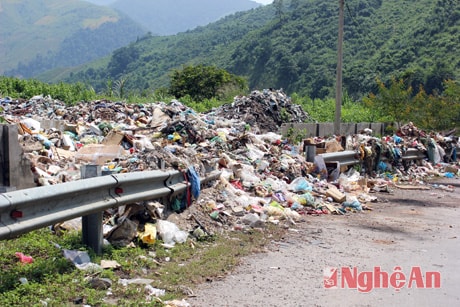 |
| Garbage is overflowing onto National Highway 7 (near Muong Xen town, Ky Son district). |
In Quynh Luu district and Hoang Mai town, along the Mai Giang river, Quen stream, and coastal areas, garbage is everywhere. Although some communes have designated garbage collection points, they quickly become overloaded. Not only in coastal areas, but also in the communes of Quynh Van, Quynh Tan, Quynh Thach, Quynh Hau, Quynh Hong, and Cau Giat town, waste is ubiquitous. Because there are no specific guidelines or regulations on waste disposal from local authorities, each household handles its waste in its own way. The most common method is to throw it wherever it can be. Seeing others dump their waste, people join in, resulting in the formation and expansion of spontaneous garbage dumps in both area and height.
For example, at Ngạn slope, bordering the two communes of Quỳnh Văn and Quỳnh Tân, an illegal dumpsite formed more than a year ago has now grown to almost head height, teeming with flies, rats, and insects. Mr. Hồ Ngọc Dũng, Vice Chairman of the Quỳnh Lưu District People's Committee, stated: “Although the Ngọc Sơn landfill, covering over 5 hectares, is now operational and collects approximately 30-40 tons of waste daily, it still cannot meet the demand. It is estimated that the entire district generates about 80-100 tons of household waste daily. The current rural waste situation in the district is becoming increasingly critical.”
In the districts of Hung Nguyen, Nam Dan, Nghia Dan, Thanh Chuong, and Do Luong, rural waste management is a pressing issue. It's easy to see that along the left bank of the Lam River, running through the communes of Hung Linh, Hung Long, Hung Khanh, Hung Lam, Hung Nhan, etc., garbage is piled up, emitting a strong, foul odor. Mr. Nguyen Van Thuong, from Hung Long commune, said: “To hire a garbage truck, each person has to pay 3,000 dong per month. However, the truck only comes to collect the garbage once every 10 days, so the garbage piles up, causing serious pollution. Households living near the garbage dump have to keep their doors and windows tightly closed all day to avoid the stench entering their homes.”
Con Cuong, one of the mountainous districts with the greatest tourism potential in our province, currently lacks a landfill. Without a waste collection service, garbage is dumped everywhere by residents. Along National Highway 7, in the town area or under bridges, garbage and rocks are piled up in heaps. Mr. Nguyen Huy Chuong – Head of the Culture and Information Department of Con Cuong District – said: “Recently, the district approved the Project “Construction and Development of Tourism in Con Cuong District giai đoạn 2013 - 2015”, focusing on the development of ecotourism. However, to effectively implement the project, one of the urgent issues that needs to be addressed is household waste. Although the district's population is not large, in the long run, without a landfill and treatment facility, garbage will be everywhere, affecting the tourism environment. However, the difficulty remains the funding for building a large-scale, centralized landfill.”
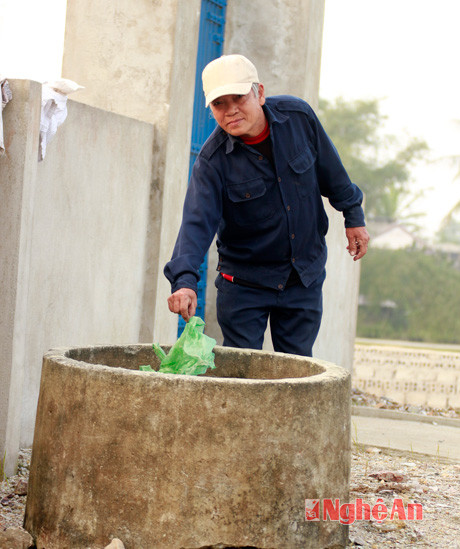 |
| Household garbage bins in Hung Tien commune. |
Multiple modelsefficient waste collection
While many localities are struggling to manage waste, some communes have adopted innovative and effective methods to minimize environmental pollution. A prime example is Nam Xuan commune, one of the vegetable-growing communes in Nam Dan district. Previously, like many other localities, waste management was a major problem due to residents' habit of indiscriminately dumping garbage along canals, fields, and ponds, causing unsightly village landscapes and environmental pollution. To address this, in 2012, the People's Committee of Nam Xuan commune built a centralized waste disposal site covering 1,500 square meters, with a total investment of over 140 million VND. The commune also supported the construction of 1,532 new two-compartment waste pits for households (accounting for 95% of households). 166 concrete waste bins were constructed and placed in convenient locations, alongside main roads leading to the fields, to make it easy for people to dispose of used bottles and pesticide containers from agricultural production.
Organizations such as the Farmers' Association, Women's Association, and Youth Union are stepping up propaganda and mobilization efforts to encourage people not to throw garbage and animal carcasses into ponds, lakes, and canals, and to consciously collect and dispose of used pesticide packaging in designated garbage collection bins. After collecting garbage in these bins, each hamlet assigns people to transport the waste to the commune's waste collection site for disposal. Mr. Nguyen Sy Tan from Hamlet 4, Nam Xuan Commune, said: "Since the garbage collection bins were built, the fields, village roads, and alleys have become cleaner, and conflicts related to garbage have also disappeared."
A waste collection model in Hung Tien commune (Hung Nguyen district) is considered highly effective. With over 700 households and 3,100 inhabitants, the amount of waste generated daily by the people of Hung Tien is quite large, approximately 3-4 tons. While the commune lacks a centralized landfill and waste collection services, to prevent environmental pollution caused by waste, since 2008, households in Hung Tien have adopted a highly effective method of waste management at home. Each family digs pits for waste storage or, if they have the means, builds waste tanks. Waste is collected in these pits and tanks and sorted at the source. Biodegradable waste is buried and used as fertilizer in production; non-biodegradable waste such as glass bottles, nylon, plastic, etc., is collected and deposited in a designated area by the commune. After 5 years of implementation, the household waste management model of Hung Tien farmers has given the commune a new look. While other localities, especially the border areas between different communes, are overwhelmed with uncontrollable amounts of waste, in Hung Tien, the village roads and alleys are clean and tidy, and the living environment has improved significantly.
Besides the initiatives launched by the government, with the involvement of mass organizations, especially women's groups, waste collection and sorting in some localities has been quite successful. For example, in Tan Phu commune (Tan Ky district), since August 2011, the Women's Association has established a club called "Waste Sorting at Source and Reducing the Use of Plastic Bags". Members of the club receive training and knowledge from Women's Association officials on how to properly sort and process waste. To date, the club has had a truly positive impact on the awareness of the women. Most women in the commune now use containers such as baskets and trays instead of plastic bags when shopping; they know how to sort waste at home and have become active advocates, encouraging family members and neighbors to participate.
In Do Luong district, under the leadership of women's associations at all levels, waste collection teams have been established in each village and hamlet. Each household voluntarily contributes 4,000 VND per month to pay the collection team. In addition, the two weekend days are designated as environmental sanitation days for each hamlet. Women sweep village roads and alleys, clear drainage ditches, and collect household waste at the end of each alley for the collection team to transport to the commune's central waste disposal site. To date, the entire province has dozens of "Women and the Environment" clubs and hundreds of "Self-managed Waste Collection" women's groups. Through these models, women's associations at all levels have contributed to raising awareness among members and the community to participate in environmental protection; gradually forming civilized habits and behaviors, thereby contributing to the completion of criteria for new rural development.
A coordinated effort is needed.
From the effectiveness of the above models, it can be seen that wherever local authorities and organizations actively participate, the environmental hygiene awareness of the people is raised, limiting the indiscriminate dumping of garbage that causes widespread pollution. However, currently, many communes do not really pay attention to environmental sanitation as well as the management of rural waste collection and treatment. Therefore, according to Mr. Ho Ngoc Dung - Vice Chairman of the People's Committee of Quynh Luu district, communes need to direct hamlets to publicly implement environmental sanitation regulations, take measures to penalize households that violate them, and at the same time allow households to monitor each other and mobilize each other to protect the environment. On the other hand, in the planning of new rural construction, communes need to allocate a certain area for garbage collection and disposal within hamlets; contract with local environmental cooperatives or environmental service companies to collect inorganic waste and transport it to the district or provincial landfill for treatment.”
Meanwhile, Mr. Dang Anh Dung – Permanent Deputy Secretary of the Thanh Chuong District Party Committee – suggested: “Every week, localities should organize a “Environmental Sanitation Day” to conduct a general cleanup, cleaning the surrounding environment, especially village roads and alleys. Areas with a lot of waste must be collected and transported to processing facilities. Furthermore, in the work of waste collection and environmental sanitation, districts should establish a few model communes; each commune should establish a few model hamlets; and each hamlet should establish a number of model families to replicate on a wider scale. In considering the recognition of cultural families and cultural hamlets, the criteria for environmental sanitation should be seriously considered. Organizations need to strengthen propaganda to raise awareness of environmental sanitation among their members, considering maintaining environmental sanitation as a criterion for evaluating and ranking branches and members at the end of the year.”
Mr. Ho Si Dung, Head of the Environmental Protection Sub-Department (Department of Natural Resources and Environment), stated: "We can easily see that the authorities and organizations in many localities are still struggling with environmental protection in general, and waste collection and treatment in particular. The dissemination of information to the public about environmental protection awareness, as well as the implementation of inspection and penalty measures for littering, remains limited. Many localities have included environmental sanitation as a criterion for evaluating the title of 'Cultural Family,' but it seems this criterion is often overlooked during the review process. Some localities have planned for a common waste disposal site, but transporting waste from individual residential areas to the site remains a difficult problem due to the lack of specialized vehicles. Furthermore, many waste collection points are organized improperly, causing localized pollution." Meanwhile, the socialization of waste collection and treatment has not been effectively implemented: private waste collection facilities have not yet been established; the collection of environmental sanitation fees in rural areas still faces many difficulties… Some districts such as Quynh Luu, Thanh Chuong, Tan Ky… have waste collection service units, but waste collection is only carried out in the town and neighboring communes.
According to Decision No. 494/QD-UBND.DTXD dated February 4, 2013, of the Provincial People's Committee on approving the solid waste management plan in the province until 2020, the province aims to build 15 centralized solid waste treatment facilities by 2015 and 15 by 2020. Therefore, in the coming period, districts without approved solid waste landfills should urgently construct and put them into operation; those without approved projects should expedite site selection and investment project planning. To overcome financial difficulties, the People's Committees of districts, towns, and cities need to implement social mobilization policies to attract individuals and organizations to participate in the collection and treatment of solid waste throughout the province.
Currently, several domestic and foreign companies and corporations have invested in local solid waste treatment projects, which have been approved by the Provincial People's Committee. These include Costruct Company from Italy investing in Thai Hoa town; Tien Thinh Joint Stock Company in Quynh Luu; and Trung Viet Joint Stock Company in Hung Nguyen… This is a positive sign for solid waste treatment in general and rural waste treatment in particular. It is hoped that with the coordinated and active involvement of all levels of government, departments, and organizations, the issue of waste treatment and environmental sanitation in rural areas will improve, allowing people to focus on economic, cultural, and social development, and promoting the construction of new rural areas.
Minh Quân - Triều Dương


