
Initial management of malaria threatening malignancy.
To help reduce the number of unnecessary malaria patients being admitted to higher-level hospitals, a tiered malaria treatment system is essential to ensure this requirement is met. It also helps healthcare facilities at all levels, especially lower-level facilities, to proactively manage and treat patients with early signs of malaria before transferring them to higher-level facilities, thereby reducing mortality. How to identify these signs?
To help reduce the number of unnecessary malaria patients being admitted to higher-level hospitals, a tiered malaria treatment system is essential to ensure this requirement is met. It also helps healthcare facilities at all levels, especially lower-level facilities, to proactively manage and treat patients with early signs of malaria before transferring them to higher-level facilities, thereby reducing mortality.
How can we identify them?
For rural health workers, patients with malaria must be closely monitored. If any of the following signs are indicative of severe malaria, such as mild, transient disturbances of consciousness with symptoms of lethargy, delirium, or restlessness; persistent high fever; gastrointestinal disturbances with symptoms of frequent vomiting, dehydration due to diarrhea, and acute abdominal pain; severe headache; or severe anemia with symptoms of pale skin and mucous membranes, the first dose of the dihydroartemisinin-piperaquin combination drug (brand names: arterakine, CV artecan) should be administered immediately, and the patient should be transferred to a higher-level medical facility. It is important to note that the drug must be finely ground and completely dissolved in cooled boiled water. Before administering the medication, the patient should be given a small amount of water to test; only if the patient does not choke or vomit should the prepared medication be given.
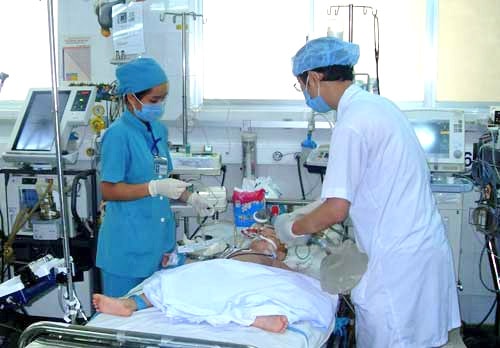
An emergency case involving the treatment of a malaria patient at Children's Hospital 2, Ho Chi Minh City.
For commune, ward, and town health stations, as well as private medical facilities, patients must be closely monitored to detect the warning signs of severe malaria mentioned above. When a patient shows warning signs of severe malaria, the first dose of artesunate or quinine hydrochloride should be administered immediately if the patient is a pregnant woman in the first trimester; then the patient should be immediately transferred to a higher-level facility. Note that artesunate should not be administered to pregnant women in the first trimester unless quinine is unavailable. If the transport time exceeds 8 hours, the next dose should be administered as prescribed in the treatment protocol.
How to use specific injectable medications for treatment.
Currently, injectable artesunate is supplied to commune, ward, and town health stations by the National Malaria Control Project, making it convenient for initial treatment of patients showing signs of severe malaria before referral to higher-level facilities. The injectable artesunate comes in 60mg powder vials, with dosage based on body weight: an initial dose of 2.4mg/kg; followed by a booster dose of 1.2mg/kg at the 12th hour if the patient is transported to a higher-level facility over a long distance. The 60mg artesunate powder is mixed with 1ml of 5% sodium bicarbonate as a solvent (included with the vial). Shake well until the artesunate powder is completely dissolved and the solution is clear; then add 5ml of 0.9% sodium chloride for intravenous injection. The addition of 5ml of 0.9% sodium chloride is to ensure accurate dosage for pediatric patients. If intravenous injection is not possible, intramuscular injection is possible. Simply mix artesunate powder with 1 ml of 5% sodium bicarbonate, shake well until the artesunate powder is completely dissolved, and then inject intramuscularly.
Quinine hydrochloride and quinine dihydrochloride are currently rarely available in healthcare facilities, especially at the lower levels, due to low usage and limited production by the pharmaceutical industry. If available, these medications can be used as prescribed. Quinine hydrochloride comes in 500mg ampoules and is administered intramuscularly with an initial dose of 10mg/kg body weight; a repeat dose of 10mg/kg body weight should be given after 8 hours if the patient's travel distance to a higher-level facility is too far. Note that the total daily dose should not exceed 30mg/kg body weight.
Quinine dihydrochloride, available in 500mg ampoules, is diluted with 0.9% sodium chloride or 5% glucose solution for intravenous infusion at a dose of 20mg/kg body weight over the first 8 hours; after 8 hours, continue infusion at a dose of 10mg/kg body weight if the patient's travel distance to a higher-level facility is too far; the total daily dose should not exceed 30mg/kg body weight. Caution is needed regarding the potential for abscess formation when injecting quinine dihydrochloride intramuscularly, as it can easily cause abscesses. Intravenous administration of quinine dihydrochloride can easily lead to hypoglycemia and cardiovascular collapse due to rapid infusion rates.
Recommendation
Currently, the number of deaths from severe malaria in many localities has been controlled and reduced, with some areas even experiencing no malaria-related deaths for many years. However, this has led to complacency, resulting in some patients with severe malaria going undetected and untreated, leading to fatalities; especially those with imported malaria from other areas. To prevent severe malaria from causing deaths, appropriate initial detection and treatment are crucial from the moment patients show warning signs of severe malaria. On the path towards eliminating malaria in the future, three basic goals need to be achieved: no deaths, no outbreaks, and a reduction in the number of cases annually.
According to SK&ĐS-(MĐ)


