
Mr. Ngo's shipyard
(Baonghean)Right next to Quen creek, at the confluence of the Mo and Thai rivers, at the Quynh Nghia estuary (Quynh Luu district), there is a shipyard named Ho Van Ngo. The dedication, meticulousness, and responsibility of each worker create a source of pride for the people of this coastal region...
One day in early March, our reporting team went on a field trip to the Quỳnh Lưu coastal area. In the late spring sunshine stretching across the riverbank, we saw the hunched backs of the shipbuilders at the shipyard of Mr. Hồ Văn Ngò, in Hamlet 4, Quỳnh Nghĩa Commune. Upon entering the shipyard, we immediately encountered the shipbuilders having lunch. After the simple invitations from the shipbuilders, one kind-faced, cheerful shipbuilder said, "We shipbuilders live together like family; we're used to calling ourselves the 'shipbuilder family'."
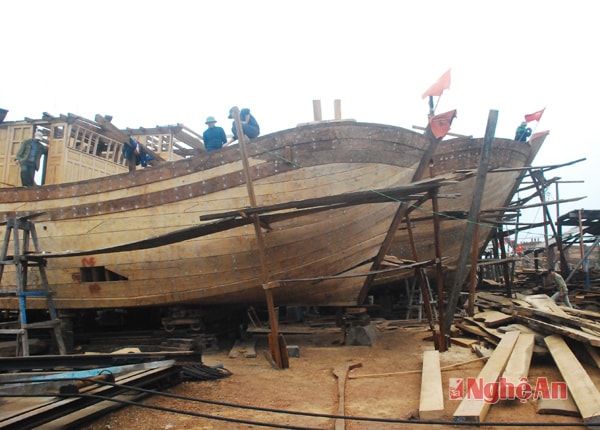 |
| The 750CV boats at Mr. Ngo's shipyard are preparing for launch. |
The shipbuilder from Quynh Tho, Nguyen Van Minh, told us that the shipbuilders here are mainly from the communes of Quynh Tho, Quynh Nghia, and Quynh Tien, with Quynh Tho being the most numerous. They are genuine fishermen and farmers; to join, they must at least know how to use a plane and a saw… and one principle is to obey all assignments from the boss. Shipbuilding is busy, and those who live far away may only return home to visit their wives and children once a month. The fishing boat building profession requires high precision for the boats to be good and safe, so those who recruit must know the abilities of each worker to assign tasks. Each person is responsible for a specific task: sawing wood, pulling slipways, bending hulls, drilling pegs, planing… Everyone is passionate, persistent, and devoted to the profession. For the main workers here, this profession is like "in their blood," difficult to leave.
Because they lacked the opportunity to venture out into the open sea, they could only entrust their love and faith in the ocean through their ships, hoping they would be strong enough to withstand storms and tempests. After some investigation, we learned that Minh was the one entrusted with the most arduous task by Mr. Ngo, the one who would "join the ranks." Minh's responsibility was to daily assign tasks to each worker. To earn the boss's trust, one had to be a skilled, loyal, and passionate craftsman. Minh is the third generation in his family to build fishing boats. At just 10 years old, he followed his grandfather to build boats in the area. He vividly remembers that as a child, every morning he would see his grandfather wake up at dawn, carrying a saw and chisel, and only return late at night. Once, he followed along and saw his grandfather and others launching a boat amidst the applause and cheers of the boat builders and villagers. A burning passion surged within him: to become a boat builder. That dream came true; after graduating from the village school, he followed his grandfather to build boats and became a boat builder in the 1990s.
Mr. Minh shared: "Shipbuilding is hard work, busy, and often involves exposure to sawdust and the noise of machinery. The important thing is that if you love the job, everything will be done meticulously and thoroughly. Compared to the past, shipbuilders now have a much easier time because of the advanced trolley-pulling system. Over 70% of the work, from sawing wood, chiseling, planing, drilling, etc., is done by machines. A large boat can be completed in 4 months with only 8 people. In the past, a small boat required more than a dozen people working tirelessly for nearly 5 months." Mr. Minh confided: "In this profession, besides diligence, skill, and perseverance, you also need a heart for the job, treating the customer's boat as your own home." Therefore, not only Mr. Minh, but all the shipbuilders here are truly dedicated and responsible in every assigned task. His job is building the boat frame, the most important stage, because it determines the sturdiness of a ship. He never overlooked even the smallest detail. He said: "Besides building according to the correct model and size, ensuring aesthetics, it must be sturdy and airtight. Just one small mistake will cause the ship to malfunction during operation, and the most common problem is the ship's swaying." Having been a craftsman for over 20 years, Minh always remembers his grandfather's advice: "For fishermen, the ship is their 'mobile home,' therefore, the craftsman must be responsible in every drill hole and chisel stroke…"
Mr. Ho Van Ngo, the owner of the shipbuilding facility, enthusiastically recounted: Born into a coastal family, his parents were farmers, with a side job trading timber. Growing up, he joined the army and participated in the resistance war against the US, serving as a sailor on a ship belonging to the Nghe An Maritime Company. Mr. Ngo clearly remembers that at 8:00 AM on September 1, 1968, his ship was hit by an enemy torpedo. There were five sailors on board; four perished, leaving only him alive with numerous injuries (he is a 4th-degree disabled veteran). Returning home in 1974, he joined a boatbuilding cooperative (part of the Alliance Handicraft Cooperative). At that time, the fishing industry was underdeveloped, and capital was limited, so the cooperative disbanded.
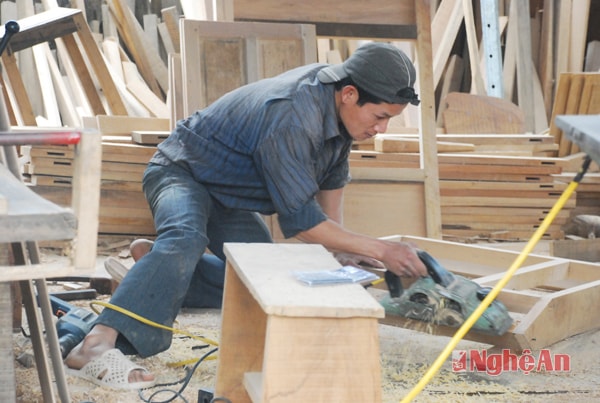 |
| The craftsman's diligence. |
Having experience in boat building, in 2004, he established a boatyard. At that time, local fishermen mainly fished near the shore, so most built small boats with small engines. Combined with manual production methods relying primarily on human labor, the products were of poor quality and production was slow. In recent years, many local fishermen have pooled their capital to build larger boats with powerful engines, ranging from 350 HP to over 700 HP, for offshore fishing. Currently, Mr. Ngo's workshop is building four boats with 750 HP engines, a hull length of 25 meters, a width of 7.5 meters, and a side height of 3.5 meters. Each newly built large boat costs 3-4 billion VND, not including fishing gear worth nearly a billion VND. Earlier this year, Mr. Ngo's boatyard started work on four large boats. To date, customers have ordered 10 boats with engines exceeding 700 HP. The size and design of the ship are chosen by the customer, and the craftsmen must adhere strictly to the design.
The workers at Mr. Ngo's shipyard all come from farming backgrounds. They were originally carpenters who made household furniture and flooring, and when they were hired as shipbuilders, they all had some knowledge of the craft. However, the work assignments depend on each worker's aptitude. Mr. Ngo explained: "Usually, the work here is assigned to one 'employee' (Mr. Minh). The 'employee' has to oversee all the work in the shipyard. The most difficult thing for the 'employee' is arranging and organizing the workers efficiently to ensure high work productivity. Therefore, the owner must choose the most experienced 'employee'. For a new ship, there are two stages that require high skill and experience: assembling the frame and fitting the ship's planks."
The craftsmen assigned to this task must be highly skilled. The wood used for the frame is a type of teak that doesn't crack, while the wood used for the planks is a type of sandalwood. These are two heavy, high-quality woods that can withstand the effects of saltwater. Before joining the planks to the hull, the craftsmen must use fire to bend them before joining. The planks are 5 cm thick and 25 cm wide, requiring experienced bending and joining. Mr. Ngo told us that a 750 HP ship required 150 cubic meters of wood and 7 tons of various nails to complete, and the craftsmen had to work continuously for 4 months. After the entire hull is finished, the painters do the final work. There are two types of paint used: anti-rust paint for the inside and anti-fouling paint for the outside. That's the nature of seagoing vessels.
Thanks to the dedication of the owner and the workers, Mr. Ngo's shipyard has become increasingly reputable. Not only fishermen from Quynh Nghia, but also from Quynh Phuong, Tien Thuy, and other areas come here to contract for new shipbuilding. Each time a ship is launched at Lach Quen wharf and sails out to sea, every worker at Mr. Ngo's shipyard feels as if they are bidding farewell to a loved one. They watch until the ship disappears into the mist over the vast ocean...
X.Hoang - T.Huong


