
4 locations for installing traffic cameras in Vinh City.
(Baonghean) - On National Highway 1 passing through Vinh City, there are 4 locations where traffic safety surveillance cameras have been installed at intersections.
Starting on August 7th, Nghe An province will implement a system for monitoring and handling traffic safety violations on National Highway 1A, specifically the section passing through Nghe An. This is a significant step forward in smart traffic management, ensuring effective patrolling, control, and handling of traffic safety violations.
The "extended arms"
In implementing Project 617 on "Building a system for monitoring and handling traffic safety violations on key national highways and expressways" approved by the Prime Minister, the C67 Department has recently coordinated with relevant units to build, install, and put into operation a system for monitoring and handling traffic safety violations on several national highways and expressways such as the Noi Bai - Lao Cai Expressway, the Ho Chi Minh City - Trung Luong Expressway, etc., and has recorded positive results.
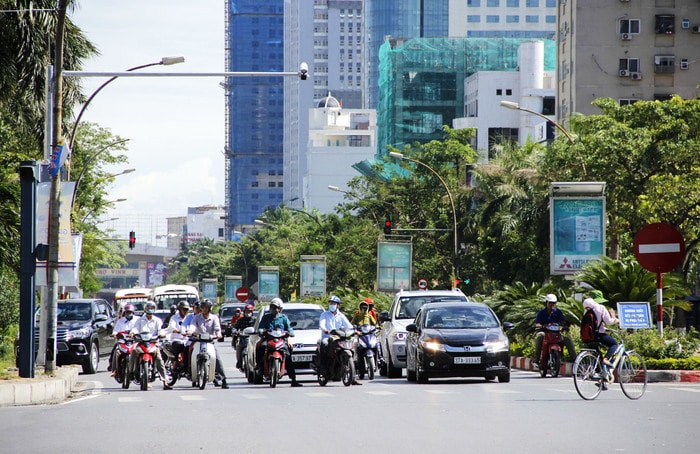 |
| Surveillance cameras are installed at the intersection of Nguyen Thai Hoc and Quang Trung streets (Vinh City). Photo: Canh Nam |
According to Project 167, National Highway 1A passing through Nghe An, Ha Tinh, and Quang Binh provinces will be equipped with 34 surveillance devices of various types, connected to traffic safety violation monitoring and processing centers at the local traffic police departments. In Nghe An, the camera system will be installed at 8 different locations (in both directions), all of which have been surveyed and are traffic "hot spots". In Vinh City, cameras will be placed at 4 locations, including:Vinh University intersection; Le Mao Extended - Tran Phu intersection; Vinh Market intersection and Nguyen Thai Hoc - Quang Trung intersection.
Each camera is integrated with software to monitor violations such as speeding and lane violations, observing and recording traffic images; it has the ability to recognize all types of vehicle license plates (cars and motorcycles) day and night, regardless of weather conditions, with high accuracy, greatly assisting in the detection and handling of traffic safety violations.
Colonel Cao Minh Phuong, Head of the Road and Rail Traffic Police Department, said: “In addition to detecting and handling violations of road traffic safety regulations, the surveillance camera system also provides strong support for traffic flow management; storing image information to support investigation, understanding the circumstances and causes of accidents, and identifying the perpetrators of accidents…”
For each violation, data about the offending vehicle detected by the camera is immediately sent to the tablets of the patrol teams. The teams use the images to stop the offending vehicle and issue a fine. In cases where the camera detects a violation but the patrol teams cannot process it directly, the camera will send the data to the central control system at the Traffic Police Department of the Provincial Police. From the vehicle's license plate, all information about the vehicle owner will be transferred to the control center. Then, all images and violation information will be sent to the registered address for "on-the-spot" fines.
If the vehicle owner who committed the violation has received the violation notice and images but still fails to comply, the Traffic Police Department will coordinate with vehicle inspection centers or local authorities to apply measures such as refusing vehicle inspection or enforcing compliance.
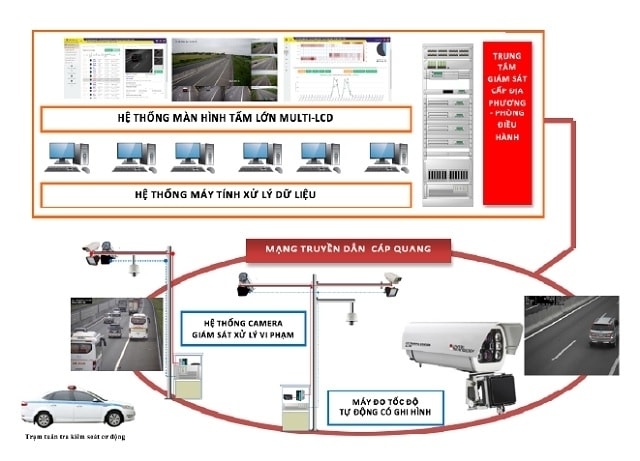 |
| This diagram illustrates the operation of the intelligent traffic monitoring system installed on National Highway 1. |
Continue issuing fines remotely via camera.
After a temporary suspension due to unforeseen circumstances, starting in mid-August, the Traffic Police Department of Nghe An Province deployed a system for monitoring and handling violations via cameras. Initially, enforcement will be conducted using data from four cameras in the city, and then, based on experience gained, it will be expanded to the entire national highway network within the province.
Immediately after the system becomes operational, the Traffic Police Department will widely disseminate information through mass media and local awareness campaigns to ensure that people are aware of and comply with the regulations. Simultaneously, they will deploy personnel to monitor and handle violations.
When "on-the-spot" traffic cameras are installed, vehicle owners are the ones directly penalized, thus they will certainly be more careful on the road. In addition, they must also participate in monitoring and taking responsibility for their vehicles in cases where they lend them out, or transportation businesses must also have sanctions against their drivers... It can be seen that the deployment of surveillance camera systems has a significant impact on the psychology and awareness of road users, making many people "afraid" and reducing violations. As a result, vehicle management will also be much easier.
Lieutenant Colonel Nguyen Truong Giang - Head of the Investigation and Enforcement Team - Provincial Traffic Police Department explained: "When using the 'cold penalty' method, meaning the vehicle owner will be responsible for the violations, they will certainly have to complete all the procedures for transferring ownership. From there, vehicle management will be much easier."
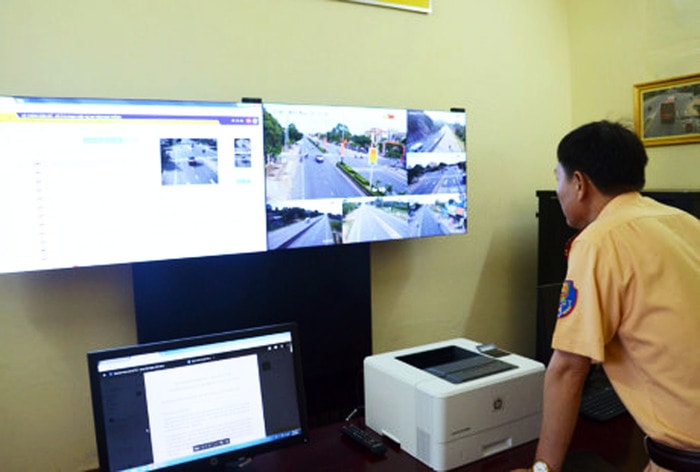 |
| Images and videos of traffic violations are transmitted to a processing center for traffic police to monitor and issue penalties. (Illustrative image) |
Furthermore, in reality, on current roads, there are many traffic participants who stubbornly argue when being processed by traffic police, and this can even lead to acts of resistance against law enforcement if the traffic police do not explain clearly and the violators lack self-control. In addition, there are also many cases of people exploiting their connections to exert pressure, seek favors, etc.
Major Dang Van Cuong, Head of the Dien Chau Traffic Police Station, affirmed: "In the future, using the 'cold penalty' system will solve the problem of bribery. Because all images of violations will be automatically saved, and that data will be continuously updated by the Department of Road and Rail Traffic Police. If a violation occurs, it will certainly be processed, so drivers need to change their mindset."
Besides the benefits of raising awareness and responsibility among traffic controllers and reducing pressure on patrol and control forces, the installation of cameras also has another extremely practical advantage. The deployment of surveillance cameras will undoubtedly provide a wealth of valuable data to authorities in investigating accidents, thefts, and robberies. With cameras in place, the mindset of criminals will change, thereby significantly curbing criminal behavior. And certainly, with this "on-the-spot" penalty system, approximately 1 million people managing and using over 1.4 million vehicles in the province will have to improve their awareness and responsibility when participating in traffic.
Canh Nam
| RELATED NEWS |
|---|


