
Mr. Son: Using foliar fertilizer products for industrial tea plants.
(Baonghean)This is a model using BIO-PLAN and GROW-MORE foliar fertilizers, which was jointly implemented by the Department of Agriculture and Rural Development on a 1-hectare industrial tea plantation in Anh Son. The model has demonstrated new effectiveness in intensive tea cultivation.
During a field workshop evaluating the effectiveness of using foliar fertilizers with BIO-PLAN and GROW-MORE products on industrial tea plants in Anh Son district, we had the opportunity to visit the 1-hectare tea plantation of Mr. Nguyen Van Viet in Hamlet 1, Phuc Son commune. Mr. Viet's tea plantation was selected as a pilot site for the model and has extensive experience in tea cultivation. His tea garden was planted 15 years ago, and until then, his family has cared for the tea using manure, inorganic fertilizers, microorganisms, and pesticides. In 2012, he received assistance from the district's Agricultural Extension Station in using the two aforementioned products to care for his tea plants.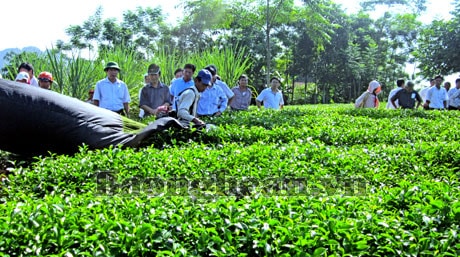
The Department of Agriculture and Rural Development is verifying the effectiveness of a tea cultivation model using two products at Mr. Viet's household in Hamlet 1, Phuc Son, Anh Son.
According to Mr. Nguyen Van Viet, the foliar fertilization model using two products, BIO-PLAN and GROW-MORE, was implemented over a period of six months (starting in March 2012). The investment level, land size, implementation location, implementation time, and amount of inorganic fertilizer used were the same for both the model and the control group. Each hectare received 850 kg of nitrogen, 1,200 kg of phosphorus, and 600 kg of potassium. The model hectare also utilized two additional fertilizers applied to the leaves, stems, branches, roots, and soil. To implement the fertilization of tea plants with these two products, Mr. Viet applied microbial organic fertilizer before pruning the tea plants in November-December 2011. This organic fertilizer was sourced from his family's buffalo and cattle farming and pond mud. By March 2012, 5-7 days after pruning the tea plants, it was considered appropriate to apply the two fertilizers by spraying them on the leaves, roots, and branches of the tea plants.
According to recommendations from provincial agricultural extension officers, the BIO-PLAN fertilizer should be diluted with clean water at a ratio of 1/1000, and sprayed evenly on the stems, branches, roots, and soil. Farmers should use 40ml of BIO-PLAN mixed with 40 liters of water per 1 sao (approximately 1000 square meters) of tea plants, spraying once every two harvests (every 70-80 days). This fertilizer should not be mixed with pesticides. For the second product, GROW-MORE, use 40g of the product mixed with 40ml of water per 1 sao, spraying evenly on the leaves and buds of the tea plants. The spraying frequency should be 3-4 times per harvest (every 7-10 days). This product can be sprayed together with pesticides. The investment cost for the model tea plantation is nearly 28 million VND/ha, while the control plot cost 21 million VND/ha.
To demonstrate the effectiveness of using the two foliar fertilizers, Mr. Viet implemented a harvesting machine on a 12.5-meter-long section of both the control and model tea plots. The results showed that the control plot yielded 7.7 kg, while the model plot yielded 11.2 kg, an increase of over 42%. According to Mr. Viet, from April to the present, his 1-hectare model tea plot has undergone three harvests with an average yield of 3.2 tons/ha. After deducting costs, the net profit is 38 million VND/ha/year, an increase of 13 million VND/ha/year compared to the control plot. He happily stated: “The tea plants are free of fungal diseases, the green moss is dead, the base of the plants is clean, the leaves are a darker green, and the buds are more numerous and plump. Especially, the tea plants did not die during the recent drought, and the buds remained fresh and green.”
The two fertilizer products, BIO-PLAN and GROM-MORE, are two advanced products from Huong Nam Joint Stock Company (Hai Phong). These fertilizers contain nitrogen, phosphorus, potassium, and other minerals such as calcium, magnesium, sulfur, boron, iron, zinc, copper, molybdenum, and manganese, which are used for soil improvement, seed soaking and germination, and environmental treatment. Mr. Tran Van Ha, Head of the Anh Son Agricultural Extension Station, enthusiastically stated: “Our entire district has nearly 2,000 hectares of industrial tea plantations. From the Gia Giang tea region, the Youth Volunteer Team 1, and the October Tea Enterprise, farmers have applied advanced organic fertilizers using these products and foliar composting. This provides a basis for tea growers to easily use these two foliar fertilizers to further increase productivity, yield, and income from tea cultivation.”
It is understood that the Anh Son District Education Union is currently requesting the Agricultural Extension Station to implement the application of these two fertilizer products for growing clean vegetables and raising safe chickens among teachers and staff in schools.
Luong Mai


