
Three questions from the 2018 high school math exam.
Feedback regarding the 2018 National High School Graduation Examination Mathematics test continues to raise concerns about the standardization of an exam when serving different objectives.
|
| Some questions from this year's Math exam. |
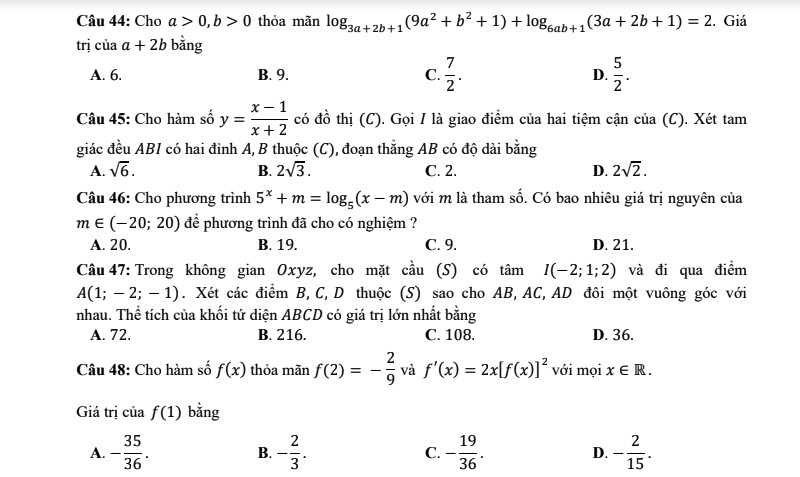
Is being too difficult a good way to differentiate people?
Mr. Nguyen Anh Dung, a former math teacher at Lam Son High School (Thanh Hoa province) who has trained many generations of students to win international and national awards, commented on this year's math exam:
“The first 20 questions of the exam are suitable for average students. The next 10 questions are likely to differentiate between average and above-average students. With the last 20 questions, above-average students will find it very difficult to complete each question in 4-5 minutes. Most of these questions require detailed, essay-style work to choose the correct answer. The process of guessing and elimination to select the correct answer is very difficult to apply. Many students choose answers based on intuition, and they might be lucky to get it right.”
Teacher Dung noted that the assessment of "easy or difficult" should be considered in relation to the time allotted for the exam. For example, if each difficult question requires 4-5 minutes to solve, then with 20 difficult questions, the 90-minute time limit of a multiple-choice exam is insufficient.
|
| Teacher Nguyen Anh Dung |

Teacher Dung believes that this year's exam has too many difficult questions – challenging both in terms of understanding the approach to solving them and in implementing the solutions.
"Most of the questions from 31 to 50 are very challenging. It should be understood that having many difficult questions does not necessarily mean differentiating students' abilities."
At the press conference concluding the exam supervision work on the afternoon of June 27th, a representative from the Ministry of Education and Training stated that this year's exam questions had a higher level of differentiation, and the increased difficulty was understandable given the broader scope of the exam – covering both the 11th and 12th grade curricula.
In the 2017 exam, there were many perfect scores of 10, and in some cases, candidates with over 29 points still failed to get into medical school. This year, many predict that perfect scores of 10 will be rare, and the number of candidates achieving high scores will decrease significantly.
The fact that the math exam in the last two years has leaned towards either extremes of being too difficult or too easy has led the public to question whether the Ministry of Education and Training is simply catering to public opinion and making things difficult for candidates, or whether the Ministry itself is also questioning the dual purpose of this exam.
If the exam is too difficult, the primary objective of assessing graduation eligibility, which the Ministry insists is crucial, will be disregarded. In this case, increasing the difficulty level of the exam will only serve the purpose of university and college admissions.
If the exam is too easy, to the point where most localities have graduation pass rates above 90%, is it necessary to organize a national exam with such a dual objective?
In response to this question, Mr. Nguyen Anh Dung argued that the "2-in-1" purpose is what makes the exam so burdensome. "It must be understood that the nature of the high school graduation exam and the university/college entrance exam are different," he said.
However, he did not support allowing localities to organize their own high school graduation exams. “In our country, the general education program is common across all localities, so a common graduation exam is reasonable. University and college admissions should be separate. Schools can hold joint exams as before, or each school can take the initiative.”
Quiz: Does it hinder mathematical thinking and ensure uniformity in learning?
 |
While the majority of candidates and teachers considered the exam difficult and lengthy, there were also some dissenting opinions.
Teacher Bui Viet Ha, a mathematics and computer science expert who has written computer science textbooks for the Ministry of Education and Training for many years, shared that he had tried creating a different exam paper.
“In the first 5 minutes, I answered 25 questions correctly. After that, using quick drafts, I managed to answer another 10 questions in about half an hour. After that, I stopped, but that's about 35 questions in 35 minutes.”
According to him, the exam was fine. Because the exam needed to meet the requirements of multiple choice, graduation assessment, and classification for university admissions; therefore, shortcomings were unavoidable.
Before mathematics exams were introduced in a multiple-choice format in 2017, there were many analyses by mathematicians about whether this format was appropriate. Many scientists argued that the multiple-choice format for mathematics exams would hinder students' mathematical thinking.
Commenting on this issue, teacher Nguyen Anh Dung shared: “The characteristic of mathematics is logical thinking. Multiple-choice exams like this year's make teaching and learning burdensome, diminishing students' interest in the subject. I believe essay-based exams are more suitable for mathematics. Students can better develop their thinking skills and problem-solving abilities.”
Meanwhile, Mr. Bui Viet Ha argued that multiple-choice exams must accept some drawbacks: "For example, if a student doesn't know anything and randomly circles answer A from beginning to end, they are almost certain to get more than 2 points. That's the price of multiple-choice exams. In return, this format saves the effort of manual grading."
Dr. Sai Cong Hong shared:"Our standardized testing system is still in its infancy."
Another problem arises when exams are conducted in a multiple-choice format: candidates complain that some exam papers are difficult while others are easy.
Regarding the question of how the difficulty levels of multiple-choice test papers are balanced, Mr. Sai Cong Hong affirmed at the press conference on June 27th that the question standardization process in the test question bank is conducted systematically with the support of technology, so it is impossible for questions of the same difficulty level to differ significantly across different test papers. As for explaining how the difficulty levels are balanced, this is a very complex technical issue that cannot be explained in just a few sentences.
However, representatives from the Ministry of Education and Training have not yet confirmed the proposal to publish the score distribution for each exam code to demonstrate that the difficulty levels of the different codes are equivalent.


