
Lesson 1: Best Practices and Effective Models
(Baonghean) - Implementing Directive No. 09-CT/TƯ dated December 1, 2011, of the Central Party Secretariat on "Strengthening the Party's leadership over the nationwide movement to protect national security in the new situation," in recent years, Nghe An province has focused on building and replicating good practices and effective models in the movement, contributing to ensuring political security, social order and safety, and creating conditions for local socio-economic development…
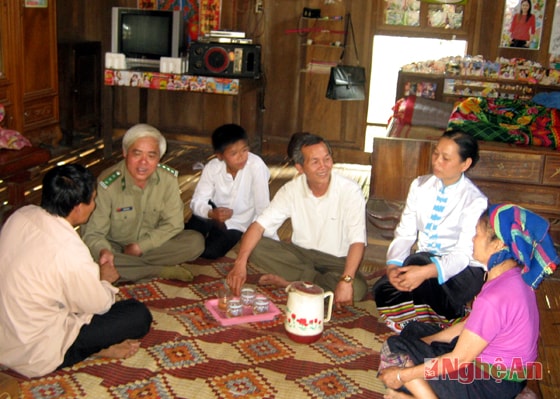 |
| Officials from Thong Thu commune (Que Phong district) disseminate legal information to households. Photo: Dang Cuong. |
| RELATED NEWS |
|---|
Hoa Lam hamlet (Hung Hoa commune - Vinh City) is a fishing village on the Lam River, with 68 households and 217 inhabitants. The lives of the villagers are closely tied to small-scale fishing on the river, along the coast, and in the estuaries. Previously, the hamlet often experienced disunity, with some outsiders organizing gambling, using drugs, illegally trading gasoline, oil, and explosives, and violating regulations on fishing nets, affecting maritime traffic; most of the villagers' fishing vessels did not operate safely according to the law… Since 2012, with the assistance of the Nghe An Waterway Traffic Police Department, the hamlet has begun building a "Peaceful Fishing Village" model.
Over the past three years, Hoa Lam has seen significant changes. Residents have received training on inland waterway safety and strictly adhere to legal regulations, such as equipping themselves with adequate life-saving and rescue equipment, requiring boat operators to possess professional certificates, and ensuring that all fishermen have licenses and operate only in permitted fishing grounds. Mr. Dau Xuan Thuong, head of Hoa Lam hamlet, happily stated: "The 'Peaceful Fishing Village' model has fostered a higher sense of awareness and responsibility among residents in building the community and village; making Hoa Lam a place free from social vices and criminal offenses, with no third births and no violations of the Inland Waterway Traffic Law."
In Quynh Luu district, with its unique characteristics of being a religious and coastal area, and having a significant ethnic minority population (500 households, 1,000 people in Tan Thang and Quynh Thang communes), the movement for all citizens to protect national security has been concretized over the years through the development of models with forms and methods of operation suitable to the actual conditions of each locality. For example, in coastal communes with advantages for tourism development such as Quynh Bang, the Party committee and government have built a model of a self-governing security and order team for beach tourism areas with the participation of two residential clusters of 15-20 households; most members of the self-governing team are households with business kiosks on the beach, in the spirit of "helping the locality is also helping ourselves" in implementing security and order to attract tourists.
Cau Giat town has a dense population, making it prone to social vices. Block 3, bordering Quynh Hong commune and home to 21 Catholic households, was selected as a pilot unit for implementing the "3 Management, 4 Maintenance" model (3 management includes: good management of the area, property and construction activities, children's education, and environmental sanitation; 4 maintenance includes: preventing crime and social vices; avoiding complaints to higher levels; maintaining neighborly relations; and preventing superstition). After implementing the model, security and order in the area stabilized, and neighborly relations became stronger. This model was then replicated in 12 blocks throughout the town. For rural communes, the District Steering Committee for the "All People Protect National Security" movement encouraged the communes to develop self-governing family clan models for security and order, contributing to the creation of peaceful villages. Currently, in Quynh Luu district, over 2,000 clans have established clan management boards, and nearly 1,800 clans have developed clan charters and regulations for their activities.
There are many other outstanding models in other localities, such as the "Eliminating stigma, bringing smiles, helping those who have erred" model in Thai Hoa town; the "Peaceful Bell" model in Hung Tan commune (Hung Nguyen); the "Veteran members participating in the people's patrol club" model in Bao Thanh commune (Yen Thanh); and the "Village free from drugs and social evils" model in some villages and communes of Dien Chau and Hung Nguyen districts. "Safe School" at Vinh University; "Crime Reporting Mailbox" in Do Luong, Quynh Luu; "Helping Each Other"; "Civilized Urban Neighborhoods, Free from Crime and Social Evils" in Vinh City; "Peaceful Parish" at Vinh Giang Parish, Con Ca Parish, Nghia Loc Commune (Nghia Dan); "Peaceful Parish, United in Building New Rural Areas" at Luong Khe Parish, Thanh Hoa Commune (Thanh Chuong)... In these initiatives, the self-governing community groups play a key role in gathering information about crimes, recording all "activities" within the community, understanding the situation in their area, and monitoring households within their jurisdiction. They act as an extension of the commune/ward police in residential areas, providing thousands of valuable pieces of information to relevant agencies for timely action and maintaining security and order at the grassroots level.
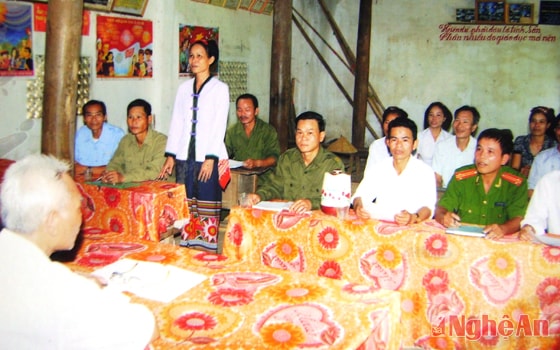 |
| Launching the nationwide movement to protect national security in the self-governing group of Nua village, Yen Khe commune (Con Cuong). Photo: Xuan Thong |
For mountainous areas, with a land border of 419 meters, accounting for 1/4 of the total length of the Vietnam-Laos border, bordering three provinces: Xieng Khouang, Hua Phan, and Bolikhamsai; there are 42 border markers, including 35 main markers and 7 auxiliary markers, 2 main border gates (Nam Can International Border Gate, Thanh Thuy National Border Gate) and 2 auxiliary border gates (Tha Do Border Gate, Tam Hop Border Gate)... many complex issues related to security and order are present, including the illegal trafficking and use of narcotics, illegal migration, illegal proselytization, and human trafficking. Therefore, border security protection is determined to rely on the people's support and build a people's security posture in the border region (comprising 27 communes with 305 villages, including 83 border villages in 6 districts: Ky Son, Tuong Duong, Que Phong, Con Cuong, Anh Son, and Thanh Chuong).
Models of people participating in protecting national security in border districts are having a significant impact and playing an important role in the lives of the people, because the mentality of ethnic minorities in the highlands is that they need to "see and hear" before they believe and follow. Currently, Ky Son district has established 19 models such as self-governing clans for security and order, and self-governing committees for security and order. Among them, the security and order clan model of the Xong clan (Muong Long commune, Ky Son) is noteworthy. This clan has more than 60 households scattered across many villages. Although the economic conditions of the households in the clan are still difficult, they have learned to build a healthy life together. Mr. Xong Ga Vu, head of the Xong clan, said: In addition to encouraging descendants not to participate in social vices, not to cultivate opium poppies, buy, sell, possess, or use drugs, the clan has established rules that severely punish any family member or grandchild who violates the law. The clan members also regularly help and exchange business experiences, leading to improved living standards and reduced law violations.
In the mountainous district of Que Phong, where the buying, selling, and transporting of drugs remains extremely complex, several successful models have been developed, such as the "Drug-Free Village" in Huu Van village, Chau Kim commune (Que Phong), managed by the village's Veterans Association. This village, a "hotspot" for drug use in Chau Kim commune, has successfully helped four people overcome their addiction since its implementation. They have received assistance from the government, organizations, and associations, including loans and technical guidance to develop their economy and escape poverty. For example, Lo Van Chung, a long-time addict, successfully overcame his addiction thanks to the village's support. He boldly borrowed capital to plant trees and raise livestock, and has become a relatively well-off household. Furthermore, Chung has been admitted to the Party and is currently the Party Secretary of Huu Van village.
Based on Directive 34/CT-BTL of the Border Guard Command and Directive 12/CT-UB on organizing the movement "Mass participation in self-management of border lines and markers, maintaining security and order in border villages," in recent years, the provincial border guard force has coordinated with Party committees and authorities at all levels to establish hundreds of self-management models for border lines and markers in border villages, attracting thousands of people to participate. Lieutenant Colonel Le Nhu Cuong - Deputy Head of Political Affairs (Provincial Border Guard Command) said: "Through these self-management teams, people in border areas have actively participated with the Border Guard in patrolling and clearing border lines and markers, promptly providing the Border Guard and local authorities with information and signs related to criminal elements, detecting and handling incidents in a timely manner, preventing hotspots and complex situations on the border..."
To date, surveys show that the province has 480 models of the nationwide movement to protect national security that are being consolidated, built, and put into operation (42 models were newly registered in 2014), of which 150 models are considered to be operating effectively... Depending on the specific characteristics of each region, religion, and terrain, each locality has developed innovative and effective approaches, fostering the spirit and responsibility of each citizen, along with efforts from all levels and sectors to maintain security and order and protect the Fatherland, meeting the new demands of the current situation.
(To be continued)
Khanh Ly - Pham Bang


