
Lesson 1: The pioneers who settled and opened up new lands.
(Baonghean)Nearly 30 years ago, with their youthful energy and ambition to conquer new lands, the youth volunteer teams transformed barren hills and remote, inhospitable forests into promising new economic zones.
The emergence of the Youth Volunteer Force for Economic Development has had a widespread and inspiring impact on economic development, poverty reduction, and job creation for young workers; it has also contributed to national security and defense stability, the development of cultural life, and forest protection in difficult and border areas. However, after fulfilling their pioneering mission, these Youth Volunteer Force units face the need for transformation and reorganization in appropriate directions.
The Youth Volunteer Brigade for Economic Development 1 was established in 1986, with its "headquarters" located in Long Son commune (Anh Son district). This was the first pilot model of the Nghe An Youth Volunteers during the period when the country began its reform and is considered the "elder brother" of the Youth Volunteer Force for Economic Development. Leading us on a tour of the prosperous economic zone with its undulating tea plantations, and recalling the early days of hardship when they first came to reclaim and develop the land in this sacred, dangerous forest, General Pham Van Loan, the Brigade Leader, shared with emotion: "In the beginning, the brigade had 22 members with an area of 500 hectares in three communes: Long Son, Cao Son, and Khai Son. The land consisted of barren hills covered with wild plants, teeming with leeches and snails, with no electricity, roads, schools, or health stations. Many people were hesitant."
However, with the belief that "with human effort, even stones can be turned into rice" and the spirit of "wherever there are difficulties, there are young people," the cadres and members of the Youth Volunteer Team worked tirelessly day and night under the sun and wind on the hillsides to awaken the potential of the land. Wherever land was opened up, they built houses and established residential villages. For each area exploited, the team mobilized its members to plant and cultivate various crops. To date, the land area under the management of Team 1 has reached 2,500 hectares, with 500 members. Team 1's strengths lie in tea and cassava cultivation.
Although it was a new model, unprecedented, and carried out in mountainous and remote areas with many difficulties, with innovative approaches and high determination, the Youth Volunteer Brigade 1 - Economic Development quickly proved its suitability, transforming the barren Bau Dung area into a prosperous new economic zone. This initial success laid the foundation for the strong development of the Youth Volunteer Force, especially after the Provincial Party Committee's Directive 04 CT/TU dated September 4, 1996, on strengthening the leadership of the Youth Volunteer Force - Economic Development, resulting in the establishment of 10 Youth Volunteer Brigades, operating in almost all difficult areas of the province.
The youth volunteer brigades have effectively exploited and utilized barren hilly areas, contributing to the formation and development of specialized areas for industrial crops and raw materials serving the province's processing industry, such as tea, pineapple, cassava, and sugarcane. In addition to key crops, the brigades also focus on planting fruit trees, vegetables, and successfully implementing the forest development, protection, and reforestation program in the area (reaching 40,939 hectares). Each Youth Volunteer Brigade for Economic Development has become a center for agricultural and forestry extension, producing high-quality seeds, ensuring timely product distribution; and disseminating, applying, and transferring scientific and technological advancements to production within the brigade and surrounding areas, especially to ethnic minority communities in the highlands.
The Youth Volunteer Brigades for Economic Development also serve as centers for attracting, mobilizing, and integrating investment resources for production development and the construction of essential technical infrastructure to support production and daily life. This is an effective form of concentrated investment to build large-scale production models, serving as a visual introduction and educational tool for people in mountainous areas, creating conditions and impetus for rapid and sustainable development in the region, and contributing to economic development linked to the construction of new rural areas. Many brigades have boldly invested in and introduced new plant and animal varieties for cultivation, creating high-quality products that have become their own brands and are favored by many people...
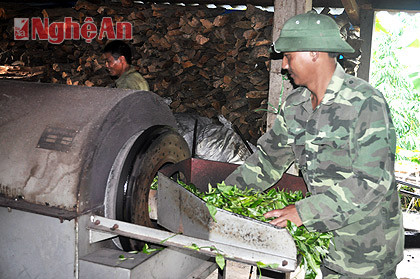 |
| Mr. Lau Ba Mai, the first Hmong person to become an officer in the 8th Youth Volunteer Brigade (Huoi Tu - Ky Son). |
Traveling from the western part of Nghe An province to Huoi Tu (Ky Son district), the base of the 8th Youth Volunteer Brigade, one can fully appreciate the significance of the work the brigade has done to help the Mong ethnic people in Ky Son overcome poverty. The greatest success is the development and creation of the Tuyet Shan tea brand, famous throughout the country. When they first arrived to take up their duties in this area, located at an altitude of 1,200 meters above sea level, with a cool climate year-round but steep terrain and chronic water shortages, the question of what crops to plant to help the Mong people escape poverty, stabilize their lives, eliminate opium cultivation, and prevent illegal migration was a major concern for the brigade's officers and members. Then, after many trips to the South and North, the then-leader of Youth Volunteer Team 8, Mr. Nguyen Ho Lam (now the Deputy Chief of the Office in charge of building new rural areas), finally found a plant with potential for development in this land: Tuyet Shan tea, whose seeds were taken from the high mountains of Ha Giang.
Finding the right variety of tea plant was difficult enough, but successfully conducting trial plantings and then persuading the Hmong people to follow suit was even more challenging. The determination and enthusiasm of those leading the effort, such as Team Leader Nguyen Ho Lam, followed by Nguyen Trong Canh and Nguyen Quang Trach, along with the support of the province, Ky Son district, and even the people of Huoi Tu such as Mr. Vu Dua Tong - then Chairman of the Huoi Tu Commune People's Committee, and Vu Chong Dia - now Chairman, strengthened the confidence of the team members in the "vitality" of Tuyet Shan tea in Huoi Tu. With 25 hectares of land reclaimed by the Hmong people, the team members began clearing the land, preparing the soil, and planting the tea plants experimentally.
The tea plants grew increasingly lush. The team was very excited, but in the first few years, the villagers didn't immediately follow suit. Despite much persuasion, only a few households in the ethnic minority community agreed to plant them. The team's officers nurtured the seedlings, transported them to the fields, prepared the land, and guided the villagers step-by-step in planting tea. By early 2005, the Youth Volunteer Team 8 began harvesting its first tea buds, with all products processed on-site. To date, the total area planted with high-quality Shan Snow tea has reached 450 hectares (of which the Mong ethnic minority cultivates 410 hectares, the rest is managed by the team), with 250 hectares under commercial production and an average yield of 1.5 tons/ha. 100% of the fresh tea buds from the villagers are purchased and processed on-site by the team.
To ensure the villagers have enough to eat and can confidently continue cultivating tea, the team's officers also provide guidance on the techniques of growing short-term crops such as vegetables and beans, as well as fruit trees and livestock farming in the villages. Currently, in addition to the 1 hectare of off-season vegetable cultivation, the team has expanded to 5 hectares in the villages of the ethnic minority people. Thanks to this, not only is a local supply of fresh vegetables ensured, but hundreds of tons of vegetables worth billions of dong are also supplied to the market each year; the 3 hectares of various fruit trees generate an estimated income of 250 million dong annually. Since 2007, the unit has also successfully implemented a trial planting of 20,000 lily plants, yielding an income of 720 million dong, and established a model for concentrated confinement of Sindhi crossbred cattle, eliminating the traditional free-range farming practices of the ethnic minority people.
This very place also developed a Youth Village consisting of 25 families, mainly children of the Hmong ethnic group. They were guided by the Youth Volunteers on how to do business and increase production. To date, their lives have become stable. Many young Hmong people are striving to become exemplary and pioneering Party members. Standing on the hilltop, looking towards Huoi Tu Youth Village, we were struck by the sight of charming new houses, clean and spacious grounds, and each family having a small garden with various green vegetables for daily meals.
Mr. Ly Tong Cu, one of the 25 households in Huoi Tu Youth Volunteer Village, happily said: “Thanks to the Youth Volunteer Team, my family not only knows how to grow tea but also develops breeding of Sind crossbred cattle... earning more than 100 million VND per year.” Mr. Vu Giong Dia, Chairman of the People's Committee of Huoi Tu Commune, excitedly added: “In Huoi Tu, only the Tuyet Shan tea plant thrives, providing the people with a prosperous life! The tea plant has been growing on this land for 10 years, and now Huoi Tu has less than 58% of households living in poverty. Thank you to the Youth Volunteer Team for bringing new ways of thinking and doing things to our Hmong people.”
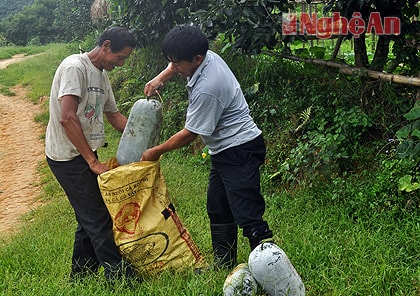 |
| Mr. Nguyen Van An (on the right) - one of the first 12 people to clear land in Team 8, with a high yield of pumpkins during the harvest season. |
The success of the economic development model in Huoi Tu also served as the foundation for the formation of Team 10, tasked with supporting the Mong ethnic group in exploiting the land potential in Na Ngoi commune. With a policy of supporting 100% of the seed costs plus 5 million VND/hectare, and with team members providing guidance and direct assistance in planting tea to individual households, and signing commitments to purchase all fresh tea leaves at an average price of 6,000 VND/kg, the Mong people in Na Ngoi commune have now developed nearly 120 hectares of Tuyet Shan tea. Team members and the Mong people have become like family; many officers are treated like their own children and grandchildren, even adopting the Mong surname, such as Mr. Vuong Trung Uy - Head of the General Administration Department, known as Vu Nanh Uy, and Mr. Nguyen Trong Canh - Team Leader, who adopts the Mong surname Vu Trong Canh…
Thanks to the dedicated, hands-on guidance of the team members, the Mong people in Huoi Tu, Na Ngoi, and Muong Long not only know how to grow tea but have also developed many poverty alleviation models such as rice cultivation, raising Sind crossbred cattle, black chickens, black pigs, growing taro, green squash, ginger, and various vegetables. The land of Huoi Tu and Na Ngoi is now becoming a bright spot in the picture of new rural development in Ky Son.
Looking at the reality of the past nearly 30 years, it is clear that for a province with a large area, over 83% of which is mountainous, home to six ethnic minority groups (Thai, Tho, Khmu, Mong, O Du, and Dan Lai), and with 419 km of border, the lives of people in mountainous areas are still very difficult. Therefore, the construction of Youth Settlement Villages and Youth Volunteer Brigades for Economic Development in mountainous and border regions plays an extremely important role in the task of developing the economy and society, maintaining national security and defense, redistributing the population, and ensuring a rational allocation of human resources between regions in the province. With 10 Youth Volunteer Brigades for Economic Development (now 8 brigades) evenly distributed across mountainous and border districts, they have provided stable and long-term employment for over 2,200 young families and created jobs for tens of thousands of seasonal workers.
Most young people who joined the Youth Volunteer Brigades were unemployed or had unstable jobs with low incomes. Now, they have stabilized their lives and risen to wealth, becoming millionaire farmers. Visiting the farms of the Brigades' households in the Youth Volunteer Brigades 2 and 5, located in difficult areas of Thanh Chuong district, reveals the willpower and determination of these "pioneers." Alongside the sprawling tea hills, each household has dozens of citrus trees, pomelos, and several hectares of fragrant root crops. Every farm has five to seven buffaloes and cows, dozens to hundreds of chickens and ducks, and ponds full of fish. According to Mr. Nguyen Viet Nhan, Deputy Team Leader of Production Team 3/2, one of the first households to reclaim land in the Youth Volunteer Brigade 2, the fruits of his and his wife's hard work over decades include over 300 orange trees, 5 sao (approximately 0.5 hectares) of hybrid rice, 3 sao of corn, 10 sao of tea, 5 hectares of forest, 4 buffaloes, and 100 chickens… bringing in an annual income of 80-100 million VND.
In most Youth Volunteer Brigades for Economic Development, member households produce goods and benefit from the products they create. The Brigades are responsible for managing state-approved economic projects; managing land planning, providing technical guidance, acting as a "facilitator" at both ends (seeds, fertilizers, pesticides, and product distribution), and supporting production for members and people in the region. “Without the close and dedicated care, encouragement, guidance, and direction from the team's command, how could we have had the courage to stay, settle down, and prosper on this land? Thank you to the team for bringing tea plants, orange trees… bringing prosperity to our team members' households,” – Mr. Ho Viet Cuong, one of the “millionaire” farmers with an average income of 250 million VND/year in production team 3/2 (Youth Volunteer Team 2), sincerely expressed when we visited his family's VACR farm model.
Besides promoting economic development, the Youth Volunteer Brigades for Economic Construction also contribute to building a new cultural life, eliminating outdated customs, preserving and promoting national cultural identity; eradicating illegal logging in the areas where the brigades are stationed, and contributing to maintaining security and order in border regions. The brigades are also where many brigade members have found love, their happiness blossoming from shared hardships and sacrifices. Many have become elderly Youth Volunteer Brigades, with families of two or three generations settling down and prospering in the lands they themselves pioneered.
| Recognizing and commending the achievements, the President awarded the First-Class Labor Medal to the Youth Volunteer Brigade 1 - Economic Development; the Second-Class Labor Medal to the Youth Volunteer Brigade 2 - Economic Development; the Third-Class Labor Medal to the Youth Volunteer Brigade 4 - Economic Development; the Youth Volunteer Brigade 6 - Economic Development; and Comrade Nguyen Minh Tho - former Commander of the Youth Volunteer Brigade 1 - Economic Development. The Prime Minister and various levels and sectors also awarded many prizes to collectives and individuals of the Youth Volunteer Brigades - Economic Development in the province. The brigades also had the honor of welcoming many high-ranking delegations from the Party, State, ministries, and sectors to visit their youth economic development models. |
Along with the task of exploring the potential of difficult, mountainous, and border regions, the youth brigades serve as an effective educational environment for young people, fostering their training, dedication, and growth. They are also a cradle for nurturing and training cadres for the locality and the youth organization. Many generations of "soldiers" of the Youth Volunteer Force for Economic Development have become management cadres of the brigades, many have transferred to other sectors, becoming chairmen, secretaries, and deputy secretaries of districts, and heads and deputy heads of departments and organizations in the province... The success and impact of these "pioneers" are the clearest evidence of the will, aspirations, and pioneering spirit of "wherever youth are needed, youth will be there; wherever there are difficulties, youth will overcome them" which has become the action of the younger generation.
However, after nearly 30 years of construction and development, as a new and pioneering model, the Youth Volunteer Brigades have also encountered shortcomings in their operation. Transformation is inevitable when the "old garment has become too tight" and fails to keep up with the general trends of the integration era.
Text and photos: Khanh Ly - My Ha


