
Lesson 2: No common ground found
(Baonghean) - Unresolved pollution issues, a lack of common ground between businesses and residents, especially since Saigon Beer - Nghe Tinh Joint Stock Company invested in a new production line to increase capacity to 50 million liters/year in 2005, have made the issue of environmental pollution remediation at Saigon Beer - Nghe Tinh Joint Stock Company even more heated. Residents are frustrated and have filed numerous complaints, escalating to higher levels of authority…
(Baonghean) - Unresolved pollution issues, a lack of common ground between businesses and residents, especially since Saigon Beer - Nghe Tinh Joint Stock Company invested in a new production line to increase capacity to 50 million liters/year in 2005, have made the issue of environmental pollution remediation at Saigon Beer - Nghe Tinh Joint Stock Company even more heated. Residents are frustrated and have filed numerous complaints, escalating to higher levels of authority…
It must be affirmed that the expansion of production and business operations, and the increase in capacity, while environmental protection conditions were not yet fully met, by Saigon Beer - Nghe Tinh Joint Stock Company has indeed caused environmental pollution (emissions, coal dust, wastewater, noise, etc.) at many times, affecting the lives and activities of the people. Mr. Ho Sy Dung - Head of the Environmental Protection Sub-Department (Department of Natural Resources and Environment) said: “In reality, the company has been inspected and fined administratively many times by functional agencies under the Ministry and the Department of Natural Resources and Environment for violating environmental protection regulations. However, the company has also made efforts to remedy the situation by investing in technology lines, focusing on investing in and improving the wastewater treatment system and implementing some measures to remedy and minimize environmental pollution...”.
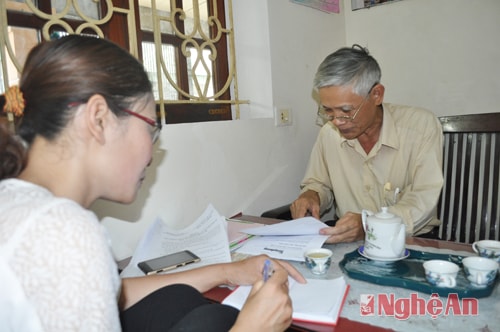 |
| Mr. Pham Ngoc Mai, head of Block 10 in Truong Thi Ward, shared his concerns about pollution with the reporter. |
| RELATED NEWS |
|---|
In the environmental protection inspection report on Saigon Beer - Nghe Tinh Joint Stock Company (Conclusion No. 3068 dated October 3, 2012) by the Ministry of Natural Resources and Environment, it is clearly stated that "the results of the analysis of wastewater samples after the company's wastewater treatment system before discharge into Canal No. 3 - Truong Thi Ward, compared with QCVN 40:2011, with Kq=0.9, kf=1.0 column B, all analyzed parameters meet the permissible standards. The results of the analysis of exhaust gas samples after the treatment system compared with QCVN 19:2009/BTNMT (column three), all parameters meet the permissible standards. The company has a hazardous waste generator registration book, pays environmental protection fees for wastewater, has reported on the generation and management of hazardous waste as required, and conducts periodic environmental monitoring."
However, at the time of inspection, the company did not have an environmental protection plan for the Beer Production Line Upgrade Project with a capacity of 50 million liters/year, did not have a wastewater discharge permit; and did not carry out waste monitoring and surrounding environmental monitoring as required, violating Point C, Clause 2, Article 8 of Government Decree No. 117/2009/ND-CP dated December 31, 2009 on handling violations of environmental laws, and was fined VND 12,500,000.
Despite numerous efforts to address and mitigate environmental issues, in 2013 the company still experienced an unforeseen incident that angered residents, leading to complaints and protests with banners and slogans, pressuring local authorities to demand that the company cease production and relocate its factory.
The company's management acknowledged that in 2013, the company experienced incidents related to wastewater and flue gas systems, such as foul-smelling wastewater due to improper operation by workers and management, which weakened the microorganisms in an aerobic biological treatment tank. Coal dust was dispersed into residential areas due to a malfunctioning pump in the wet dust suppression system, which was not detected in time by operators, and the time to purchase replacement equipment was long due to the lack of readily available parts on the market; scale buildup on the surface of the dust suppression tank reduced the effectiveness of the spray nozzles due to obstruction of the spray jets. The foul odor was caused by cracks in the concrete surface of the tank lid during operation, and leaks in the process pipes installed to the tank due to vibrations from the exhaust fan at the connection point to the anaerobic tank. Noise and unsanitary conditions at the factory's side gate were attributed to the movement of transport vehicles entering and exiting for goods delivery and receiving, and a lack of awareness regarding general hygiene…
Following complaints from residents, on May 30, 2013, the company held a meeting with residents and representatives from Truong Thi ward at the ward's People's Committee. At the meeting, the company director accepted responsibility, clearly stated the cause, and committed to resolving the issues as quickly as possible. In fact, the company implemented several specific measures, such as: To address the odor-causing wastewater, the company replaced the process control officer; withdrew all the microbial culture to a sludge silo for treatment; and replaced the microbial culture in the emergency tank to restore normal operation. After two days, the problem was resolved. To prevent coal dust from spreading into the residential area, the company replaced the pump with a new one, installed three backup pumps; thoroughly cleaned the dust suppression tank; and built an additional 12m³ settling tank to settle sediment and prevent pump damage. Simultaneously, move the vibrating exhaust fan underground, clean the tank surface and the joint between the lid and the tank wall, apply a non-shrinking additive; and cover the entire surface of the anaerobic tank where odors originate with a 10 cm thick layer of grade 200 crushed stone concrete to limit odor dispersion.
Regarding noise and unsanitary conditions at the side gate area, the company has issued a notice to transportation units, specifying regulations so that when transporting goods to and from the company's back gate, drivers are not allowed to honk loudly, affecting the lives of the adjacent residential area; vehicles entering to deliver and receive goods must register with a sequential number and vehicle number. The company has also promptly developed a detailed Environmental Protection Plan for the Saigon Beer Nghe An factory with a capacity of 50 million liters/year, which was approved by the Ministry of Natural Resources and Environment in Decision No. 2344/QD-BTNMT dated November 25, 2013. Environmental monitoring is conducted periodically: air quality every 6 months; dust and noise every 6 months; and wastewater every 3 months during normal production and every month during peak production.
However, as the saying goes, "if you don't like it, you'll find fault with it," and the goodwill and efforts of Saigon Beer - Nghe Tinh Joint Stock Company were not appreciated by the people, and the situation remained tense. Even before the Lunar New Year in 2014, some households in Block 10, Truong Thi Ward, donated 20 million VND to buy materials to fill in the ditch to prevent the beer company from discharging wastewater into ditch number 3, but this was discovered and stopped in time by the local authorities…
In response to the situation, on February 25, 2014, the Standing Committee of the People's Council and the People's Committee of Truong Thi Ward organized a conference for the leaders of Saigon Beer - Nghe Tinh Joint Stock Company to dialogue with the people about the pollution caused by the company's production, with the participation of representatives from the province and city. At this conference, representatives of the people (mainly concentrated in Block 10) requested the Provincial People's Committee to suspend production of Saigon Beer - Nghe Tinh Joint Stock Company; relocate the Saigon Beer - Nghe Tinh factory out of the residential area; prohibit the discharge of wastewater into Canal No. 3 (until relocation); address the pollution of Canal No. 3 and the polluted area; and compensate for health damage to the people in the polluted area. When implementing environmental protection projects, there must be public oversight… At this dialogue, Mr. Hoang Lam Hoa, Director of Saigon Beer - Nghe Tinh Joint Stock Company, stated: “Currently, no matter how I explain it, the people don't believe or listen. I will take concrete action. Please give me time to address the environmental pollution problem.”
However, on March 15, 2014, some households, mainly concentrated in Block 10, still sent petitions for help everywhere, even to the central government. Mr. Pham Ngoc Mai - Deputy Secretary of the Party branch, Head of Block 10 - who directly drafted the petition, stated that: In reality, the environmental pollution from the beer company is difficult to remedy because the technology is outdated, not synchronized, and was installed and renovated from the production facility of a soft drink factory in a cramped space and operating at overcapacity. Currently, the untreated wastewater is continuously discharged into Canal No. 3 along Nguyen Xi Street, causing serious pollution to the entire southeastern area of Vinh City. More than a hundred people in Block 10 and neighboring blocks have died from cancer, and many more are suffering from serious illnesses due to exposure to toxic waste, especially those who drink well water and those who have lived in the area for many years. At the dialogue session on February 25, 2014, many households in Block 10 also demanded that the beer company "compensate residents for health damages."
However, Mr. Pham Ngoc Mai (the representative of the residents of Block 10 who spoke at the dialogues and directly drafted the petitions - as he said) also admitted that "the people only suspect but have no basis," and "my house is not affected, it's just the people who suffer." A resident of Block 10 said: "If we're talking about health effects, then those directly involved in production at the factory should be affected first. For decades, we haven't seen anyone get sick..." According to Official Letter No. 3608 dated October 3, 2012, from the Ministry of Natural Resources and Environment, Official Letter No. 280KL-TTr-TNMT dated January 25, 2013, from the General Department of Environment, as well as the results of monitoring in the first quarter of 2014 by the Center for Environmental Monitoring and Technology (Department of Natural Resources and Environment), the wastewater quality of the beer company meets the permissible standards.
In fact, it's not just the brewery discharging wastewater into Canal No. 3; domestic wastewater from residents of blocks 7, 8, 9, 10, 11, 14… plus restaurants, hotels, car washes, turmeric processing plants… all dumped in along with all kinds of waste. Therefore, according to many people, blaming the brewery entirely for polluting the canal is not objective. Mr. Dau Hong Quang, head of Block 9, stated: “Objectively speaking, the environmental pollution in Canal No. 3 is due to the wastewater from residents along the canal; the brewery only contributes to a part of it. The stench from garbage accumulating day after day is normal. Even the claim that the brewery causes cancer hasn't been proven by any expert assessment or evidence. I signed the petition because they said that as the block head, I must represent the people (Block 9 has 13 households living along Canal No. 3). The purpose of signing was to petition for solutions to the pollution in Canal No. 3, not to demand compensation or relocation from the brewery.” Mr. Tran Anh Quyen, from Block 14, also argued: “Blaming the brewery 100% is incorrect because wastewater from residential areas also flows into the canal, including restaurants, car washes, and eateries... it's very dirty.” The leaders of Truong Thi ward also confirmed: "Drainage ditch No. 3 is a public utility, and the wastewater from residents also flows into it."
Another reason for public outrage was that when increasing production capacity to 50 million liters/year, Saigon Beer - Nghe Tinh Joint Stock Company had not yet completed a detailed Environmental Protection Plan, leading to public suspicion of exceeding its capacity in discharging wastewater. This was a major shortcoming; however, the company later rectified the issue, and the detailed Environmental Protection Plan was approved by the Ministry of Natural Resources and Environment.
At the dialogue on February 25th and in a recent letter (dated May 4th, 2014) sent to the General Department of Environment on behalf of the residents of Block 10, Mr. Pham Ngoc Mai argued that the beer company's preparation of a detailed Environmental Protection Plan for the 50 million liter/year production project without consulting the People's Committee of Truong Thi Ward, or holding dialogues with the community of Block 10 and surrounding blocks violated Articles 14 and 15 of Government Decree 29 dated April 18, 2011; and Article 6 of Circular 01 dated March 16, 2013. Therefore, the approval of the plan by the Ministry of Natural Resources and Environment also caused resentment among the residents.
Regarding this matter, Mr. Bach Hung Cu - Deputy Head of the Environmental Protection Sub-Department (Department of Natural Resources and Environment) stated: According to Article 6 of Circular 01 dated March 16, 2013 on consulting opinions on detailed environmental protection plans (Decree No. 29/2011/ND-CP dated April 18, 2011), it is specifically stipulated as follows: 1. The facility owner is responsible for sending a document, along with a summary of the main contents of the detailed environmental protection plan, to the People's Committee of the commune or ward where the facility's production, business, or service activities are carried out to request consultation opinions.
2. Within 15 days of receiving the document from the business owner, the People's Committee of the commune or ward shall send a written response in accordance with the prescribed form. If, after this period, the People's Committee of the commune or ward consulted does not send a written response to the business owner, it shall be considered to have agreed with the business owner.
3. If necessary, before issuing a written response, the People's Committee of the commune or ward may consult with and request the project owner to coordinate a meeting with representatives of the local community to present, discuss, and dialogue on the detailed environmental protection plan. Clause 1, Article 15 of Decree No. 29/2011/ND-CP dated April 18, 2011, stipulates the consultation process with the People's Committee of the commune or ward directly affected by the project as follows: a) The project owner shall send a document to the People's Committee of the commune, representatives of the local community, and organizations directly affected by the project, along with a summary of the main investment items, environmental issues, and environmental protection solutions, to request consultation; b) If necessary, the People's Committee of the commune or ward shall convene representatives of organizations and communities directly affected by the project, inform the project owner about the time, location, and participants of the dialogue session, and co-chair the dialogue with the project owner within a maximum of 10 days from the date of receiving the request for consultation from the project owner.
In this case, Saigon Beer - Nghe Tinh Joint Stock Company sent Document No. 187/CV-BSGNT to the People's Committee of Truong Thi Ward requesting opinions on the detailed Environmental Protection Plan for Saigon Beer - Nghe Tinh Joint Stock Company. On May 8, 2013, the People's Committee of Truong Thi Ward received the document and issued a reply, Document No. 101/UBND-DT dated May 15, 2013, stating that they "basically agree with the summary of the detailed Environmental Protection Plan for Saigon Beer - Nghe Tinh Joint Stock Company" and "request relevant agencies to consider approving the detailed Environmental Protection Plan for Saigon Beer - Nghe Tinh Joint Stock Company". Mr. Nguyen Tat Thien - Chairman of the People's Committee of Truong Thi Ward, said: After issuing the document to the brewery, the ward also sent a public copy to the neighborhood blocks.
Therefore, the Ministry of Natural Resources and Environment's approval of the detailed Environmental Protection Plan of Saigon Beer - Nghe Tinh Joint Stock Company is in accordance with the law, while the two previous attempts (the 2005 Environmental Impact Assessment Report and the 2009 Environmental Protection Plan) were not approved due to the lack of consultation and sociological investigation.
Unfortunately, the People's Committee of Truong Thi Ward followed the wrong procedure, causing public outrage and leading people to believe that the beer company "cut corners" and disregarded public opinion. In this case, if it was deemed unnecessary to summon representatives of the directly affected organizations and communities for dialogue, the ward should have sent the document to the residential blocks before sending it to the brewery so that the people could participate and contribute their opinions.
Photo caption:Reporters


