
Lesson 3: Visiting Xieng village and listening to love songs.
Many places in the mountainous areas of Nghe An province have Xieng villages, and Mon Son commune (Con Cuong district) is no exception. This is one of the community tourism destinations that the district government officially designated as such at the end of 2012.
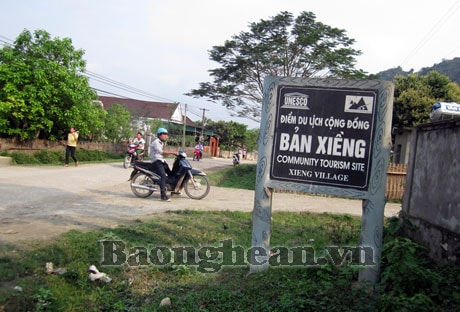
The road to Xieng village.
We went to the village headman, Ngan Van Mai, to ask for permission to visit the village and inquire about how the villagers are developing tourism. He said, "You're very lucky. If you had been a few minutes later, I would have already gone up to the fields." There was a herd of cows waiting for grass up there, so Mr. Mai could only spare us a short time. He explained that the village is considered a community tourism destination due to its unique advantages.
Besides tourism products like stilt houses, brocade fabrics, and folk singing, the village also boasts the scenic Pha Lai dam. The dam is also a tourist attraction that draws a large number of visitors from near and far every year. It also serves as a river landing from which people can take motorboats to the Dan Lai villages upstream on the Giang River. While traveling on the river, one can spot a few nimble monkeys clinging to branches, and many small animals like squirrels and flying squirrels. Some households in the village have purchased motorboats to serve the transportation needs of villagers traveling to and from the upstream villages, as well as official delegations; however, tourist visits are rare, occurring only once in a blue moon.
Since being recognized as a community tourism destination, the village management board has taken a study tour to Mai Chau (Hoa Binh province) to learn about tourism development. There, Lac village has been a tourist destination since the 1960s, so it has a lot of experience in this field. Both Vietnamese and foreign tourists flock there... “The Thai language there is the same as ours, and the stilt houses in our village are just as beautiful as theirs. So why should we be inferior to them? I believe that if we do it the right way, we can be just as successful as them,” Mr. Mai confidently stated.
The scenery of the Giang River and the Pha Lai dam has long been famous, but the story of community-based tourism is only just beginning. Visiting other villages, I realized that stilt houses could also serve as accommodation for tourists. At this point, the locals started thinking about this, but found that their stilt houses still lacked many things, such as enclosed toilet facilities. The stilt houses of the Thai people in Lac village, even though not as tall as those in our village, are fully equipped and can accommodate Western tourists. Meanwhile, those who visit Xieng village often stay overnight in Luc Da or Con Cuong town. Although we've considered structuring some of the beautiful stilt houses in the village to serve as tourist accommodations, investing in renovating these houses would cost tens of millions of dong, so it remains just a plan for now.
The village has a regularly operating weaving group, which has been active since 2008, mainly consisting of women who take advantage of their free time during the agricultural off-season; it hasn't yet become a traditional craft village. Although a cooperative has been established, the income is not as consistent as in the Hoa Tien craft village in Quy Chau. Ms. Ha Thi Hang, the head of the Xieng village handicraft cooperative, said: "Our main customers are still foreign tourists. During the most recent visit of a tourist group from France, the cooperative members earned tens of millions of dong from sales."
On such occasions, the cooperative members take on the additional tasks of cooking traditional dishes and performing cultural shows for tourists. However, only 6-7 groups of tourists visit the village each year, so their main work is weaving brocade.
The elderly people in Xieng village still cherish the traditional folk songs. Through the introduction of Ms. Ha Thi Hang, we found our way to Mrs. Thuong's house. When asked her last name, she replied, "Just call me Mrs. Thuong from Xieng village!"
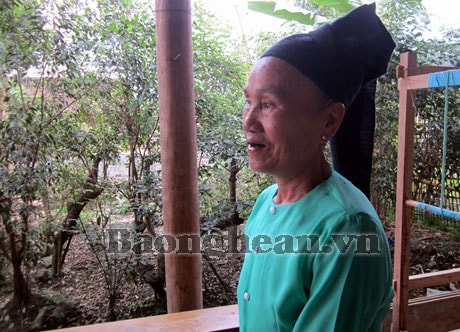
Ms. Thuong, a folk singer from the Thai Folk Song Club.
It was late afternoon when the old woman led her herd of cows through the gate. Hearing from Ms. Hang that I was a journalist and a Thai person who enjoyed folk songs, she quickly tied the cows into the shed. Although well past the age of "ancient wisdom," she was still very sharp. Every step was swift. She said to me in Thai, "I thought young people wouldn't like listening to folk songs." I replied, "But I know the 'xang chu' tune and I'd like to hear you sing it." She chuckled mischievously, "It's only for people of the same age, and only sung when young!" Then she began, "Hey, young man from a distant village/When you come to our village, don't speak so rudely." After a moment's thought, I responded with a folk song from my hometown: "I am just a little bird learning to lay eggs/A young rooster learning to crow..." The folk song seemed out of place with Mrs. Thuong's folk song, causing everyone to burst into laughter.
On ordinary days, I and others in the community only listen to modern music. Though we don't say it out loud, deep down, we always reserve a place for Thai folk music. It's like a wellspring, just waiting for the right moment to flow. That day, Mr. Thuong was also happy because at least he wasn't disappointed that young people loved Thai folk music.
As they parted ways, Mrs. Thuong said, "Meeting you today reminds me of my youth when young men and women would sing folk songs everywhere. The boys would play the flute, the girls would sing, it was so much fun." And Ms. Hang said, "If you want to hear folk songs, I'll call you when there's a wedding in the village. Those occasions are when you can truly experience folk singing..."
Huu Vi


