
A costly lesson!
(Baonghean) - During her pregnancy, 18-year-old Xong Y Ca from Muong Tip commune, Ky Son district, only went for check-ups at the commune's health station twice and did not get any regular vaccinations. On the day of delivery, Xong also did not go to the commune's health station but gave birth at home, with her grandparents assisting and using a bamboo stick to cut the umbilical cord...
With innocent faces and sorrowful eyes, Lầu Bá Cọ (21 years old) and his wife Xồng Y Ca (18 years old), from Huồi Khỉ village, Mường Típ commune, Kỳ Sơn district, looked at their 15-day-old daughter lying on a hospital bed receiving intravenous fluids. They awkwardly listened as nurses at Nghệ An Obstetrics and Pediatrics Hospital instructed them on how to care for their child. Two years ago, Lầu Bá Cọ arranged his marriage according to the traditional customs of the Hmong ethnic group in Mường Típ commune. Having married at such a young age, their family's economy depended entirely on slash-and-burn farming, making their married life very difficult.
Over a year ago, Xong Y Ca became pregnant, much to the joy of her family. Throughout her pregnancy, Xong Y Ca continued to work tirelessly in the fields, and the girl, not yet 18 years old, didn't even consider going for prenatal checkups or ultrasounds. This was partly because her house was too far from the commune's health station, and partly because generations of Hmong people in the village had lived like deer and stags in the forest, rarely going to the hospital unless absolutely necessary. During her nine months of pregnancy, despite encouragement and advice from village health workers, Xong Y Ca only went for checkups twice and didn't get her regular vaccinations as recommended.
On the day of delivery, like other pregnant women in the village, following the customs of the Hmong people, Xong Y Ca gave birth at home. Her mother and mother-in-law assisted with the delivery. Thanks to her good health, Y Ca's birth went quite smoothly. The newborn baby's umbilical cord was cut and the bleeding stopped by her paternal and maternal grandmothers using a bamboo stick they had kept in the kitchen for a long time, following traditional methods. Believing the birth was successful, with both mother and child healthy, Lau Ba Co and his family were overjoyed and invited a shaman to perform a ritual and named the baby Lau Y Ho. After the ceremony, the baby girl showed strange symptoms such as incessant crying, refusing to breastfeed, and appearing stiff, causing the whole family to panic and worry.
At that time, Lầu Bá Cọ's older brother, Lầu Bá Dìa, the Deputy Secretary of the Party Committee of Mường Típ commune, had just returned home from school. Seeing his niece in danger, Mr. Dìa took her through the forest to the Kỳ Sơn District General Hospital for emergency treatment. The hospital then used an ambulance to transfer baby Ho to the Nghệ An Obstetrics and Pediatrics Hospital for urgent treatment of neonatal tetanus. Upon admission, the newborn girl was in critical condition, experiencing continuous convulsions, cyanosis, increased muscle strength, etc. The Infectious Diseases Department of the Obstetrics and Pediatrics Hospital mobilized all doctors and modern equipment to provide emergency care, including mechanical ventilation, gastric tube insertion, and treatment according to the tetanus protocol. Dr. Nguyễn Văn Sơn, Head of the Infectious Diseases Department, said that after more than a week of treatment, Lầu Y Ho has basically overcome the critical stage.
This is a rare and rather miraculous case because normally, babies infected with neonatal tetanus have a very poor prognosis, with most dying. For a long time, we have been working towards completely eliminating neonatal tetanus through vaccination of mothers during pregnancy and absolute sterilization measures during umbilical cord cutting and delivery. However, due to a lack of understanding and complacency, some ethnic minority families in mountainous areas still perform home deliveries, using bamboo sticks to cut the umbilical cord, leading to heartbreaking consequences. "This is truly a lesson for all families, a warning to the people as well as the grassroots medical staff in the villages and hamlets of ethnic minority communities in mountainous areas," said Dr. Son.
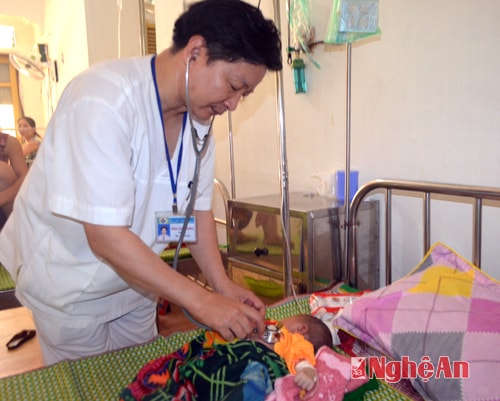 |
| The doctor is monitoring Lầu Y Ho's health. |
After more than a week of caring for his daughter in the hospital, listening to the doctors explain the cause of the tetanus infection and her current health condition, Mr. Lau Ba Co's expression relaxed somewhat. Mr. Co honestly confided: "In our village, every household has a bamboo stick to cut the umbilical cord after birth. For a long time, very few people have gone for vaccinations or regular check-ups during pregnancy." Mr. Lau Ba Dia, Deputy Secretary of the Party Committee of Muong Tip commune, said that not only in Huoi Khi village but also in many other villages in the commune, the economic lives of the people are still difficult, and their awareness levels are limited, so the conditions for medical care are not yet adequate. The case of little Lau Y Ho is a lesson for everyone. By the time the article went to print, we received information that Y Ho had been discharged from the hospital. "After this incident, I will urge the commune and village health workers to actively spread the word to the people, using Ho as an example so that everyone in the villages must go for regular check-ups during pregnancy, and seek medical help from doctors and health workers when they are sick, instead of self-treating at home," Mr. Dia confided...
Nguyen Khoa


