
Bai Lu - Legends and Ideas
 |
He went first, she followed, to the Gate of Heaven.
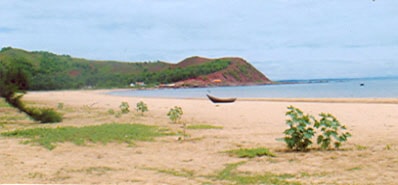
Watch the sunset over Bai Lu beach.
Mist hangs over the mountain slopes, the soul of the Night Tomb.
Over there, at the foot of the hill, the waves of the open sea...
Bai Lu is located in the northeastern part of Nghi Loc district, within the Nghi Yen and Nghi Tien communes, situated in the southeastern coastal arc of Lach Van - Cua Hien - Cua Xa in Nghe An province. It's a region densely packed with mountains and rivers, with vast skies and seas, and countless vivid historical stories, legends, and events.
Bai Lu is a beach with stunning scenery, crystal-clear water, and one of the most tranquil spots in Nghe An province. The name Bai Lu comes from Lu Mountain (Lu Son). The mountain stands majestically by the beach, like a wandering traveler searching for the romantic melody of the waves and the enchanting scent of a young maiden in love. The traveler stops by the temple, offers incense and prays to Buddha, then, as if inspired by the warmth and light of Buddha, decides to stay here. He follows the footsteps, listening to the mesmerizing song of the sea maiden, like the Little Mermaid in a fairy tale. We too are drawn into the ancient folk opera "Quan Am Thi Kinh," following Lu Ngoc as she searches for her beloved, Tieu Hong, in this place.
On the way to Heaven's Gate - Bai Lu, there is a temple dedicated to the Mountain God and the Holy Mother, originally the Ne Temple where the La Hoang River and Khe Ne stream flowed into Cua Hien, which was moved here. The section of the river leading to Cua Hien has now been filled in, and this is where the tragedy of My Chau took place: she was beheaded by her father, King An Duong Vuong, and then, wielding a rhinoceros horn, parted the waves and descended into the sea - Bai Lu. My Chau's tomb in La Nham is located here. The Jade Well is where My Chau's last drop of blood remained, which Trong Thuy looked into and transformed into a sparkling pearl.
The temple dedicated to Princess Bạch Y, the beloved daughter of King Hồ Quý Ly, is located beside the Iron Canal. The canal's water is a vibrant blue, stained by iron ore from Thiết Sơn (Iron Mountain), also known as Thần Vũ Mountain, which was once stained red with blood in the legend of Princess Bạch Y. The story goes that: While the Ming army was busily preparing to invade Vietnam, King Hồ Quý Ly and his sons Nguyên Trừng and Hán Thương actively built bases and deployed forces throughout the land to resist the invaders. The king ordered the construction of the Hồ Dynasty Citadel on Đại Huệ Mountain and mobilized the people to dig the Iron Canal to transport food and weapons along the river to Đại Huệ. The digging dragged on for many days without success due to obstacles such as iron ore rocks and collapsing sand; the soldiers and laborers were exhausted, and many died. Impatient, King Hồ sent his beloved princess, with her enchanting singing voice and exceptional musical talent, to encourage and motivate the people to dig the canal more quickly. The extreme suffering caused by the soldiers and laborers digging the canal moved the princess's heart. A kind old man from a nearby village advised her, and they devised a plan to stop her father's canal digging work and save the laborers. They cut down all the Bloodwood trees in the area, chopped them up at night, and scattered them into the canal bed. By morning, the entire unfinished section of the canal was stained red with blood, a truly horrifying sight. They told her father that the canal digging had disturbed the dragon's vein (severing the dragon's neck), and that the work should be stopped. This plan was exposed, and King Ho ordered his beloved daughter beheaded on a rock by the canal bank as a warning. The rock (where the princess was beheaded) was struck by a powerful lightning bolt in broad daylight and split in two, hence it became known as the Split Rock. From then on, the princess, unjustly killed, appears nightly as a girl in a white dress wandering along the banks of the Iron Canal. Out of compassion for her, the people erected a temple in her honor, calling it the White Robe Princess Temple, located right next to Hon Ne. The White Robe Princess has become a sacred deity – a holy mother who protects the people of Nghe An province.
During the reign of Emperor Thieu Tri, in the second year (1842), while sailing on the Iron Canal, the Emperor heard stories about the legend of this place and stopped to compose a poem. He then had a stone stele erected as a commemorative marker. The stele still stands on the hillside, hidden among thorny bushes, about 10 meters from National Highway 1A, in So Mountain, Dien An commune, Dien Chau district. The poem (translated by the author of this article) is as follows:
Crossing thousands of mountain peaks and surrounded by streams,
Listen to the story of the Creator of old.
The Iron Pit was shattered, leaving behind visible marks.
By divine providence, the ports were opened, allowing for the free flow of water.
Such mysterious and wondrous principles exist.
This flat land is a place where the world prospers.
No mountain in Lung Thuc dares to compare.
Cultivating a great tree is truly wonderful.
The Iron Canal, also known as Thiet Cang, is so named because it flows around the iron mountains and is considered one of the eight most beautiful scenic spots in the ancient Dong Thanh district. A map written in Chinese characters during the Nguyen dynasty notes Thiet Cang as follows: "Thiet Cang runs from Cam Giang to Thien Uy Cang, 10 li long, 4 truong wide, 4 chi deep at high tide, 2 chi at low tide." 10 li is approximately 4 km. Thus, the Iron Canal runs from Cam Giang Bridge to near Cuong Temple, near My Ly station, at kilometer marker between Hanoi and Vinh (27-28). At this section of the canal, where it branches off towards Bai Lu, at kilometer marker 21 pointing towards Vinh, there is a beautiful iron rainbow bridge crossing the canal to the monument commemorating the Le Dynasty Canal. Below the monument are stone steles inscribed with the names of the transport soldiers who sacrificed their lives for the revolutionary cause on the Le Dynasty Canal. The Iron Canal is also a fascinating attraction for tourists visiting Bai Lu. On the road from Hanoi to Vinh, from Mo Da Mountain, where the An Duong Vuong Temple is located, the road, river, and railway run side by side, winding through the majestic mountains, creating a vibrant picture worthy of the ancient poems praising it:
The road to Nghe An is winding.
The green mountains and clear waters are like a painted picture.
Standing on Mount Lữ, one can admire the panoramic view of a vast area. To the southeast, one can clearly see Song Ngư, Mắt Island, Lan Châu, and closer to the mainland are Hùng Lĩnh, Lan Châu, Núi Rồng (Dragon Mountain), Núi Lò (Lo Mountain), Núi Cờ (Co Mountain), Núi Kiếm (Sword Mountain), Chuồng Gà (Chicken Coop), Núi Mão (Mao Mountain), Tượng Sơn (Elephant Mountain), Quyết Sơn (Quyết Sơn Mountain). To the north, along the coast, are Đầu Rồng (Dragon Head Mountain), Hòn Thè (Thè Island), Hòn Câu (Câu Island), Dạ Sơn (Dạ Sơn Mountain), Cấm Sơn (Cấm Sơn Mountain). To the west are Đại Vạc (Đại Vạc Mountain), Thần Vũ (Thần Vũ Mountain), Lèn Hai Vai (Hai Vai Rock), Đại Hải (Great Sea), Đại Bàn (Great Table), Đại Tứ (Great Tứ Mountain), Đại Huệ (Great Huệ Mountain), Thiên Nhẫn (Heavenly Blade Mountain), Lam Thành Sơn (Lam Thành Sơn Mountain)... The clear blue waters of the Cấm River flow towards Cửa Lò beach on the right bank of Bãi Lữ, further enhancing the beauty of the "Heaven's Gate" landscape – the waves of Bãi Lữ beach.
With its stunning natural landscape, some have likened Bai Lu to a "Da Lat on the sea." Bai Lu Investment and Business Joint Stock Company is the investor behind the Bai Lu Beach Ecotourism Area, covering nearly 160 hectares, featuring mountains, forests, and the sea. The project is divided into two phases: Phase I (2005-2008) – completion of the high-end beachfront resort in Bai Lu. Phase II (2008-2015) – construction of a 5-star hotel on the mountainside, a casino, a helipad, a miniature Great Wall of China, a golf practice range, a musical fountain, a cultural and sports complex, and other entertainment services.
Currently, many tour groups and tourists have come to Bai Lu for relaxation, swimming, and sightseeing. If the Bai Lu project is completed, it will certainly be one of the most ideal resort destinations in Nghe An and the whole country. Mr. Nguyen Bang Toan, Chairman of Nghi Loc District, even has the idea of developing the Bai Lu Eco-tourism Area to be on par with major tourist areas in Southeast Asia, in order to attract more international tourists!
Dao Tam Tinh -Director of Nghe An Library


