
Green sticky rice cake on the island
(Baonghean) - Overcoming countless storms and rough seas, bundles of green banana leaves from the mainland have reached the frontline islands, bringing the taste of Tet (Vietnamese New Year) from home to the soldiers stationed there. The green sticky rice cakes, wrapped in square banyan leaves and banana leaves, are cherished and treasured by the soldiers, as if they are carrying within them all their longing for home and their unwavering determination to hold their weapons firmly to protect the sea and islands of the Fatherland!
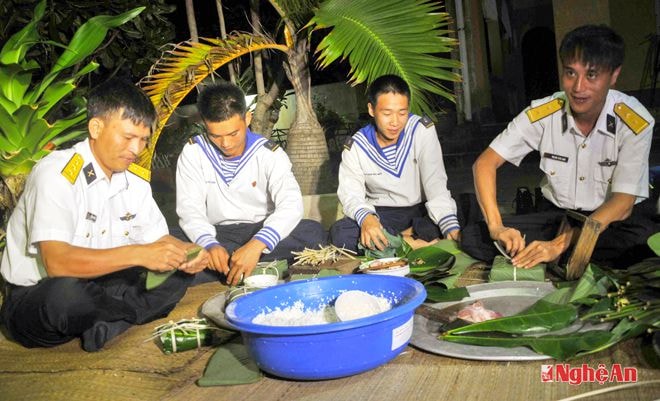 |
| Making banh chung (traditional Vietnamese rice cakes) in preparation for Tet (Lunar New Year) on the island. |
Stepping off the pier at Cam Ranh naval port on a late winter day to head to Truong Sa for the troop rotation and withdrawal mission at the beginning of 2015, each soldier felt an indescribable excitement in their hearts. It was a journey where the soldiers' baggage included not only personal military equipment, but also bags and pouches filled with silk lotus and apricot blossoms, photo albums, sets of flashing lights, and small packages of colorful fabrics and paper for decoration... And most importantly, there were bundles of fresh dong leaves, bamboo stalks, and hundreds of pigs, distributed equally among four naval ships to the remote islands.
These scenes, though seemingly ordinary, evoke deep emotions. In a corner of a large military port, sounds and images suddenly fill the air, reminiscent of a peaceful Vietnamese village bustling with excitement as it prepares for Tet (Vietnamese New Year). These moments bring a sense of closeness to the distant islands, and the warmth of the mainland is carried along, spreading warmth to these remote locations.
Ship 571 (the Truong Sa ship), on which we were aboard, arrived at Truong Sa Dong Island on the third day of our voyage. When delivering Tet gifts, goods, and necessities to the first island outpost, we were disheartened to see the bundles of banana leaves beginning to dry and curl at the edges. Colonel Phan Ngoc Quang, the head of the task force, couldn't hide his impatience, knowing that the sea voyage still involved passing through 11 more islands and would take at least two weeks to reach the final island, Tien Nu Island.
The weather in Truong Sa during winter is still hot and sunny, and combined with the heat from the cargo hold, it poses challenges in ensuring that the banana leaves do not spoil. After a quick consultation, the "order" was given to assign soldiers to regularly rearrange the bundles of banana leaves, water them with fresh water, and protect them from saltwater and sea breezes.
Upon reaching the islands of Da Dong, Phan Vinh, Toc Tan, Nui Le, and Tien Nu, the officers and soldiers were not discouraged by strong winds and high waves while transporting goods from the ship to the boats, their only concern being... the damage to the banana leaves. The islands in the archipelago are relatively close to each other; on our journey, the furthest distance was from Truong Sa Dong Island to Da Dong (about 60 nautical miles), while the remaining islands were spaced an average of 15-25 nautical miles apart.
However, reaching each island usually takes 1 to 2 days. The islands are all located on large coral reefs, spanning hundreds or thousands of hectares. To travel from the ship to the islands by boat, especially towards the end of the year, it's only possible in the afternoon, as that's when the tide is high enough for the boat to pass through the coral reefs, a distance of about 3 to 7 nautical miles. Fortunately, after the 12th day of the journey, ship 571 brought us to the final island of our trip - Tien Nu Island, where the banana leaves transported to the islands were still of good quality for wrapping banh chung (Vietnamese rice cakes).
On Tien Nu Island, a submerged island at the easternmost point of the Truong Sa archipelago, 375 nautical miles from the mainland, Lieutenant Vo Van Thuong (from Hao Kiet village, Vinh Thanh commune, Yen Thanh district) said: "Among the goods brought from the mainland for Tet, banana leaves are one of the things the officers and soldiers on Tien Nu Island look forward to the most. Because Tien Nu Island is the furthest island on the journey, in many years, by the time the ship arrived, the banana leaves had already spoiled, dried out, and become unusable for wrapping cakes. That year, the Tet spirit was greatly diminished, because on the submerged island, it was impossible to find any other leaves to replace the banana leaves for wrapping cakes. This year, receiving bundles of fresh banana leaves, the soldiers are overjoyed. The soldiers on Tien Nu Island will continue the regular preservation process to keep them fresh until the 28th or 29th of the 12th lunar month for wrapping cakes. To keep the banana leaves fresh until the day of wrapping cakes for Tet, they have planned to put the leaves in a cold storage compartment." I now understand the immense yearning of these naval soldiers to rediscover the flavors of Tet (Vietnamese New Year) from their hometowns. This further deepens my appreciation for those who have chosen such a challenging profession, accepting hardships and sacrifices for the sake of their sacred and noble duty.
After completing the handover of new troops at the island outposts, Ship 571 continued its journey to receive the troops who had completed their mission and organized a Spring Festival celebration with the officers and soldiers on Phan Vinh Island. Captain Trinh Trong Luong, Deputy Political Officer of the island, said: "Previously, the officers and soldiers on Phan Vinh Island wrapped banh chung (traditional Vietnamese rice cakes) in square banyan leaves. In recent years, due to the timely delivery of dong leaves to the island during Tet, they have been using dong leaves. However, dong leaves often dry out and lose their green color by the time they reach Truong Sa. Therefore, when wrapping banh chung, the inner part is still wrapped in square banyan leaves to keep the cake green, while the outside is wrapped in dong leaves. In these difficult conditions, to ensure that there is a 'green banh chung' on the Tet feast table, the officers and soldiers have created a unique Truong Sa banh chung."
The traditional bánh chưng, as in the legend of Prince Lang Liêu, son of King Hùng Vương VI, symbolizes the earth, while bánh dày symbolizes the sky. The outer leaves and the filling represent the parents who gave birth to them. In Trường Sa, bánh chưng is wrapped in square banyan leaves along with dong leaves, symbolizing the unified body of Vietnam and Trường Sa as a sacred part of the Vietnamese nation, surrounded by the mainland and an indispensable part of Vietnam. On these remote islands, the naval soldiers and people of Trường Sa still make bánh chưng to offer to their ancestors and the heavens during the New Year's Eve and the three days of Tet. Despite the difficult and challenging circumstances, the vitality of Vietnamese culture remains strong and leaves a deep mark on every inch of the nation's sovereign land.
Ngo Kien


