
Alarm raised over workplace safety issues at construction sites.
(Baonghean) - In recent years, the demand for infrastructure and housing construction has increased, leading to the strong growth of freelance construction work, which is considered an easy way to make a living. However, worryingly, the issue of workplace safety for freelance construction workers is being neglected...
Danger is imminent.
We visited one of the three-story houses under construction in the Tecco planned area - Hamlet 18, Nghi Phu (Vinh City), where workers were working at heights of dozens of meters without any safety equipment.
To reach their work area, besides climbing several flights of stairs without railings, they also had to ascend a makeshift ladder constructed from thin wooden planks. Yet, the workers continued to move around, mix mortar, and build walls as usual. Materials were transported up using a winch with two wooden poles tied diagonally and precariously positioned on the wall.
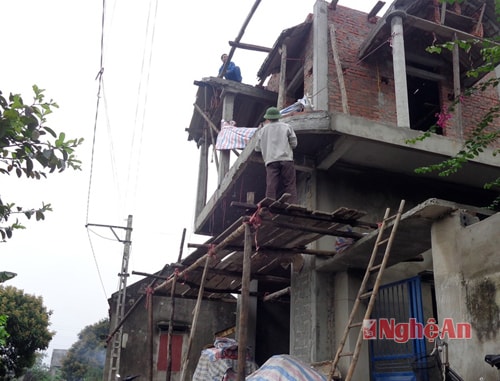 |
| The construction workers working at heights in the residential building project lacked any personal protective equipment (photo taken at a residential construction site in Hamlet 13, Nghi Phu Commune). |
Mr. Le Van Ha, a construction worker residing in Phuc Tho commune (Nghi Loc district), said: “In the beginning, I was very scared, but I got used to it and now I'm not afraid of heights anymore. Most of us became professionals through construction work as assistants; few have received proper training. This is a dangerous job, and we just remind ourselves and each other to be careful at work.”
At another construction site, a worker carried a long wooden beam, stepping from one end of the newly built wall to the other like a tightrope walker in a circus. On the formwork floor, countless pieces of nailed planks lay scattered haphazardly. Looking out from the fourth floor of this building, the surroundings resembled a massive construction site: some houses were being built, others had their roofs poured, and some were having their walls plastered… Several workers stood precariously on wooden scaffolding.
One worker added: "Working at height without proper safety equipment is a bit scary for newcomers, but we've been doing it for a long time so we're used to it. Having steel scaffolding would be safer, but it's heavy to move and takes a lot of time to assemble and disassemble. That's why contractors always use wooden scaffolding to save on costs and transportation."
Floating management
In recent years, many localities in the province have seen rapid development of housing infrastructure, leading many workers to choose construction as a means of livelihood. For large, reputable construction companies, the signing of labor contracts and hiring of workers are transparent. Workers must meet certain strict requirements set by the company before being offered a contract, along with labor insurance benefits. Meanwhile, private contractors hire seasonal workers with no requirements beyond skill, and without labor contracts or accompanying benefits.
Currently, several freelance construction teams, formed by private contractors, consist of around ten people, depending on the project. Typically, private construction projects today are governed by very strict contracts. The homeowner provides the construction site and supplies materials. The contractor is responsible for the quality of the work, the construction schedule, and all workplace safety issues. That's the contract, but in reality, things often turn out quite differently.
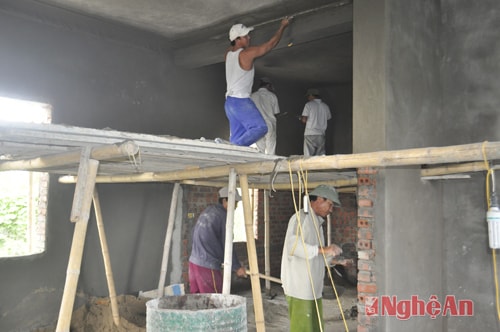 |
| The construction workers were provided with virtually no personal protective equipment. |
Mr. Tran Van Tho, a contractor in Nghi Duc commune (Vinh City), said: “Currently, freelance construction teams are springing up like mushrooms, so the competition is quite high. Therefore, we have to take on many projects at once to earn a living. Workers in teams like ours are usually acquaintances or relatives. When working, we often remind each other to be careful to avoid accidents, but it's difficult to address issues related to occupational safety. In over 10 years of doing this job, my construction team has never had a serious accident. When constructing houses in Vinh City, I often see the order enforcement teams from the wards and communes come to supervise whether the construction is according to the plan and design, but I've never seen them inspect occupational safety and health.”
Although there are no specific statistics on workplace accidents in freelance construction, the reality is that there have been quite a few accidents in this profession, ranging from minor injuries to disability or even death.
From this situation, it is clear that to overcome the risks of occupational accidents for freelance workers, it is first necessary for project owners and construction contractors to be self-aware in complying with the law and regulations of the State in the construction sector; improving the quality of construction projects and ensuring absolute occupational safety both during the construction process and upon completion and commissioning. In addition, relevant agencies and local authorities also need to play a more active role and take responsibility in inspecting and supervising occupational safety for residential construction projects in their localities.
| Ms. Nguyen Thi Huong, Chief Inspector of the Department of Labor, Invalids and Social Affairs, stated: "Currently, it is very difficult to handle cases of occupational safety violations among freelance construction workers because there is no one to manage them, and no one takes responsibility. If an accident occurs, they do not report it to the authorities or the government. Freelance workers and those employed by rural laborers for construction companies are not trained, and their awareness of occupational safety is low. Usually, when an accident occurs, the employer and the worker reach an agreement and compensation on a voluntary basis, because both parties had previously signed a construction contract stipulating that the worker is fully responsible for occupational safety. We have also not encountered any cases where workers or their family members sue the contractor after an accident because, in reality, part of the fault also lies with them." |
Minh Quan
| RELATED NEWS |
|---|


