
When will folk singing from the weaving quarter become a tourism product?
(Baonghean) - For a long time, the people of Nam Dan have been nurturing the idea of preserving the traditional folk singing style of "hat vi phuong vai" to entertain tourists.However, much work remains to be done to make folk singing from the weaving quarter an attractive tourism product.
Folk singing (Hát ví phường vải) has become an integral part of the spiritual life of the people of Nam Đàn. It has gone through many ups and downs, and at times seemed on the verge of being forgotten. In the 1970s and 80s, it was revived, but later, due to the influence of the market economy, it faced many difficulties. Recently, we visited Xuân Hòa to see the Folk Singing Club, chaired by Mr. Đinh Xuân Tình – Chairman of the Elderly Association of the commune. The club's strength lies in the participation of folk artist Nguyễn Thị Hai (90 years old), who is considered the "soul" of the club.
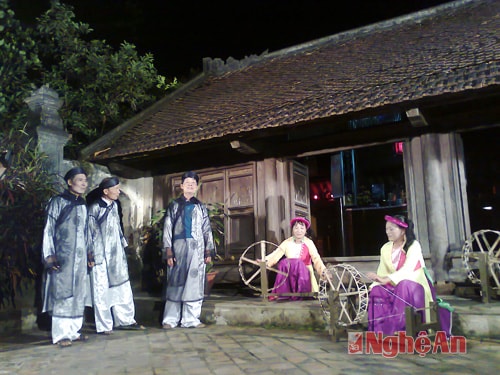 |
| Folk singing of the weaving guild performed in Kim Lien commune, Nam Dan district. Photo: Xuan Tam. |
Considered one of the most effective clubs in Nam Dan, it still operates on a "scheduled" basis. Despite having a management board, it has yet to establish specific operating regulations due to a lack of funding. Each time it performs, the elderly members of the club have to handle everything themselves. In a conversation with artisan Nguyen Thi Hai, I learned of her deep concern: how to get the club's attention from the local government, even if it's just a small celebration after the club's successes; how to raise funds for regular club activities, even if only once a month; and how to encourage younger generations to love folk singing like their elders did… As for Mrs. Ho Thi Mao, the club members have more than enough passion. During rehearsals for the Village Lotus Singing Festival or performances on Senior Citizens' Day, the elderly still diligently practice day and night, hoping to pass on many melodies to their descendants and compose new lyrics... only then can folk singing from the weaving village truly become a part of life and fully showcase the beauty and charm of their homeland's melodies.
In a conversation with Mr. Tran Van Sinh (cultural officer of Xuan Hoa commune), it was learned that, in fact, the local government has not yet had any mechanisms, policies, or financial support for the club's activities. This is partly due to the commune's limited budget, and partly because the commune's cultural officer has not been actively involved in advising, supervising, or closely monitoring this issue. Therefore, the club has faced many difficulties in its operation. In the future, with their responsibilities, the commune's cultural officer will advise the Party committee and the government to provide financial support to enable the club to operate more regularly.
Meanwhile, at the Kim Lien – Nam Dan folk singing club, which boasts the highest number of folk artists awarded the title in the province, only 10 remain, and the club's activities are not very promising. They hold regular meetings two or three times a year; whenever there's a performance or festival, they gather to reminisce about excerpts and ancient lyrics. When asked about his concerns, Mr. Tran Van Tu (85 years old), the club's chairman, explained: "The club members are all elderly, and we lack funding despite numerous requests and proposals to the commune and district levels, but nothing has changed. However, Mr. Tu's greatest worry is that the artists are getting older and will eventually pass away, yet passing on their skills to the younger generation remains a difficult task. Their passion cannot overcome the 'worry of making ends meet.' In the old days, the elders sang and played in the folk singing clubs because society at that time was less competitive; they wore what they had and ate what they could find." However, nowadays society has developed and progressed; village roads and alleys are all paved with concrete, and people are forced to keep up with this industrialization and modernization, so they are compelled to think about economic development. Ultimately, we can't blame the younger generation, but it's sad that fewer and fewer people are participating in the folk singing club. And when our generation "returns to dust," will we be able to maintain the folk singing club?
When discussing this issue with Mr. Le Xuan Tam – Deputy Director of the District's Culture and Information Center, we learned that: In 2006, the Nam Dan District People's Committee issued the Project "Preservation and Promotion of Phuong Vai Folk Songs in Nghe An - Ha Tinh Folk Songs," with the aim of preserving and promoting Phuong Vai folk songs so that this art form becomes a tourism product serving domestic and foreign tourists visiting Nam Dan. However, to date, after more than 7 years of implementation, the project still faces many difficulties and obstacles, such as the melodies not being appealing to young people; the number of dedicated professionals with in-depth knowledge of Phuong Vai folk songs is still too small; and the connection between the new and the old among generations is still uneven. Although some Phuong Vai folk song clubs have been formed, their activities are not continuous or regular, and are still seasonal and spontaneous, participating in rehearsals only when there is a performance, thus lacking maturity in the craft; And a perennial reason is that the operating funds of these clubs are passive, mainly depending on the members themselves, with no support (even minimal) from the local government.
To revive and promote the folk singing tradition of the "Phuong Vai" folk singing style, the district's Department of Culture and Sports annually selects key individuals, forms teams, and includes these folk songs in provincial-level folk art festivals, competitions, and performances such as the "Lang Sen Singing Festival" and the "Folk Song and Instrument Festival." To date, many localities have revived and developed this style, including Xuan Hoa, Nam Giang, Nam Thanh, Khanh Son, Nam Tan, Nam Loc, and Nam Nghia. A prime example is the "Hoang Thi An" Folk Singing Club in Kim Lien commune, which attracts a large number of members of all ages and operates in an organized manner, contributing significantly to the collection and preservation of the folk songs of the homeland. Notably, during the annual Lang Sen Singing Festival, held in conjunction with the Lang Sen Festival, the district's Department of Culture and Sports stipulates that participating teams must include a performance of "Phuong Vai" folk singing.
In the coming time, Nam Dan will continue to encourage all levels of people to participate in the "Phuong Vai" folk singing tradition, linking it with other forms of community cultural activities. The province will continue to improve the form, quality, and content of the performances to create appeal and attract enthusiastic participation from young people. Viewing "Phuong Vai" folk singing performances will be included as part of the tourism program at the Kim Lien historical site and other historical sites and scenic spots in the district. Hopefully, when Nghe An folk songs are recognized by UNESCO as an intangible cultural heritage of humanity, Nam Dan's "Phuong Vai" folk singing in particular, and Nghe Tinh folk songs in general, will become an attractive cultural tourism product for domestic and international tourists visiting Nam Dan, Nghe An.
Thanh Thuy


