
Shortcomings in the management and licensing of private housing construction.
(Baonghean)Although Thai Hoa Town was established more than 5 years ago, the management and licensing of private housing construction still have many shortcomings, affecting urban aesthetics, planning, and the safety of buildings.
Quang Tien is one of the four central wards of Thai Hoa Town. According to regulations on urban planning and order management, after being recognized as a town, the construction of private houses requires a building permit. However, due to limited awareness, many households violate these regulations, failing to complete the building permit procedures. Even if they do have permits, the procedures are often rudimentary and merely perfunctory (such as incomplete or incorrect application forms, missing or poorly designed plans, and missing site plans). Statistics from the first six months of 2013 show that 15 households in the ward built houses without registering for building permits with the ward. The ward People's Committee has established inspection teams to handle violations, but the situation remains uncontrolled.
Explaining the reasons for violations in the field of private housing construction permits, Ms. Nguyen Thi Kim Oanh, Chairwoman of the People's Committee of Quang Tien Ward, Thai Hoa Town, said: "People's awareness of granting private housing construction permits is still limited, and some even know it's wrong but still proceed. The ward does not have a dedicated urban regulations team; the staff are part-time and have limited expertise in construction permit issuance, making it very difficult to control all aspects of the work."
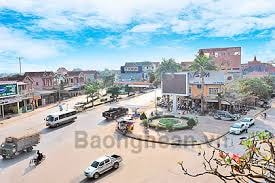
A view of Thai Hoa town.
It can be said that, although Thai Hoa Town has been established and operating for 5 years, meaning that the work of restoring urban order and managing construction permits has also been going on for the same amount of time… However, to date, this work has not been strictly managed or standardized, and violations in the field of private housing construction permits are still common in wards and communes. For example, although private housing construction is still taking place daily and the number of households is very large, the number of permits issued is not high, especially in rural areas, where almost no construction permits have been issued. In 2012, the town only issued permits for 13 cases, and in the first 6 months of 2013, it was 16 cases. The results of reviewing illegally constructed family homes from 2010 to the present in some wards and communes are as follows: Tay Hieu commune has 103 cases; Dong Hieu commune has 101 cases…
To address shortcomings and enhance urban management in the area of construction permits, the Town's Urban Management Department has advised the Town People's Committee to direct the issuance of construction permits and coordinate with the tax authorities to strictly manage the collection of construction taxes. Annually, the town organizes training for wards and communes, from the chairpersons of the People's Committees to the officials responsible for issuing construction permits, to ensure they are up-to-date on relevant documents and procedures for construction permits.
Mr. Nguyen Ngoc Tuan, Head of the Urban Management Department of Thai Hoa town, said: “Currently, the People's Committee of Thai Hoa town is reviewing and rectifying the issue of unauthorized construction projects throughout the town. However, the town has not yet established a Town-level Urban Inspection Team or Ward-level Urban Regulations Teams (only Hoa Hieu ward has established one on its own). Regarding this issue, Thai Hoa town has developed a plan to establish Urban Regulations Teams in wards and communes to strengthen the specialized team for managing urban order, but there are still obstacles related to mechanisms and policies, and there are no legal regulations or procedures guiding the implementation.”
Thai Hoa town is aiming to become the Northwest regional center of the province. However, reality shows that during the transition from village to town, residents have not yet adapted to urban life and lack understanding of their civic duties in the new administrative unit. Meanwhile, one of the tools for managing urban order in Thai Hoa town is the issuance of construction permits, but this is still lax and not strictly managed, leading to revenue losses and consequently limiting the management of urban infrastructure. In addition, the inspection and handling of violations lack decisiveness and fail to create a deterrent effect on violators.
This situation not only negatively impacts urban aesthetics, but also highlights the numerous difficulties and shortcomings in urban order management within the town that need to be addressed. To overcome this, the town needs comprehensive measures to effectively manage this work, especially by strengthening public awareness campaigns to enhance people's understanding and responsibility in contributing to building a civilized and modern town.
Text and photos: Le Thanh


