
French elections: Francois Hollande leads.
Preliminary results announced at 8 PM local time on April 22nd (1 AM on April 23rd Vietnam time) by French television at Paris City Hall showed Socialist Party (PS) candidate Francois Hollande leading with 28.4% of the vote, while incumbent President Nicola Sarkozy, the candidate of the Union for a Popular Movement (UMP), received 25.5% of the vote in the first round of the 2012-2017 French presidential election. These two candidates will continue their race in the second round, which will take place on May 6th.
Preliminary results announced at 8 PM local time on April 22nd (1 AM on April 23rd Vietnam time) by French television at Paris City Hall showed Socialist Party (PS) candidate Francois Hollande leading with 28.4% of the vote, while incumbent President Nicola Sarkozy, the candidate of the Union for a Popular Movement (UMP), received 25.5% of the vote in the first round of the 2012-2017 French presidential election. These two candidates will continue their race in the second round, which will take place on May 6th.
According to these published results, in the first round of the French presidential election, the voter turnout was 20% of the 44.5 million eligible voters, higher than the 16.2% in the 2007 election but much lower than predicted. However, as predicted by polls close to the first round, the leaders of the two largest parties in France secured the highest voter support to advance to the second round.
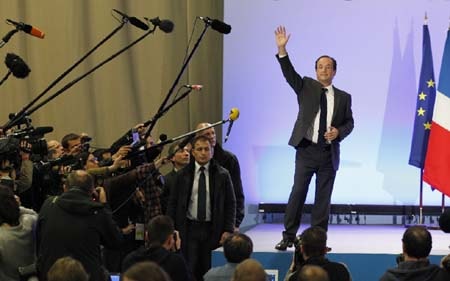
Francois Hollande gives an interview after leading in the first round. Photo: AFP-TTXVN
The biggest surprise in the first round of the election was candidate Mari Le Pen, who finished third with 20% of the vote, compared to the 10% her father, Jean Mari Le Pen, achieved in the 2007 election. In her first presidential campaign, the National Front (FN) candidate achieved a record-breaking score, surpassing her 16.86% lead in 2002.
Contrary to expectations, Jean Luc-Mélenchon, the candidate of the Left Front, whose core is the Communist Party and the Left Party, only garnered 11.7%, settling for fourth place. However, public opinion considers the double-digit result a remarkable success for the left-wing coalition, and this victory will have significant implications for Hollande's chances in the second round.
The biggest disappointment in the first round was Françoi Bayrou of the Democratic Movement (MoDem), who received only 8.5% of the vote and had to settle for fifth place.
Preliminary results show that the incumbent French president's popularity has significantly declined compared to the 2007 election, when he won 31.18% of the vote. Speaking after the announcement of the first-round results, he reiterated his desire to hold three live debates with his opponent Hollande before the second round. "I propose three debates focusing on socio-economic issues, social issues, and international issues," he emphasized.
However, Sarkozy's proposal was once again rejected by his opponent Hollande. "We don't have to change the organization just because of the bad results. We just need a debate with sufficient time," the Socialist candidate emphasized in front of a large number of domestic and foreign journalists. Speaking in Tulle, a left-wing stronghold in central France, after the preliminary results were announced, he asserted that French voters had "given him the best possible position to become the next President of the Republic."
In the first round of the election, Hollande won overwhelming support in the overseas provinces, with 53.29% of the vote compared to Sarkozy's 17.96%. In Martinique, he secured 51.98% of the vote, and in Guadeloupe, he received 57%.
Reportedly, as many as 700 journalists from 33 countries and territories around the world are closely monitoring the developments of this year's French presidential election.
According to the News


