
Wild chicken trap
(Baonghean) - Currently, eating wild chicken meat and raising wild chickens as pets is a "trend". This has created an unprecedented craze for hunting wild chickens in the forest areas of Nghe An province.
Hai, a seasoned trapper from Quang Thanh, Yen Thanh, agreed to take me on a wild chicken hunting trip. Hai's equipment was quite elaborate: decoy chickens; cassette tapes; 10 snare traps and numerous other traps and trail traps; and plenty of food and water...
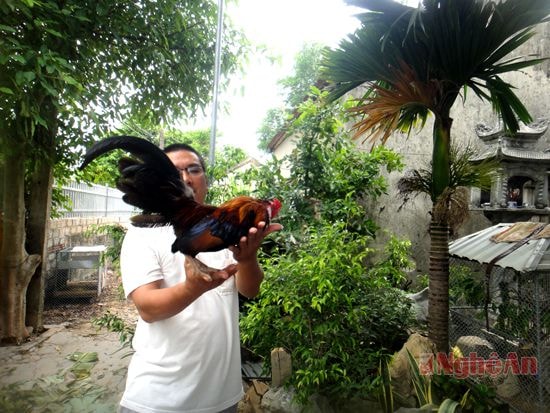 |
| A wild chicken used as bait is priced at 3 million VND by a chicken trapper in Quang Thanh commune, Yen Thanh district. |
The place we went to was the forest area of the 6th Youth Volunteer Brigade (bordering three districts: Yen Thanh, Nghia Dan, and Tan Ky). We arrived at a valley with many bushes. Hai crawled into the bushes to set traps along the trails. According to Hai, it takes experience to identify the trails that wild chickens frequently use in order to set traps. If a wild chicken walks through and steps on the trap, its leg will be caught.
After setting more than 10 traps along the trail, Hai continued to lead me deeper into the forest, choosing an open area beside a small stream to set up his snare traps. These traps were made from bicycle brake cables tied to nylon ropes forming a noose. Hai tied all 10 traps to forest branches, hammered nails into the ground, and covered them with dry leaves. Then he placed a decoy chicken in the middle. He had also caught this decoy chicken, raised and trained it, and it was very effective at luring wild chickens. The final step was to play the sound of wild chickens crowing on a cassette tape to assist the decoy. Hai explained that these "forest birds" are very clever; even the slightest noise would make them fly away and never come near again. So, after setting the traps, we hid behind the bushes, holding our breath and waiting...
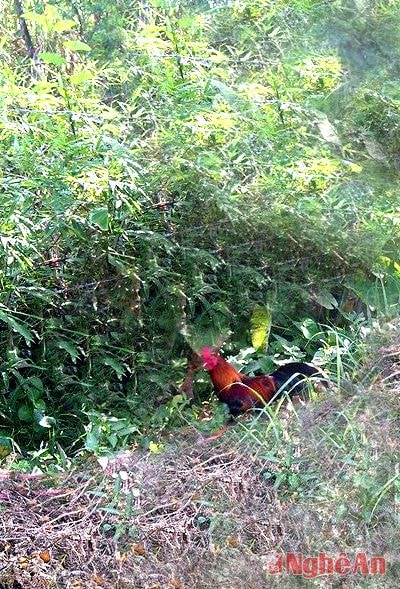 |
| A wild chicken is being used as bait. |
As if understanding its owner's intention, the decoy rooster stretched its neck and crowed loudly, its crowing echoing throughout the forest. After a few crows, it stood still to rest. The sound of wild chickens from the cassette player hidden under the tree continued to "crow" at full volume, providing realistic support. More than two hours passed without any sign of activity. I was frustrated and told Hai we should go home, but he whispered to me: "Trapping wild chickens requires patience. It's June and the sun is blazing hot. They're out foraging, but they'll definitely come to this stream to drink." "There are just as many wild chickens in this area as in the forests of the high-altitude mountainous districts," Hai said. Before he could finish, a wild chicken crowed in response from the bushes in front of him. Following the crow, a beautiful wild chicken, with red feathers, lead-colored legs, long, sharp spurs, and pure white ears, flew towards him. It ruffled its neck feathers, glaring at the decoy chicken – the intruder in its territory – as if ready to strike, but it kept its distance to assess the situation. At that moment, the decoy chicken also stretched its neck and crowed provocatively. Unable to bear it any longer, the wild chicken, enraged, lunged forward. Suddenly, with a "snap," it was caught by its leg, thrashing about and squawking loudly. Hai winked, smiled, and ran to free the wild chicken, putting it into a cage.
Looking at his "prize," Hai exclaimed: "We're lucky, brother! This one is a rare, multicolored one, worth almost 3 million dong. Let's go home!"
After clearing away the snares, we returned to the valley to remove the traps along the trail and caught two more wild hens. With the current price of wild chicken meat at 300,000 VND/kg, Hai had earned 600,000 VND, plus the five-colored rooster he sold to wealthy collectors for ornamental purposes, which fetched between 2.5 and 3 million VND. It was truly a lucky day for a chicken hunter.
Hai confided, "In the past, there were many wild chickens; some days I could trap a dozen, but now there are so many hunters that they're rare. In my village, there are more than a dozen professional chicken trappers. The number of amateurs is countless. Every household in this area knows how to trap wild chickens." Returning via another stretch of forest, we heard the loud crowing of wild chickens, but according to Hai, those were decoy chickens and the sounds of roosters in the caststables used by the wild chicken trappers.
To learn more about the poaching of wild chickens, we traveled to the mountainous districts of Con Cuong, Tuong Duong, Ky Son, and Que Phong... In these areas, the number of wild chicken traps is even greater than in the lowland forest regions. Traps are set everywhere, and many people even enter the Pu Huong Nature Reserve and Pu Mat National Park to trap wild chickens. Some even bring flintlock guns and sporting rifles to hunt them. Ha, a hunter in the Bai Phu area of Con Cuong, said: “We go into the forest for a day and a night and can shoot about 20 or 30 wild chickens. These spoils are sold to specialty restaurants for 150,000 VND per dead chicken.” I asked if there were many wild chicken hunters in Con Cuong. Ha replied: “It’s impossible to count them; in my village alone, there are dozens of professional trappers and shooters.”
According to our research, hunting wild chickens is not only a livelihood for farmers but also a hobby for some wealthy individuals who drive luxury cars and carry sports rifles. These wealthy individuals even bring along imported liquor, electric grills, and other equipment for hunting trips lasting several days...
Mr. Vi Van, from Mon Son commune, Con Cuong mountainous district, confided: "In the past, wild chickens were incredibly numerous in the villages; they even came to 'interact' with domestic chickens. Every morning, the wild chickens would crow loudly. However, due to excessive hunting, they are now scarce. Hunters now have to go deep into the forest to hunt wild chickens." Mr. Van sighed: "At the current rate of hunting and extermination, it won't be long before rare and endangered wild chicken species listed in the Red Book in the forests become extinct. Destroying the ecosystem means destroying the living environment..."
The increasing poaching of wild chickens not only puts this "forest bird" at risk of extinction and disrupts the ecological balance, as Mr. Van warned, but it also poses many safety risks to the forests. Many individuals exploit the hunting of chickens to hunt other rare animals and illegally exploit forest resources.
Furthermore, hunting wild chickens is also a dangerous profession, as there have been many cases of people being bitten by venomous snakes or accidentally shot while hunting, resulting in death in localities such as Ky Son, Que Phong, and Quy Chau...
Reportedly, in response to the poaching of wild chickens, the Forest Management Board has coordinated with the Nghe An Forest Protection Department to implement various preventative measures.
However, in reality, the hunting of wild chickens is still increasing, and many markets and restaurants in Nghe An province still openly sell wild chickens...
Tien Dung


