
A Vietnamese mother's secret to teaching her 5-year-old to speak English exceptionally well.
Using a play-based learning method, many mothers have successfully taught their children English at home.
Learn from iPad and YouTube.
Ms. Lieu Thuy Tien, a lecturer in Hotel Management at the National Economics University, is widely known among parents for her highly effective method of teaching English to children. Her two daughters, Miu (5 years old) and Moon (2 years old), can both use English to communicate with their mother. In particular, Miu, 5 years old, speaks English fluently and confidently with adults.
Ms. Tien introduced her child to English from around the age of one through iPads and YouTube, and by the age of two, the child began communicating frequently with her mother in this second language.
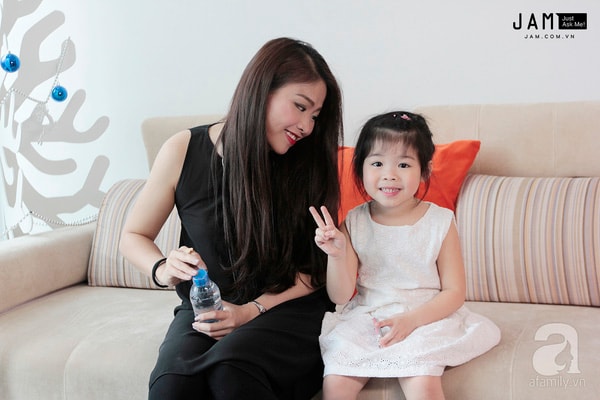 |
| Five-year-old Miu speaks English fluently and confidently communicates with adults. |
“I don’t follow any specific curriculum. All the inspiration for my child to learn and speak English comes from the games she plays on her iPad, or the cartoons she watches on YouTube. She became familiar with these things from the age of one, and by the age of two, she started talking to me in English. Miu often plays games on her iPad like cooking, doing laundry, taking care of dolls… in English.”
In addition, the children often watch YouTube, on Miu and her younger sister Moon's YouTube channel. Their father usually adds age-appropriate channels like Disneychannel, Peppa Pig, Storybots, etc., and they listen to songs in English. Each day, the two girls usually watch for about an hour before bedtime, and on weekends, their parents don't restrict them."
Ms. Tien believes that a common mistake parents make when teaching their children English is placing too much emphasis on perfect pronunciation and grammar, constantly correcting and reminding them, which gradually leads to a loss of confidence and reluctance to speak. She, however, prefers to let her children speak freely and confidently in their own way.
"In fact, when speaking, it's often unnecessary to be like that. Just let your child express themselves naturally; they will learn more and correct themselves gradually later. Avoid correcting too many mistakes at that time because it will make the child lack confidence and afraid to speak again," she shared.
Learn from games and cartoons.
Ms. Quynh Phuong (Hanoi), a mother with a 5-year-old daughter, has also found success with her method of teaching English to her child through "learning while playing".
She started teaching her child English when the child was 3 years old. Knowing that her child loved watching cartoons, Ms. Phuong set up several cartoon channels like Disney and Cartoon… so that mother and child could watch and learn together. While watching, the child would often ask, "What is the bear saying, Mom?" or "The princess is crying, what is the princess saying to the prince, Mom?"… Ms. Phuong would explain so that the child understood.
While watching movies, Ms. Phuong also encouraged her child to repeat short words and sentences many times so that she could imitate the intonation and pronunciation of the characters in the film. Having watched many movies and memorized many dialogues, little Na even imitated reporters on the TV 'interviewing' her mother with questions like "What is," "Who is," or "How are you?"... and made her mother answer.
Sometimes, Ms. Phuong intentionally gives incorrect answers so that her child can detect them and correct her, which makes the child enjoy playing this "interview" game with her mother even more. Thanks to this, at only 5 years old, the child already knows how to ask names, ages, occupations, colors, objects, etc., and confidently speaks when meeting foreigners.
"To date, Na has understood many short, simple sentences when the characters in the movie talk to each other and even acts as a 'translator' for her mother," Ms. Phuong said. She can also sing along to the background music in the movies, and although she doesn't understand the meaning or know the lyrics yet, in this way, her parents have inspired her to love English.
 |
| "Learning through play" will make learning more engaging for children (Illustrative image) |
To make learning more engaging for her child, Ms. Phuong also plays a game called "Who's Faster?" with her child to increase her vocabulary. In this game, mother and child compete to see who can "pick up" related words and put them in their basket the fastest.
Ms. Phuong prepared 10-15 small pieces of cardboard with 10-15 vocabulary words written on them, categorized by topics such as family, numbers, animals, etc.
Each day, they choose a few topics and mix them up so that the mother and child can compete to see who can pick up the most correct vocabulary cards the fastest. The winner is the one who picks up the most cards with the required vocabulary. Additionally, the child also loves playing "Treasure Hunt" because after correctly guessing the meaning of the vocabulary words based on the clues, the child quickly finds the treasure and receives a reward from their mother.
To help her child recognize and memorize the letters in simple vocabulary, Ms. Phuong made a set of 24 English letters herself, each letter written on a small piece of cardboard, for her child to play the "Letter Matching with Little One" game.
For example, when the mother asked her child what letter was missing from the word "Ba…y" (Baby), little Na quickly found the missing "b" and added it to complete the word "Baby". Or, when the mother challenged her to combine letters to form words like "dad" or "mum", the child quickly found all the necessary letters to complete the word.
Ms. Phuong said that for children who don't know how to read yet, playing this game will help them learn many vocabulary words and may be useful for their English writing skills later on.
According to VietnamNet
| RELATED NEWS |
|---|


