
What does the Ministry of Transport say about the inspection of imported cars?
Following the implementation of Decree 116 and Circular 03 on the inspection of imported automobiles, many importers have complained that it creates difficulties as the inspection process takes months and costs thousands of USD.
However, the Ministry of Transport has refuted this information. According to Mr. Tran Quang Ha, Deputy Director of the Science and Technology Department (Ministry of Transport), this information is inaccurate.
Specifically, according to Mr. Ha, regarding the testing period, Circular 03 of the Ministry of Transport has guided (regulated) the exemption or reduction of some conditions in the inspection and testing process for imported vehicles compared to domestically produced vehicles (domestically produced vehicles must test all 7 components).
Imported vehicles only require testing of a representative sample vehicle from the import batch and do not need to be tested for accompanying components such as tires, mirrors, glass, lighting, and fire-resistant interior materials (only certificates for these components need to be presented); they also do not need to undergo the evaporative emissions test, thus significantly reducing time and costs compared to testing and type approval of domestically manufactured and assembled vehicles.
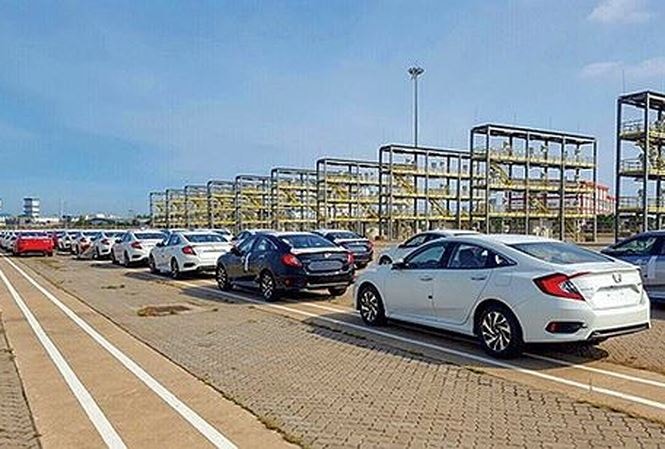 |
| The cost of thousands of dollars per batch of imported cars for emissions testing is unfounded. |
According to the import vehicle inspection procedure: after the inspection agency randomly selects samples from the imported vehicle batch (possibly two samples for simultaneous emissions and safety testing), the business takes the vehicles to a testing facility. The time and cost for testing one vehicle sample are as follows:
For emissions testing, the time from when the testing facility receives the sample vehicle to when the results are returned is no more than 2 days. The testing cost is 27 million VND/sample (for gasoline engines) and 28 million VND for diesel engines.
Regarding safety testing, the testing facility receives the prototype vehicle for testing and returns it on the same day, with the test report issued the following day (if the business provides sufficient technical documentation for the prototype vehicle). The testing cost is 12 million VND per prototype.
"Therefore, the idea that testing a car model can take up to 6-8 weeks (not including the time for submitting documents, vehicle inspection, and certification - which takes another half a month) and costs up to $10,000 for emissions testing is unfounded," Mr. Ha emphasized.
According to Mr. Ha, with a market size of 300,000 vehicles per year, import businesses cannot import small batches; each import shipment must contain at least hundreds of vehicles.
Therefore, taking a sample vehicle from an imported shipment for emissions and safety testing does not incur significant costs for importing businesses. If importers are truly cost-effective during the process, the aforementioned testing cost would be approximately 40 million VND (equivalent to nearly 2,000 USD).
Government Decree 116 was issued to implement the Investment Law, aiming to achieve the goal of implementing the Strategy for the Development of Vietnam's Automobile Industry until 2025, with a vision to 2035, as stipulated in Decision No. 1168/QD-TTg dated July 16, 2014, of the Prime Minister. This includes the requirement to ensure equality in the quality management of imported vehicles with domestically produced vehicles, creating favorable conditions for domestic enterprises to invest, expand production, and ensure vehicle safety and quality.
Currently, the Ministry of Transport confirms that three companies, namely Ford Vietnam, Honda, and Truong Hai, are actively working with partners in exporting countries to complete the procedures related to Type Approval Certificates and import automobiles into Vietnam (from Thailand and the United States) in accordance with the regulations in Decree 116.


