
Minister Mai Tien Dung: A paperless office will help solve petty corruption!
Minister and Head of the Government Office Mai Tien Dung stated: "When an electronic file is created, it will limit contact between citizens and public officials. Documents will be submitted, signed, numbered, and forwarded on time, without a single moment being wasted."
Vietnam has officially launched the National Document Interconnection System, considered a prerequisite for an integrated data platform serving e-government and moving towards a digital government. Minister Mai Tien Dung discussed the idea of paperless state agencies and the future direction of e-government and digitalization.
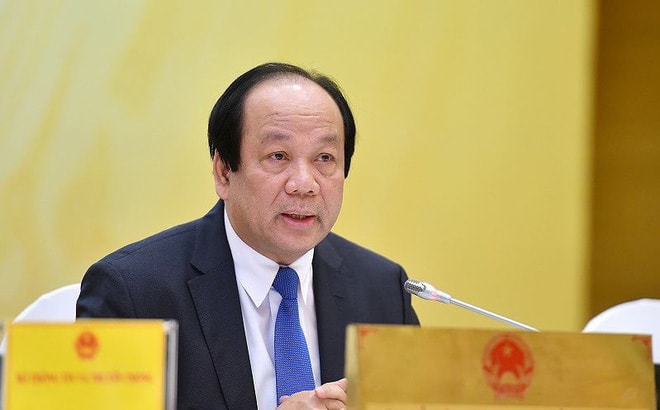 |
| Minister and Head of the Government Office Mai Tien Dung |
- In the Minister's view, what would a paperless government be like?
In fact, a modern, reformed administrative system, oriented towards a proactive, decisive, and effective government, must aim for the digitalization of documents and paperwork. Accordingly, all human resources and work processes will be reorganized, leading to savings and reductions.
In addition, the awareness and responsibility of civil servants will be enhanced. They will remind themselves that whatever they do, someone is watching and supervising them. If they do something wrong or unsatisfactory, they will immediately be criticized and evaluated.
We need to change our mindset regarding work, instead of concealing and hoarding benefits and privileges—which, as General Secretary and President Nguyen Phu Trong often says, is petty corruption that must be completely eradicated. A paperless, digital government will solve this.
 |
- Does that mean that many civil servants and public employees, on the one hand, still have the habit of working with paper documents, and on the other hand, are hesitant to use technology for fear of being controlled or monitored?
That's right. As I said, we need to change our mindset, change our approach. Previously, work could be done secretly, without transparency, with officials and civil servants able to speak and control things as they pleased because only they knew the information. This led to businesses and citizens facing difficulties when needing to complete administrative procedures and paperwork.
Now, with the creation of an electronic document system, it will limit contact between citizens and public officials. Documents are submitted, signed, numbered, and forwarded on time, with not a single moment wasted.
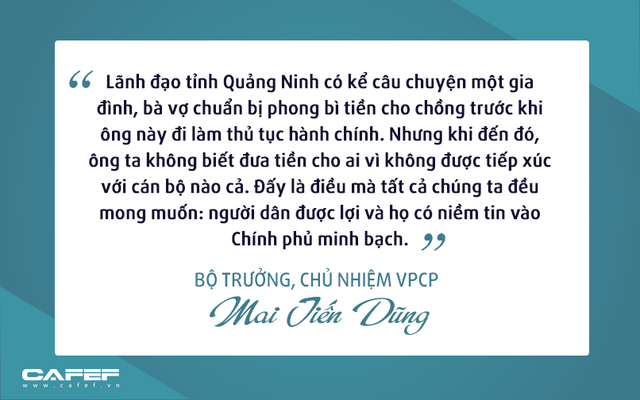
The leader of Quang Ninh province recounted a story about a family where the wife prepared an envelope of money for her husband before he went to complete administrative procedures. However, upon arriving, he didn't know who to give the money to because he wasn't allowed to speak to any officials. This is what we all desire: that the people benefit and have faith in a transparent government.
- The National Document Interconnection System can be understood as just a starting point, with the ultimate goal being e-government and digitalization. However, experts have pointed out a problem: database interconnection. How can ministries, departments, and agencies share data with each other?
This is the bottleneck. We need an e-Government architecture framework, a common design that all software companies can adhere to.
Currently, even within a single province, each department, agency, or unit has its own separate software system that cannot be interconnected. This will be rectified. In the future, based on standardization, software development companies will have to comply with this regulation. Thus, information sharing will be based on a common, comprehensive framework. This also aims to avoid scattered and inefficient investments.
Another issue that needs attention is absolute information security. Products and services are evaluated by foreign organizations and advisory boards, not just the Ministry of Information and Communications.
So how can we build public trust in e-government?
To gain public trust, the Prime Minister has directed that services needed by citizens and businesses must be prioritized. This means they must be convenient in terms of operation, connectivity, ease of use, and low cost... These procedures must meet our expectations: speed, reduced hassle, and elimination of corruption. That is the Prime Minister's wish.
But this cannot be done overnight; it's a long process. Even the infrastructure and databases are either lacking or incomplete, not properly filtered and standardized. We must proceed step by step, boldly, learning from experience and making adjustments along the way. If we strive for perfection, we won't succeed. We are a latecomer; if we don't strive to catch up, we will fall behind.
I am very pleased to see that our businesses and human resources are excellent and highly valued. However, they need to come together; if they are separate and talented, then three people sitting together will just end up arguing. The Prime Minister has also said that he wants to connect domestic and foreign businesses, large and small, to contribute to building an e-government.
Thank you, Minister!


