
The Ministry of Health recommends maintaining a 24/7 MERS prevention and control team.
On June 17th, the Ministry of Health announced that the MERS-CoV outbreak is currently developing in a highly complex manner. As of June 17th, the number of MERS-CoV cases worldwide had reached 1,329, with 466 deaths reported in 26 countries.
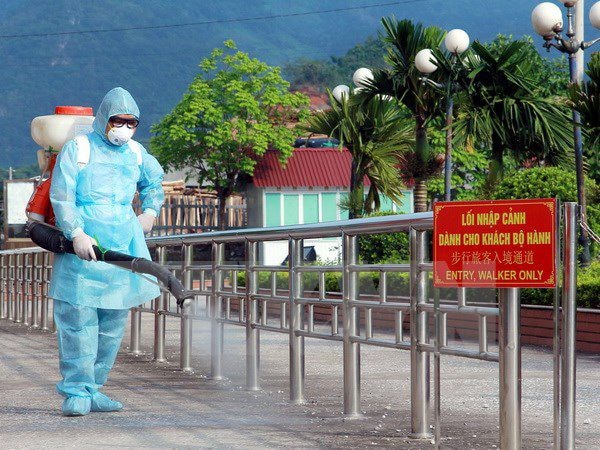 |
| Disinfectant spraying at Thanh Thuy International Border Gate. (Photo: Do Binh/VNA) |
To date, South Korea has reported 8 new cases and 1 death. Thus, from May 20th to the present, the country has recorded 162 cases and 19 deaths. Therefore, the risk of the disease entering Vietnam is entirely possible, and the risk of an outbreak is very high.
In light of this situation, to proactively prevent and control the epidemic, prevent its spread, and minimize the number of cases and deaths, the Ministry of Health requests that the Directors of the Departments of Health in provinces and centrally-administered cities direct the organization of 24/7 MERS-CoV epidemic control teams. The list of medical facilities participating in the epidemic control team will be decided by the Director of the Department of Health.
At the same time, the Ministry of Health requested the People's Committees of provinces and centrally-administered cities to direct the Departments of Labor, War Invalids and Social Affairs and other relevant departments and agencies to coordinate with the Management Boards of export processing zones, industrial parks, and construction sites to strengthen propaganda on MERS-CoV prevention measures for Korean and Middle Eastern citizens working in the country through activities of grassroots trade unions, thematic meetings, radio programs, leaflets, posters, etc.
Provinces and cities require people returning from epidemic areas to proactively declare their health status at border gates and self-monitor their health for 14 days. If they experience symptoms such as cough, fever, or respiratory infection, they must immediately notify a medical facility or the hotline number.
Provinces and cities are directing local authorities, especially communes, wards, and towns, to compile lists of households with relatives living, studying, or working in South Korea, as well as South Korean citizens who come to work and live in the area, in order to plan for contacting, advising, and disseminating information on disease prevention measures.
According toVIETNAM+


