
Training and utilizing female cadres in Tuong Duong
(Baonghean) - Implementing the "Training, fostering, assigning, and utilizing cadres at the commune, town, and village levels for the period 2011-2015 and subsequent years" project, the Tuong Duong District Party Committee has implemented many solutions to foster and utilize female cadres. This has created positive changes in gender equality in grassroots cadre work. However, reality shows that there are still limitations and shortcomings that need attention…
To date, the Tuong Duong District Party Committee has completed the review and supplementation of the leadership and management personnel plan for the 2010-2015 term and has finalized the personnel plan for the 2015-2020 term from the commune to the district level, in accordance with requirements, regulations, and on schedule. During this process, the planning process, linked to the utilization of female cadres, has been given attention, creating a competitive movement of "learning, working creatively, and building happy families" among women at all levels.
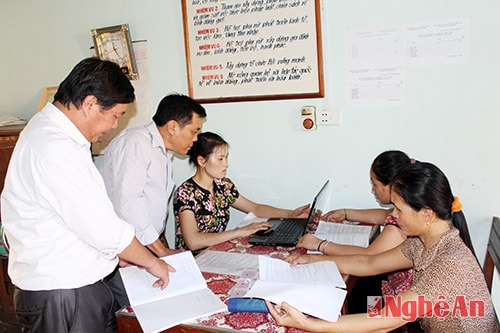 |
| Female officials in Tam Dinh commune participate in the commune's work programs. |
Tam Dinh commune has 52 officials, civil servants, and officials of various organizations and associations, of which 23 are women. This is one of the communes with the highest percentage of female officials in the district. During the 2010-2015 term, the Commune Party Committee had 8 out of 16 members who were women, accounting for 50%. According to the assessment of the Commune Party Committee Standing Committee, most female officials in the commune, especially those in the Executive Committee, have demonstrated a high sense of responsibility. In particular, the female officials in the Women's Union, Youth Union, and the Commune Fatherland Front Committee have excellently fulfilled their duties, making a positive contribution to socio-economic development and poverty reduction in the villages.
In preparation for the 2015-2020 Party Congress term, Tam Dinh commune has completed its personnel planning early, maintaining the proportion of female cadres in the Commune Party Committee and structuring 4 out of 7 female members in the Commune Party Committee Standing Committee. Comrade Ngan Van Bang, Secretary of the Commune Party Committee, stated: “In recent years, female cadres in the commune have actively studied, improved their skills, and always strived to fulfill all assigned tasks well. The Commune Party Committee has created all conditions for female cadres to access and participate in professional training courses, supplement their expertise, and contribute to Party work. In the structure for the next term, the female cadres are all between 29 and 33 years old. This age group reflects the maturity of women, allowing them to effectively undertake tasks after a period of dedication to the locality…”
Ms. Vi Thi Van, born in 1982, currently the Secretary of the Youth Union of Tam Quang commune, is one of the individuals nominated by the Tam Quang Commune Party Committee to the Standing Committee of the Commune Party Committee for the 2015-2020 term. If she receives enough votes, she will be assigned to the position of Deputy Secretary of the Commune Party Committee according to the plan. Ms. Van shared: “I always strive my best to fulfill the assigned tasks. In my current position as Secretary of the Youth Union of the commune, I, along with my colleagues in the Executive Committee, closely coordinate with other organizations to mobilize young people to develop effective production and livestock farming models, contributing to sustainable poverty reduction throughout the commune. In recent years, with the contributions of the youth, the poverty rate in the commune has decreased from over 65% to 52%. We are always aware that we must strive even harder to develop the socio-economic conditions in the area. Being included in the Party Committee's plan for the Standing Committee in the next term is an honor for me. It represents recognition from the Party Committee and the government, but it also represents a great responsibility that I, as well as my colleagues, must clearly understand in order to perform better…”
A review by the Tuong Duong District Party Committee's Organization Department shows that the average percentage of female cadres in the 18 communes and towns in the district currently stands at over 30% (twice the required rate), with some communes reaching nearly 50%. The percentage of female cadres planned for the Executive Committee and Standing Committee of communes and towns for the new term has increased compared to the previous term. For example, in Hoa Binh Town, 11 female cadres are planned for the Executive Committee for the next term, including 4 for the Standing Committee; in Tam Hop Commune, 8 female cadres (out of a total of 30 cadres) are planned for the Executive Committee, including 3 for the Standing Committee… Regarding professional qualifications, over 65% of female cadres have graduated from university; their theoretical training is mainly at the elementary and intermediate levels of political science. However, the reality is that the majority of female officials are constrained by their roles as wives and mothers, so they haven't given enough attention to investing in education and professional development. Furthermore, when handling certain "sensitive" issues, women haven't been able to fully cope with the pressure of work and public opinion.
In terms of the proportion of female cadres at all levels, Tuong Duong district has consistently exceeded the requirements over the years. However, like many other localities, there are still significant disparities in the proportion of female cadres from different ethnic groups in the district. Analysis of data from the cadre planning document for communes and towns for the 2015-2020 term in the district shows that: Of the 69 female cadres included in the plan, 55 are of Thai ethnicity, 9 are of Kinh ethnicity, 3 are of Khmu ethnicity, 1 is of Mong ethnicity, and 1 is of Tay Poong ethnicity. This stems from the actual ethnic structure in the area. In terms of population structure, the Thai ethnic group in Tuong Duong accounts for the largest proportion. This demonstrates the strong rise of Thai women in the community; they have integrated better into society and dedicate more time to learning and work. As for the women of the Mong, Khmu, Tay Poong, and O Du ethnic groups in the area, there hasn't been a significant shift in their mindset; for them, life still revolves around farming, raising children, and so on.
When discussing the disparity in the proportion of female cadres from ethnic minority groups in the district, Comrade Luong Thanh Hai, Secretary of the Tuong Duong District Party Committee, expressed his concern: “Although there are no specific regulations on the proportion of female cadres from ethnic minority groups in a district, in reality, this raises issues that the district needs to address. These include strengthening the identification and training of cadres (both male and female) from ethnic minority groups such as the Mong, Kho Mu, Tay Poong, and O Du. Along with that, there needs to be mechanisms and policies to support them so they are dedicated to social work. First and foremost, we must strengthen mass mobilization work in all fields for these ethnic minority groups…”
In recent times, to improve the qualifications of cadres at all levels in general and female cadres in particular, the District Party Committee has actively implemented Project No. 01-DA/HU (dated January 12, 2011) on "Training, fostering, assigning, and utilizing cadres in communes, towns, and villages in the period 2011-2015 and subsequent years"; in which, the District Party Committee, in coordination with the Provincial Political School, opened one part-time Intermediate Political and Administrative training course in the district, with 79 students; and sent 20 cadres to study Intermediate Political training in full-time at the Provincial Political School. However, in these activities, the proportion of female cadres from ethnic minority groups remains very low…”.
The disparity in the proportion of female cadres from ethnic minority groups in Tuong Duong reflects the reality in many mountainous and highland districts. In the long term, increasing the proportion of cadres, especially female cadres from some ethnic minority groups, will greatly contribute to solving the problems at the grassroots level.
Nguyen Son


