
A comprehensive solution is needed.
The number and quality of Party members are crucial to the development, enhancement of leadership capacity, and fighting strength of grassroots Party organizations. However, currently, Party development work in rural, mountainous, and ethnic minority areas is facing many difficulties.
(Baonghean)The number and quality of Party members are crucial to the development, enhancement of leadership capacity, and fighting strength of grassroots Party organizations. However, currently, Party development work in rural, mountainous, and ethnic minority areas is facing many difficulties.
Besides the efforts of each Party committee in developing Party members, during two consecutive terms of the Provincial Party Congresses, the 16th (2005-2010) and the 17th (2010-2015) terms, the Provincial Party Committee paid close attention to and decisively led and directed Party development work with a series of resolutions, projects, and conclusions issued, such as: Resolution 17 on "Improving the leadership capacity and fighting strength of grassroots Party organizations, and the quality of cadres and Party members"; the project to establish Party branches in hamlets, villages, and neighborhoods without Party organizations or members; the project to improve the quality of Party members; the issuance of Regulation 767 on the conditions and standards for admitting people into the Party; Resolution No. 18 on consolidating the political system in religious and ethnic minority areas; and periodic reviews, summaries, and conclusions to continue directing the work, such as Conclusion No. 09 and Conclusion No. 10...
Furthermore, the Provincial Party Committee has also issued several specific policies such as strengthening the deployment of border guard officers to work in border and coastal communes; sending cadres and Party members to live in villages, mobilizing the masses to create a pool of potential Party members, and establishing Party organizations when conditions permit. As a result, in mountainous and ethnic minority areas, where dozens of hamlets and villages lacked the conditions to establish Party branches at the beginning of the previous term (2005-2010), most have now been eliminated from areas without Party branches and members.
Thanh Phong commune (Thanh Chuong district) shares the general trend of a declining number of young people remaining in the locality after graduating from high school. However, the Thanh Phong commune Party Committee has been concerned about this and, leveraging the strengths of a strong Party organization with a large number of members, has assigned responsibility to various organizations to create a pool of potential Party members within their respective groups. Through this approach, in 2012, Thanh Phong had 20 people sent to attend the course, plus some from the previous year, resulting in the admission of 17 new Party members (the district's target was 10 new Party members). “In the coming period, the work of developing Party members in Thanh Phong commune will not be too difficult. This year, 2013, we have a pool of 17 people attending training courses, plus 3 people who attended in 2012, to be admitted. Currently, in Thanh Phong, the aspirations of young people and members of mass organizations are very good, and they are very ambitious to join the Party. The issue is that we need to create an environment for these people to strive even better to join the Party,” – Comrade Tran Ngoc Son – Standing Deputy Secretary of the Thanh Phong Commune Party Committee, expressed his optimism.
In Tan Ky, the District Party Committee and each grassroots Party committee have paid attention to identifying the root causes, determining specific responsibilities, and finding solutions to overcome the problems. The Tan Ky District Party Committee has also issued a Resolution to strengthen mass organizations within the political system. Party committees at all levels have focused on assigning tasks to Party members in charge of specific areas so that Party members can deeply understand the masses, thereby identifying positive individuals to cultivate and train, and include them in the pool of potential Party members; this is linked to the planning, training, placement, and utilization of grassroots cadres. At the same time, attention has been paid to creating a pool of potential Party members in ethnic minority areas. With this approach, Tan Ky has gradually overcome difficulties and shortcomings in Party development work, exceeding the set targets. The total number of Party members admitted in 2011 was 174/164, achieving 110% of the plan; in 2012, the number admitted was 160/144, exceeding the plan. Sharing his experience, Comrade Bui Thanh Bao, Deputy Secretary of the Tan Ky District Party Committee, said: "During the leadership and guidance process, the district has always paid attention to inspecting and urging grassroots units on the work of admitting new party members."
Difficult, due to lack of resources.
Located 15km from the center of Nga My commune (Tuong Duong district), Na Kho village is home to 100% Thai ethnic minority people. Transportation is difficult, access to information and communication is limited, and the people are almost completely isolated from the outside world. The general level of education and awareness of the people, especially political awareness and understanding of Party goals and ideals, is very limited. A portion of the young people who meet the criteria for Party membership have gone to work far away, while many who remain at home have fallen into addiction and social vices. This is the fundamental reason hindering the recruitment of Party members in this remote border village. "We are looking for an outstanding individual to recruit as a successor, but we haven't found one yet," said Comrade Le Van Toan, Secretary of the Na Kho Village Party Branch.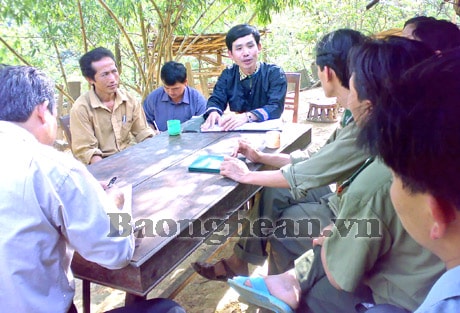
Leaders of Tuong Duong district worked with Pha Khao village - Mai Son commune on measures to combat illegal migration. Photo: VH
Similarly to Na Kho, the Xop Kho Party Branch has not admitted any new party members for many years. “Although the commune Party Committee has continuously urged and reminded rural party branches to pay attention to and develop plans to create sources for party development, the general situation is that party branches cannot find suitable candidates to train and recruit, leading to an increasing ‘aging’ of party members,” shared Comrade Luong Hong Son, Secretary of the Nga My Commune Party Committee. Slightly better, the Tung Huong Party Branch in Tam Quang commune, after 7 years of persistent effort, has finally admitted one new party member, Comrade Lo Van Tham, currently the village head.
The admission of Lo Van Tham as a Party member is considered a major "achievement" for the Tung Huong Party branch, eliminating the "blank" status of Party members among the core cadres of the village and creating more favorable conditions for implementing the resolutions of the Party branch and Party committee in the village. Not only in Nga My and Tam Quang, but also across Tuong Duong district, the work of developing Party members has been declining in recent years; some Party branches have not admitted any members for many years. In 2011, more than 200 rural Party branches in the entire district only admitted 96 members, and 79 members in 2012. This situation inevitably affects the leadership capacity and fighting strength of the Party organization.
In the low-lying mountainous district of Thanh Chuong, the work of developing Party members is also facing many difficulties. In Thanh Lien commune, the number of Party members admitted annually only reaches about 80% of the planned target. Of those admitted, the majority are teachers from schools and staff at the commune's health station. Specifically, in 2012, out of 10 Party members admitted, 6 were teachers. "Even though we're not overly demanding or have high expectations, we still haven't been able to recruit any new Party members," shared Comrade Nguyen Xuan Vy, Secretary of the Thanh Lien Commune Party Committee.
Even more challenging are the communes of Thanh Thuy, Cat Van, and Thanh Tien, which only admitted 2 new party members in 2012; while the communes of Thanh Mai, Thanh Hoa, and Thanh Duc admitted only 1 new party member. “Although the Party Committee has paid attention to the work of developing party members, including it in the emulation criteria; and has improved the quality of branch meetings to build prestige and attractiveness for the Party, the work of developing party members in rural, mountainous, and ethnic minority Party organizations remains stagnant. This led to many Party organizations failing to meet the party member development targets set by the Party Committee in 2012,” said Comrade Tran Dinh Loan, Head of the Organization Department of the Thanh Chuong District Party Committee.
Effective measures are needed.
Training and recruiting new Party members is a regular and important task in Party building. However, the current difficulty in rural, mountainous, and ethnic minority areas is that the youth, considered the "backbone" force for developing new Party members, have significantly decreased. For example, in Thanh Lien commune (Thanh Chuong district), in 2011, out of 294 high school graduates, 107 went on to university or college; 35 went abroad for work; and more than half of the remaining 150 went to work in the South. In 2012, the commune had 191 high school graduates, of which 97 went on to university or college; 40 went abroad for work; only 54 remained, mainly working in Laos and the southern provinces, with very few staying in the locality. Due to the lack of local youth forces, some youth branches, such as the Lien Yen branch, have no one to replace their secretary, even though the branch secretary is over 30 years old; or some branches have to recruit high school students to participate in activities to "nurture" the local movement. Consequently, the number of young party members in these branches is gradually decreasing, and the phenomenon of "aging" party members is increasing.
That's the reality! The issue is that we need fundamental, strategic solutions to create a solid foundation for Party member development in general and in specific areas in particular. Specifically for rural, mountainous, and ethnic minority areas, this means focusing on socio-economic development, bringing large-scale factories to the area, creating jobs, and making rural labor the main workforce, "leaving agriculture but not leaving the homeland," limiting the dispersion of the rural workforce. For remote and ethnic minority areas, due to significant inertia and low levels of education, a strong shift in mindset is needed to help them improve themselves, thereby creating active and capable individuals to fulfill assigned tasks and provide a source for the Party. Emphasis should be placed on training and developing Party members among members of mass organizations within the Front system, such as women's, farmers', and veterans' associations.
Clearly, Party development work in rural, mountainous, and ethnic minority areas is facing difficulties. Besides the main reason of a lack of resources, it must be frankly acknowledged that some Party committees have not shown sufficient decisiveness and diligence in directing, inspecting, and supervising; nor have they actively engaged in propaganda and raising awareness about the Party among union members and association members. Party grassroots organizations need to truly care for and consider the training and recruitment of Party members as a regular and important task in Party building, contributing to the development and improvement of the quality and fighting capacity of grassroots Party organizations and the contingent of cadres and Party members, ensuring the continuity and development of the Party.
Mai Hoa, Thanh Le


