
Businesses that violate occupational safety and health and fire prevention regulations need to be dealt with decisively.
(Baonghean) - The situation regarding businesses violating laws on occupational safety and health (OSH) and fire prevention and control (FPC) is becoming increasingly complex. Workers also lack awareness of protecting their own health and lives, as well as their right to demand that businesses comply. Besides raising awareness among employers and workers through propaganda, authorities need stronger measures to deal with violating businesses…
According to a summary by the Department of Labor, War Invalids and Social Affairs in 2014, the province experienced 26 labor accidents, resulting in 9 deaths and 14 injuries. However, the actual number may be higher because many businesses allowed labor accidents to occur but did not report them to the authorities for investigation and handling as required by law, instead resolving the issues silently on their own.
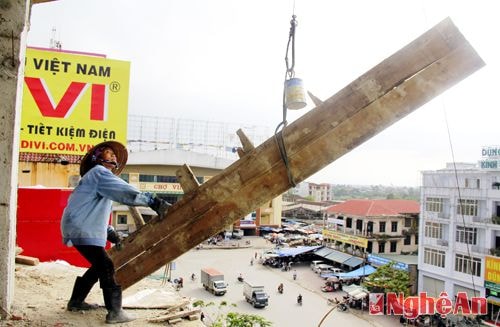 |
| Workers are not provided with personal protective equipment when working on high-rise buildings. |
In Quy Hop district, one of the localities with many mining, mineral, and construction material businesses, most have not paid attention to occupational safety and health. Ms. Nguyen Thi Thanh Nhan, Head of the Labor, War Invalids and Social Affairs Department of Quy Hop district, said: Every year, the district establishes inspection teams to check the compliance with labor laws by businesses. The teams have discovered many businesses that do not participate in social insurance and health insurance for their employees, have not established labor regulations or safety regulations, and do not provide adequate personal protective equipment for their workers.
Furthermore, the implementation of occupational hygiene has not been given sufficient attention by businesses. In 2014, the Health sector only organized health check-ups for 50 units with a total of 18,961 workers. These check-ups detected chronic bronchitis, occupational skin discoloration, silicosis, and occupational hearing loss in 6 units, with 97 people suspected of having these conditions. Environmental monitoring at 18 units revealed that 177 out of 3,052 samples did not meet the permissible standards, representing 5.05% of the samples measured.
As a province with a large number of businesses, over 7,000 in operation, more than 95% of which are small and medium-sized enterprises (SMEs) that have only invested in profit-making and have not yet paid attention to labor laws, occupational safety and health, Ms. Hoang Thi Huong, Chief Inspector of the Department of Labor, Invalids and Social Affairs of the province, said: Inspections have revealed that working conditions in most businesses are not up to standard, such as: lack of lighting, ventilation, and cramped spaces. Equipment and machinery used for production are poor and outdated, and the use of equipment and materials with strict safety requirements is not inspected or declared. Many businesses do not provide personal protective equipment, do not train workers on occupational safety and health, do not organize periodic health check-ups, and do not provide in-kind compensation for workers in strenuous occupations. Some businesses provide adequate personal protective equipment, but employees either do not use it or use it incorrectly, failing to strictly adhere to procedures, regulations, and internal rules, and implementing safe working practices in the workplace.
The reasons for this situation are that businesses have not paid sufficient attention to and invested adequately in occupational safety and health; they have not participated in occupational safety and health training courses. Meanwhile, the majority of workers in these businesses are unskilled laborers who lack basic knowledge of occupational safety and health. Therefore, many workplace accidents have occurred in the past, but businesses have not reported, investigated, or implemented the required policies and regulations for their employees. Self-inspection at businesses and production facilities is not conducted regularly.
It's clear that businesses and workers haven't paid much attention to the issue, but the relevant authorities haven't done their job well either. While the dissemination of policies and laws has been implemented, it hasn't been widespread. Inspections and audits haven't been frequent enough and haven't focused on sectors and industries with high risks of workplace accidents. According to the Provincial Labor Federation's assessment, coordination in inspection, supervision, and self-inspection of occupational safety and health at the district and grassroots levels has been neglected, remaining largely superficial, lacking proactiveness, and in some places, no inspections have been conducted for many years.
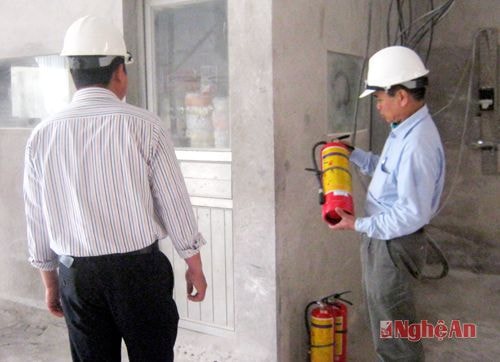 |
| Inspect the fire protection system. |
The failure of businesses to report or conduct self-inspections regarding occupational safety and hygiene, coupled with the lack of corrective measures, is hindering the compilation and assessment of occupational accident statistics across the province. This creates opportunities for businesses to "forget" their responsibilities. It is time for relevant authorities to take decisive action and implement strong sanctions to deter and address violations of occupational safety and health laws, especially those leading to accidents by businesses and employers; and violations of reporting and statistical regulations regarding occupational accidents. Simultaneously, relevant agencies need to strengthen coordination in investigating and resolving occupational accidents quickly and decisively to ensure timely compensation for injured workers and to rectify violations.
The targets set for 2015 are to reduce the frequency of fatal workplace accidents by 5%; increase the number of establishments organizing periodic health check-ups by 5%; ensure that 100% of workers in occupations and jobs with strict occupational safety and health requirements receive training and are issued occupational safety cards; and ensure that 100% of workers receive training in occupational safety and health... To achieve these targets, the People's Committees at all levels must direct businesses and production facilities in their areas to strengthen self-inspections of occupational safety and health. The Departments of Labor, War Invalids and Social Affairs in localities must strengthen information and propaganda work on occupational safety and health; organize inspections, checks, and strict supervision of businesses and production and trading establishments with occupational safety risks in their areas; and seriously implement the investigation and reporting of occupational accidents and serious incidents according to regulations. Businesses and production and trading establishments must strengthen self-inspections of occupational safety and health. Improving working conditions aims to ensure the safety of workers and create a safe working environment.
Nguyen Hung
| In 2014, the Department of Labor, Invalids and Social Affairs, in coordination with the Provincial Labor Federation, conducted inspections on the implementation of occupational safety and health regulations at 31 enterprises. As a result, 21 units were found to have violations, and administrative fines totaling 113 million VND were imposed. Also in 2014, the Provincial Fire Prevention and Control Police, in coordination with other functional agencies, conducted 6,686 inspections and follow-up checks of establishments, detecting and handling 214 cases of violations of fire prevention and control regulations and explosives management, recovering 651 million VND. |


