
We need to pay adequate attention to the scientific and technological intellectual workforce.
(Baonghean) - Nghe An is considered a "land of learning," producing many generations of talented individuals and renowned scientists in all fields for the country, such as Ta Quang Buu, Dang Thai Mai, Cao Xuan Huy, Hoang Dinh Cau, Nguyen Tai Can... and the younger generation pursuing scientific careers also accounts for a significant proportion compared to the whole country. However, to this day, the province remains among the poorest provinces. Furthermore, science and technology, considered the key to development, have not developed in proportion to the province's potential.
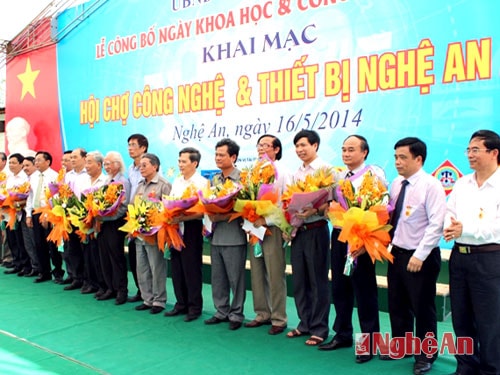 |
| Outstanding scientists and science managers were honored by the Provincial People's Committee on Vietnam Science and Technology Day (May 18). |
Developing a team of scientistslinked to the practical realities of socio-economic development.
Nghe An province possesses significant advantages in terms of human resources in science and technology, as well as infrastructure for scientific and technological development. According to survey results and data from the Nghe An Provincial Human Resource Development Plan up to 2020, the province currently has 5,571 people with college degrees or higher in the science and technology sector (out of a total workforce of 13,840 people), accounting for 40.14%. Of these, the number of highly qualified individuals includes: 97 professors and associate professors (1.74%); 258 doctors and specialists (level 2) (4.6%); 1,404 masters, doctors, and specialists (level I) (25.2%); and 3,829 university and college graduates (68.7%).
Highly qualified science and technology personnel are concentrated in two fields: social sciences and humanities, economics (accounting for nearly 50%) and engineering (accounting for about 24%), with the remainder distributed across three fields: medicine, agriculture, forestry and fisheries, and natural sciences. In terms of structure: the education sector has the largest number of personnel, followed by agriculture and forestry. Although the intellectual workforce is large in number, it has not yet met the socio-economic development requirements of the province. The production sector is severely lacking in leading personnel. In particular, Nghe An lacks skilled economic management personnel, those with in-depth expertise, and those knowledgeable in high technology; it also lacks skilled technicians and technical workers.
Discussing this issue, Dr. Nguyen Thai Tu, recipient of the Ho Chi Minh Prize and the State Prize for Science and Technology, stated: "Our province currently does not lack scientific human resources; however, the problem lies in the failure to gather and attract this workforce. We haven't yet combined basic research, high-quality human resource training, and the application of research results to production. In reality, both nationwide and in our province specifically, the field of basic science is severely lacking and weak. This is considered a core scientific area for solving future scientific problems, but we currently lack attention to this issue: even the training policies in schools show that they are not appropriate or given adequate attention."
Nghe An is a province with a tradition of academic excellence and high achievement. Every year, the percentage of students admitted to universities is quite high, ranking among the top provinces nationwide, with many students achieving top scores. However, upon graduation, very few return to work and contribute to the province. In recent years, provincial leaders have focused on policies to attract, build, and develop a workforce of scientific and technological intellectuals. However, in reality, the implementation of these policies and mechanisms still faces many limitations and has not yet been able to "roll out the red carpet" to attract truly dedicated scientific and technological intellectuals to work and contribute to their homeland.
There needs to be an incentive mechanism.timely rewards
Recognizing the importance of human resources in science and technology and stemming from the current situation, the Central Committee of the Communist Party of Vietnam recently issued Resolution No. 20, affirming that "Investing in human resources in science and technology is an investment in sustainable development, directly enhancing the intellectual capacity and strength of the nation." This resolution includes important points such as: building and implementing policies for training, nurturing, valuing, rewarding, and honoring the team of science and technology personnel; creating a favorable environment and material conditions for science and technology personnel to develop their talents and enjoy benefits commensurate with the value of their creative work; reforming the recruitment, placement, evaluation, and appointment of science and technology personnel; and having policies to continue employing highly qualified science and technology personnel who have reached retirement age.
According to Dr. Nguyen Thai Tu, science should not only focus on the current workforce but also on the next generation of scientists. Our province has Vinh University – one of the key national universities. To solve socio-economic problems, a multidisciplinary scientific workforce is absolutely necessary. Investment is needed to train scientific staff and provide funding for the university's research projects. Creating conditions for faculty and students to focus on solving practical problems facing the province is also creating conditions for the university to improve the quality of its education. This is a mutually beneficial collaboration. The cooperation model between the Mekong Delta provinces and Can Tho University is a lesson for the whole country. Can Tho University is the university of the Mekong Delta. Conversely, the Mekong Delta provinces have nurtured Can Tho University to improve the quality of its education.
For science to truly become a powerful tool and means to serve the socio-economic development of the province, it is necessary to invest in improving the endogenous scientific and technological capacity of existing scientific and technological units and agencies, specifically institutes and universities in the area, to address scientific and technological tasks serving socio-economic development. Research and implement mechanisms to link universities, research institutes, and businesses to collaborate in research and development of new technologies and products.
And there needs to be a mechanism for timely recognition and rewards for the scientific community. Annually, provincial leaders should organize meetings with outstanding scientific and technological intellectuals to share socio-economic information and call upon, mobilize, and gather the intellectual resources of the scientific community to solve tasks related to the province's socio-economic development. This will help understand the aspirations and desires of the scientific community, and effectively utilize the scientific and technological intellectual resources for development. In addition, organizing the annual Science and Technology Innovation Award Ceremony is crucial to honor and encourage organizations and individuals who have made outstanding contributions to scientific research and application. These are very important solutions. However, I believe the most important thing now is for the State and businesses and production organizations to trust and assign more tasks, and present more challenging problems to scientists. Solving challenging problems is the mission of scientists, and through this, they are also adequately compensated, earning a better income and a better life.
Hopefully, with the new guidelines and policies of the Party and the State, most recently Resolution 20 on Science and Technology, and the province's policies, the problem of human resources in science and technology will be solved, creating conditions for the province's intellectuals to uphold their homeland's traditions, contribute more intellect and strength, and help develop Nghe An's socio-economic development in line with the province's science and technology potential.
Thanh Hoa
(Department of Science and Technology)


