
Funding needs to be allocated soon.
(Baonghean)The Cleaner Production Program, implemented by the United Nations Industrial Development Organization (UNIDO) with funding from DANIDA, has been in operation since 1998, focusing on several industries such as paper, textiles and dyeing, food (seafood processing and beer), building materials, and metal processing, involving over 130 enterprises in 28 provinces and cities, including Nghe An.
Initial results have yielded economic and environmental benefits through savings in raw materials, energy, chemicals, and water, and reduced waste in production. From 2007 to 2011, 10 units in our province participated in cleaner production demonstration projects in industry, funded through the CPI program (Denmark). The Department of Industry and Trade, in coordination with the Cleaner Production Center, organized 12 workshops, 3 training courses, and numerous other promotional materials on cleaner production.
In 2008, with financial support from the Cleaner Production in Industry Project and the Nghe An Department of Industry and Trade, Song Con Sugar Company participated in the Cleaner Production project. The company collaborated with the Vietnam Cleaner Production Center to assess and implement cleaner production solutions. Through surveys and assessments by the Vietnam Cleaner Production Center, 30 solutions were proposed, for which the company invested approximately 6.8 billion VND, and 25 solutions have been implemented to date.
Notably, among the 30 proposed solutions, there was one proposed solution: "using sludge to produce bio-fertilizer." The company generates a significant amount of sludge during production, approximately 64 tons per day. Company leaders stated that they have invested in a mechanized bio-fertilizer production plant to implement this solution, with an estimated investment of 2.2 billion VND. The calculated annual benefit is 2.163 billion VND, and the payback period is only 13 months. Thanks to this correct investment strategy, the sludge treatment solution has effectively addressed the long-standing sludge problem within the factory grounds, reducing the strenuous labor required of the workers.
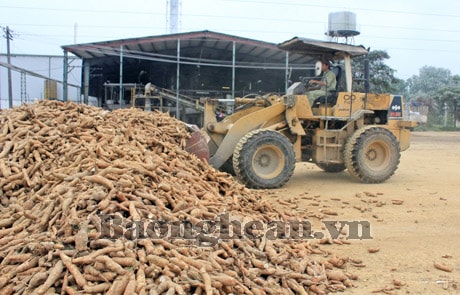
Production at the Yen Thanh cassava processing plant is causing environmental pollution.
For example, at the Trung Do Granite Tile Factory, a subsidiary of Trung Do Construction Company, with a production capacity of 3,500,000 m2 of tiles per year and a raw material consumption of over 505 tons per day, the biggest concern is the enormous electricity consumption and environmental pollution caused by air emissions, dust, wastewater, and solid waste.
Faced with this situation, the company approached the Industrial Cleaner Production Project to implement cleaner production solutions for its business. Through consultation with the Vietnam Cleaner Production Center, 29 solutions were proposed, among which the solution "Investing in the renovation of the equalization pond and the sludge dewatering system to recycle and reuse water and raw materials" received particular attention. The implementation cost for this solution is over 7 billion VND, with an annual benefit of 2,182 million VND and a payback period of 3 years and 3 months.
According to calculations, with this solution, the amount of solid waste recovered and reused is 14.84 tons/day, equivalent to 1,958 million VND/year; the amount of raw materials recovered from dust emissions is 1.458 tons/day, equivalent to 192 million VND/year; and the amount of raw materials recovered from wastewater is 14.93 tons/day, equivalent to 1,971 million VND/year.
The implementation of cleaner production practices in businesses across the province has proven effective. Most businesses that adopted cleaner production methods reduced their waste by 20%-30%. This has positively impacted the economic benefits of businesses, minimized environmental pollution, and enhanced sustainability in production and business operations.
However, at the end of 2011, the Sustainable Production Component in Nghe An was dissolved. According to Mr. Nguyen Hong Phong, Director of the Industrial Promotion Center (Department of Industry and Trade), many businesses in the province are currently eager to access this program but lack the necessary funding.
In the action plan for applying cleaner production in industry in the province from 2009-2013, the Provincial People's Committee considered allocating funds from the environmental and science and technology budgets to support, maintain, and implement cleaner production activities. However, in reality, these funds have not been allocated, making implementation difficult. Therefore, allocating funds to implement cleaner production programs in industry is essential. Businesses and companies need to proactively understand and apply this program, because in addition to environmental benefits, it also brings economic benefits and cost savings.
Pham Bang


